There is something very funny about a movie that spends two hours attacking advertising and then becomes one of the most recognizable aesthetic packages of the late 90s. David Fincher’s Fight Club came out in 1999, adapted from Chuck Palahniuk’s novel, with Edward Norton’s unnamed narrator, Brad Pitt’s swaggering Tyler Durden, and Helena Bonham Carter’s chain smoking Marla Singer.
It was supposed to be a snarling critique of consumerism, of men who bought catalog sofas to feel like real people. It ended up supplying the exact images those men wanted. The film warned that charisma can make almost anything cool. The culture responded by making the warning into a moodboard.
The Problem Was Never Just the Stuff
The narrator’s life at the beginning is bland and over organized. He is a guy who confuses lifestyle for identity. He knows his Scandinavian coffee table’s name but not why he cannot sleep. The film builds this to a simple idea: people have been taught to perform success through purchases.
What the narrator actually wants is friction, consequence, and a sense that he exists even when the catalog is gone. Tyler says advertising made everyone chase cars and clothes and that the result is a generation with no real war and no real purpose. That’s the furnace the story burns in.
This is already a step toward influencer culture. Influence online is rarely about the object itself. It is about selling the feeling that the object will pull you out of anonymity. The movie shows how empty that promise is. Then, in typical 90s irony, it creates a new promise right beside it.
Tyler Durden is an Anti-Brand That Acts Like a Brand
Tyler is introduced as the opposite of the narrator: loose where he is tight, decisive where he is passive, completely uninterested in what other people think. That is already a brand position. He has a uniform (red leather jacket, sunglasses, patterned shirts), a signature product (soap), a manifesto, and memorable copy. “The first rule of Fight Club is you do not talk about Fight Club” works like a tagline. It is short, repeatable, and looks great on a poster. It is scarcity phrased as rebellion.
If you’ve ever watched a content creator “hate” on the algorithm while filming in perfect light, you’ve seen the same move. Make it look anti-system, make it look underground, but use every system trick to make it spread. Tyler says he wants men to be free from brands. Then he becomes the most compelling brand in the room. Influencers do this all the time. “I’m tired of curated feeds” they say, while posting extremely curated photos about being tired of curated feeds.
Project Mayhem is What Happens When the Audience Copies the Packaging

As Fight Club grows into Project Mayhem, the men stop thinking and start repeating. They shave their heads, chant the rules, and follow assignments they barely understand. The film is very clear that this is a failure, not a triumph. Tyler wanted people to wake up to how consumer culture had flattened them. Instead they handed him their flattened selves. Critics have pointed out for years that a lot of viewers admired Tyler more than they recognized the satire. That misreading has become part of the film’s legend.
From Basement Fights to Follower Counts
If you look at Fight Club through a 2025 lens, it reads like an early case study in attraction marketing. You create an inner circle that is hard to get into, you tell people not to spread it, and you build rules that make members feel chosen. Humans cannot resist that. The club inside the bar functions like a private Discord or a close friends story. It promises realness after hours. It promises that unlike the glossy public feed, this is where people tell the truth.
Influencer culture, especially in its “authentic” era, has been trying to sell that same private-room feeling. Paywalled communities, subscriber-only newsletters, secret drops, short-run merch and “you had to be there” livestreams are all polite versions of going down the stairs to punch each other. Everyone is trying to escape mass commodification by creating a smaller, more intense commodity. The movie understood that the search for authenticity often pushes people toward more performance, not less.
Influencer culture keeps relearning this lesson. Followers will watch the stunts, the challenges, the brand beefs. What sticks is relationship. People want to know who you text. They want to know how you sleep. They want to know if your partner actually likes that you vlog breakfast. The narrator finds peace not in another act of sabotage but in a human face.
What the Film Was Warning us About
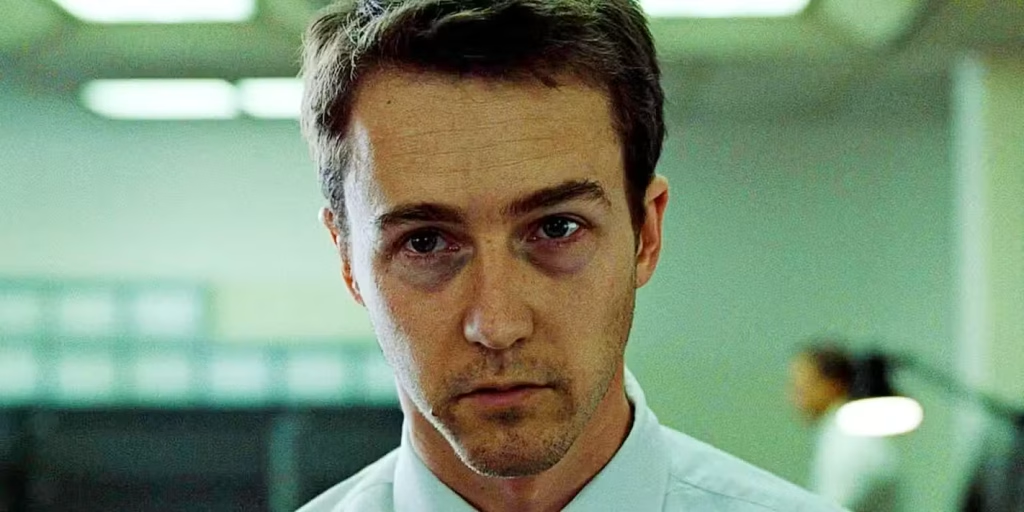
So yes, Fight Club is a movie about a man arguing with his own alter ego. It is also a movie about how quickly anti-consumer rebellion can become a consumer product. The internet just made that process faster. What took Tyler a whole film to build now takes someone a weekend on short video. The film’s prediction was not that men would blow up credit buildings. It was that people would be hungry enough for meaning that they would buy anything that wore the right scars.
In the end the film is pushing us toward an uncomfortable honesty. If we say we want freedom from branding, we have to look closely whenever something branded as freedom starts trending. If we say we want authenticity, we have to notice when authenticity becomes an outfit. Fight Club showed how seductive anarchy looks when it is photographed well. Our feeds have proved it.

Rachel Sikkema is a New Zealand-based writer and creative entrepreneur who explores the intersection of film, culture, and modern relationships. Through her articles, she examines how stories shape the way we connect, love and see ourselves – all for God’s glory. When she’s not writing about film and television, she’s watching Dexter and The White Lotus for the third time.