
There is a reason The White Lotus lingers after the credits. Mike White builds each season like a resort brochure that slowly peels back into a case study, then into a confession booth. He sets the pieces on beautiful boards, invites us to admire the view, then asks a tougher question. What would you do if no one stopped you?
A Creator Who Plays Fair and Plays Mean
White writes and directs with a magician’s timing. He enjoys plant and payoff, but he enjoys cornering his characters even more. Tanya McQuoid, played by Jennifer Coolidge, is the perfect example.
Across two seasons, Tanya floats from spiritual yearning to jittery suspicion to a finale that turns her delusions of grandeur into a fatal pratfall. It is brutal, weirdly funny, and completely in character. White telegraphs the danger and still makes it feel like a surprise.
Marriage as a Vacation Sport
Season 2’s quartet in Sicily is the show at its most playful and pitiless. Harper and Ethan, played by Aubrey Plaza and Will Sharpe, square off with their glossy foils Daphne and Cameron, played by Meghann Fahy and Theo James.
The episode cuts become a rhythm of looks, small lies, and odd alliances, until jealousy turns into motivation. White treats marriage like a game with hidden bylaws. If you want intimacy, the price might be complicity. The story asks a wicked question. Do you want to be right, or do you want to stay together?
Money Changes the Weather

The resorts are microclimates where cash is the barometer. In Hawaii, the mask of service slides off as the staff absorbs one request too many. In Sicily, sex becomes currency, and the hotel manager Valentina, played by Sabrina Impacciatore, discovers her power and loneliness in the same week.
Thailand expands the map. Industry chatter points to a larger canvas and a spiritual undertow, a place where wellness trends rub shoulders with scams, where the search for meaning has a minibar price list. The pattern remains familiar, the moral weather changes by the hour.
The Moral Test Inside the Mystery
The show’s structure is reliable. Someone has died, the week will tell us who and why, and every character is a suspect mostly because every character is flawed. White uses the mystery the way a teacher uses a pop quiz. It makes you pay attention. It also makes you weigh behavior.
The crimes are not limited to the corpse. There are smaller betrayals and sharper bargains. Who tips because it is easy, who steals because they can, who lies because it protects a fantasy. The conversation the show keeps having is about cost, not guilt.
Tanya’s Exit as a Mission Statement
Tanya’s final episode clarifies the ethos. She is neither mastermind nor victim. She refuses to see what is in front of her, then overcorrects with operatic panic. The scene lands as a warning about privilege and self mythologizing.
It also frees the anthology to move on, which is its own ruthless decision. When a character becomes an audience security blanket, the series cuts the thread. That is narrative discipline, and it keeps the moral experiment honest.
A Brand of Paradise you can Measure
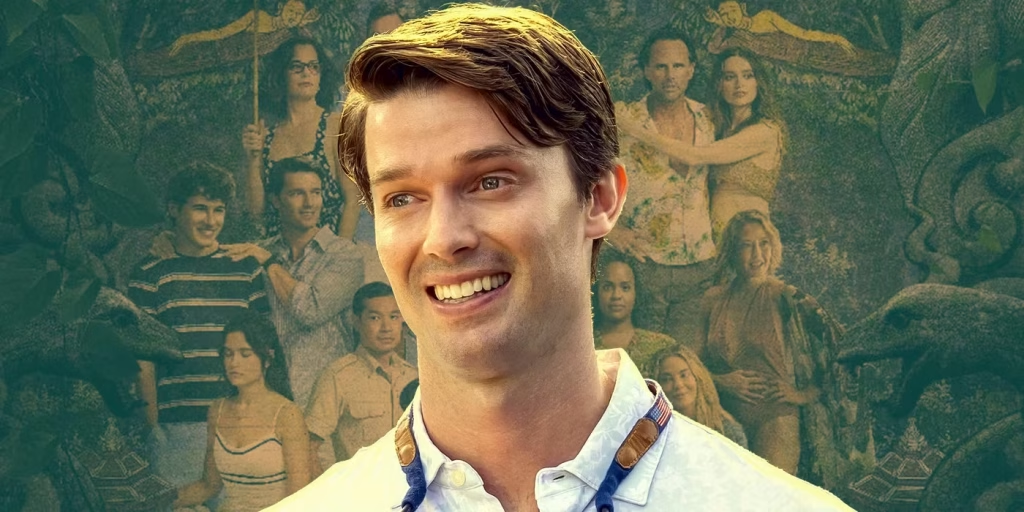
The White Lotus resorts are real-world stand-ins with a consistent sheen. Season 3 filmed at the Four Seasons Resort Koh Samui, with additional work in Phuket and Bangkok. The luxe uniformity is not a backdrop, it is an argument. If luxury promises to solve discomfort, then discomfort becomes the evidence that money cannot buy interior peace. The spa becomes a confessional you can charge to the room.
Small Symbols, Big Pressure
White loves little totems that carry territorial weight. A decorative head in a Sicilian villa, a broken object in a hotel room, a misplaced phone by the pool, they start as props and become scorecards.
Viewers debate what broke and why it mattered because the show trains us to read rooms like detectives. In a story where nobody is entirely innocent, symbols help us track who crossed a line and who pretended not to notice. That habit of decoding is part of the fun, and part of the trap. The audience gets tested too.
The Staff are Mirrors, Not NPCs
The employees are never mere quest givers. Armond’s unraveling in Season 1 maps the toll of constant deference. Valentina’s awkward awakening in Season 2 maps the cost of control. Season 3 folds in Thailand’s tourism economy, where hospitality is commerce and identity can feel like inventory. The locals are not moral tutors for rich outsiders. They have their own compromises and their own survival strategies, and the show’s better moments let those stories breathe.
What the Game Reveals
The longer you watch, the clearer the pattern. White respects free will, then puts a price on it. He wants to see who we become when the check-in cocktail wears off. Do we tell the truth, or do we reach for another drink and a better lie. The White Lotus keeps coming back to the same test and finding new answers because people are endlessly inventive in how they rationalize desire. That is the secret. The resort refreshes, the rules repeat, and human nature supplies the twists.
In the end, the show’s morality is not a hammer. It is a glass set on a slippery railing. One careless elbow, one private decision, and the whole thing goes over. That is why the series stays tense even in full sun. The view is gorgeous. The footing is not.

Rachel Sikkema is a New Zealand-based writer and creative entrepreneur who explores the intersection of film, culture, and modern relationships. Through her articles, she examines how stories shape the way we connect, love and see ourselves – all for God’s glory. When she’s not writing about film and television, she’s watching Dexter and The White Lotus for the third time.