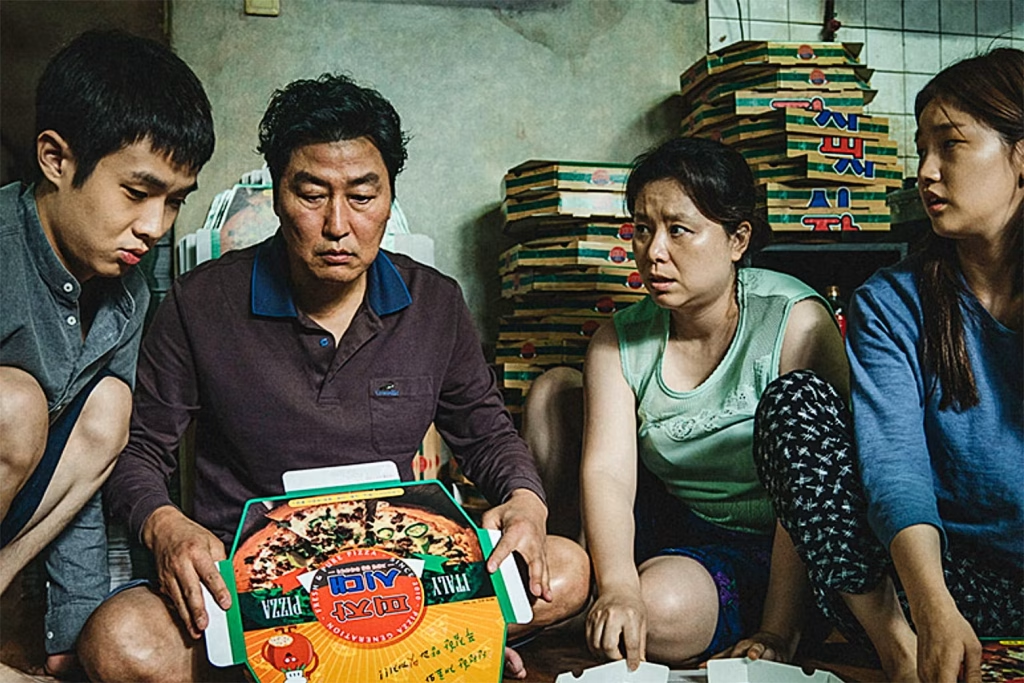
The ending of Parasite is so satisfying and so cruel that it almost feels like two different endings stitched into one final emotional trap. Bong Joon-ho sets up a story that begins like a clever con and ends like a societal eruption. The Kim family’s infiltration of the wealthy Parks is funny, tense, and weirdly aspirational. Then the film pivots into full tragedy, reminding you that class mobility in this world is not a ladder. It’s a cliff with a nice view at the top.
To understand why the last stretch hits so hard, it helps to remember how carefully the story divides space and dignity. The Kims move upward into the Park house with confidence. The moment the hidden basement is revealed, the film forces everyone back into the truth they were trying to outsmart. That truth explodes at the birthday party.
What Actually Happens in the Final Chaos
Carmy-level stress this is not. This is violence born from humiliation and fear. The Parks’ elegant lawn becomes a stage for the reality they never had to see. The Kims, who had been performing competence and charm, suddenly have nowhere to hide.
The most consequential act comes from Kim Ki-taek (Song Kang-ho). He kills Park Dong-ik (Lee Sun-kyun) and then disappears. The film later reveals that he has taken refuge in the secret basement of the Park house, living in the same hidden space that defined Geun-sae’s existence.
Why Ki-Taek Snaps at That Moment
Ki-taek’s violence is not a sudden personality twist. The film has been building toward it in small, humiliating cuts. The smell motif is the most obvious thread. The Parks repeatedly comment on the Kims’ “poor person smell,” which becomes a refined way of saying, “You are not one of us.”
At the party, Mr. Park’s reaction to the smell of Geun-sae is the final trigger. It is not only disgust. It is the casual certainty that certain bodies are repulsive by default. Ki-taek witnesses this aristocratic reflex in the middle of a crisis, while his own daughter is dying nearby.
You can read Ki-taek’s rage as personal. You can also read it as the moment he understands that no amount of service will ever grant him equal humanity in this household. Both readings work, which is why the scene feels so brutally inevitable.
The Basement Becomes the True Ending Location

After the party, Ki-woo (Choi Woo-shik) wakes in the hospital with severe head injuries. He and his mother Chung-sook (Jang Hye-jin) face legal consequences and are placed on probation. Their family is fractured. Ki-jung is gone. Their social climb is over.
This detail matters because it reveals the film’s bleak sense of circularity. Ki-taek has not escaped the system. He has simply been swallowed by it, becoming invisible labor in the most literal way.
The “Plan” That Sounds Hopeful and Isn’t
The most talked-about element of the ending is Ki-woo’s final narration. He makes a plan to work hard, earn money, and eventually buy the house to free his father. The film shows the fantasy of this future as if it might be possible. Ki-woo imagines success, reunion, and a clean, cinematic resolution.
Then Bong pulls the rug out. The film cuts back to reality. Ki-woo is still in the semi-basement. The dream is a coping mechanism, not a roadmap. This is the film’s quiet double-ending, where hope is presented and then immediately exposed as unattainable within the economic logic of the story.
The point is not that hard work is meaningless in abstract. The point is that the scale of wealth required to buy entry into that world is so enormous that the fantasy becomes almost a form of grief management.
What the Ending Says About Class, Not Just Individuals
A lesser film might conclude by assigning simple villains. Parasite refuses that comfort. The Parks are not cartoon monsters. They are polite, even generous in certain moments. But their kindness operates within an architecture of distance. They can be good people and still reinforce a brutal system.
The Kims, meanwhile, are not morally pure victims. They lie, manipulate, and displace another struggling family. The reveal of the basement forces the Kims to confront a painful truth. In a scarcity economy, the poor can be pushed into fighting each other for survival scraps.
This is why the title keeps echoing in your head. The film suggests that parasitism is not a single family trait. It is a social condition. People attach themselves to power because the alternative is invisibility.
Why the Ending Feels Both Shocking and Inevitable

The brilliance of the final act is that it matches the film’s visual argument. The story is structured around vertical movement. The Kims climb into wealth, then descend into disaster. The basement is the most extreme expression of that hierarchy, a literal underworld that the rich forget exists.
So when Ki-taek ends up living below the home’s surface, the film completes its own metaphor. The man who tried to rise through service ends up entombed inside the symbol of the life he wanted. It is a grim punchline to the earlier optimism.
You could even argue that the ending has a dark sense of humor. The Kims infiltrated the house as employees. The father remains as a permanent, unpaid ghost.

Rachel Sikkema is a New Zealand-based writer and creative entrepreneur who explores the intersection of film, culture, and modern relationships. Through her articles, she examines how stories shape the way we connect, love and see ourselves – all for God’s glory. When she’s not writing about film and television, she’s watching Dexter and The White Lotus for the third time.