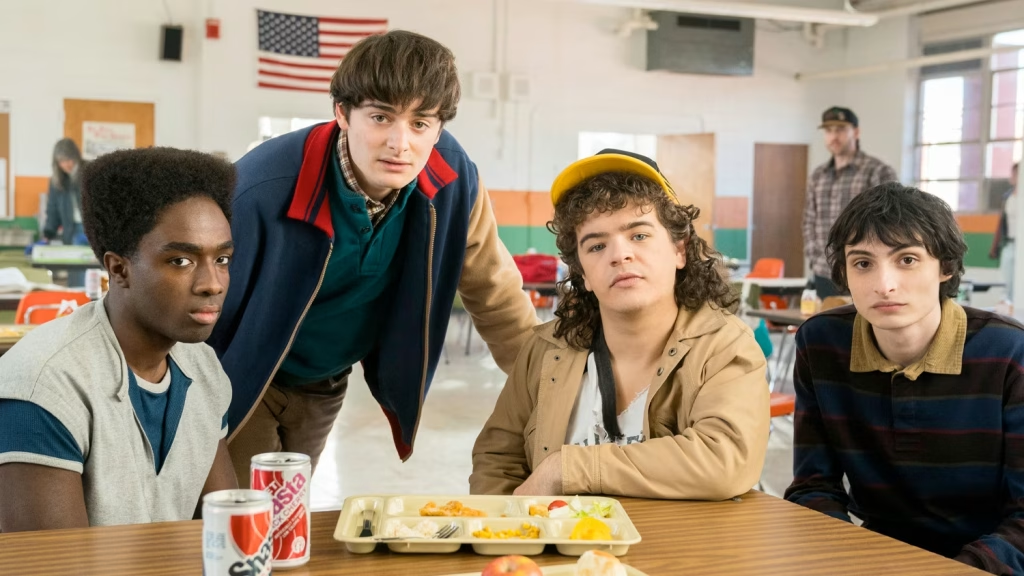
Stranger Things season 5 opens on a Hawkins that already looks halfway claimed by the dark. The rifts from season 4 still carve across town, the ground burns at the edges, and the sky does that unsettling ash snowfall that used to belong only to the Upside Down. The official setup for the final season spells it out clearly: it is the fall of 1987, the town is under military quarantine, and the gang is united around one goal, finding and killing Vecna, who has vanished.
So what happens if that infection does not stay cosmetic? What if Hawkins itself becomes the new Upside Down, not just in visuals, but in rules, power structures, and meaning for these characters we have watched grow up since 2016?
The Worldbuilding Already Leans Toward a Merger
The end of season 4 gave us that eerie wide shot of Hawkins splitting open and the Upside Down bleeding through, with red lightning, dead plants, and drifting ash. Commentators pointed out that this was more than a single gate, it looked like a dimension peeling over the town, as if reality was being unzipped.
Season 5 leans right into that direction. The town is not just recovering from a disaster, it is actively scarred. There are rifts, federal checkpoints, and no illusion that Hawkins is a normal Midwestern suburb ever again. Early tracking and first look pieces talk about imagery where the Upside Down appears to be splitting the town and surrounding landmarks, teasing a larger takeover instead of isolated incursions.
If the Monster Comes to Town, the Horror Changes
For most of the show, horror happens when someone crosses a threshold. Joyce Byers and David Harbour’s Hopper crawl through walls and tree trunks. Steve Harrington and Nancy Wheeler climb through membranes in the school. Eleven, played by Millie Bobby Brown, literally rips open doors in the fabric of reality. The Upside Down is somewhere you travel to, not somewhere you wake up inside.
A full Hawkins conversion would flip that pattern. You would not have to go through a portal to find monsters because the rules of the upside world would start to govern regular spaces. The grocery store lighting could flicker into that sickly blue. The high school gym might grow vines around the bleachers overnight. The Wheelers’ living room could trail particles of ash down from the ceiling even when the TV is on and Karen is trying to pour coffee.
Hawkins as a Living Record of Trauma

There has always been a metaphor humming under the Upside Down mythology. It behaves like a physical version of trauma, grief and guilt. Will Byers, played by Noah Schnapp, spends seasons carrying a piece of that place inside him. Max Mayfield, played by Sadie Sink, literally floats between life and death with Vecna clinging to her worst memories. Eleven keeps revisiting the lab in her mind the way someone circles back to formative harm they cannot quite shake.
If Hawkins becomes the new Upside Down, that metaphor stops being private and becomes communal. The town would embody everything that has happened since Will disappeared in 1983. The rips and scorched fields would act as permanent reminders of what the adults refused to see and what the kids had to shoulder. Even if Vecna loses, Hawkins would wear its history on the surface, not hidden in a parallel copy.
Vecna’s Victory Might Not Look Like a Classic Apocalypse
The current official description for season 5 frames it as a last hunt. Vecna is missing, the Upside Down is invading, and the government’s panic puts even more pressure on Eleven. The marketing line about Hawkins facing its darkest hour suggests the show is willing to let things get very bad on the way to any sort of resolution.
For Vecna, played by Jamie Campbell Bower, the ideal outcome probably is not simply killing everyone. It is turning the town into a stable node of his own design, a place where his psychic architecture rules the physics. The Mind Flayer’s goal has always leaned toward wide scale domination, and imagery of the Upside Down splitting Hawkins implies a takeover that spreads rather than a temporary attack.
Growing up in a Haunted Hometown
There is also a coming of age angle here that fits the show’s DNA. Stranger Things started as kids-in-the-basement genre fun and slowly moved into stories about first love, identity, and the weird grief of outgrowing your hometown. Finn Wolfhard’s Mike, Caleb McLaughlin’s Lucas, Gaten Matarazzo’s Dustin and the rest of the party have already brushed against the “do we leave Hawkins” question.
If Hawkins becomes the new Upside Down, that choice gets sharper. Leaving town would not just mean moving away from childhood memories. It would mean walking away from an active threat that only they truly understand. Staying would mean signing up for a life that looks more like Buffy patrolling the Hellmouth than anonymous adult normalcy.
So, Is Hawkins Already the New Upside Down?

Even if season 5 eventually heals the sky and closes the rifts, it has already reframed Hawkins as more than a backdrop. The town is the main battleground, the emotional archive, and the physical proof that all of this happened. The Upside Down is no longer just “over there.” It is in the soil, in the streets, and in the way these characters look at home.
Whether the finale restores Hawkins into something recognisably ordinary or leaves it as a permanent borderland, the show has already pushed us to see the two worlds as intertwined. In that sense, the question might already be answered. Hawkins has become the new Upside Down, and the real suspense now is whether anyone can grow up and move on while living inside it.

Rachel Sikkema is a New Zealand-based writer and creative entrepreneur who explores the intersection of film, culture, and modern relationships. Through her articles, she examines how stories shape the way we connect, love and see ourselves – all for God’s glory. When she’s not writing about film and television, she’s watching Dexter and The White Lotus for the third time.