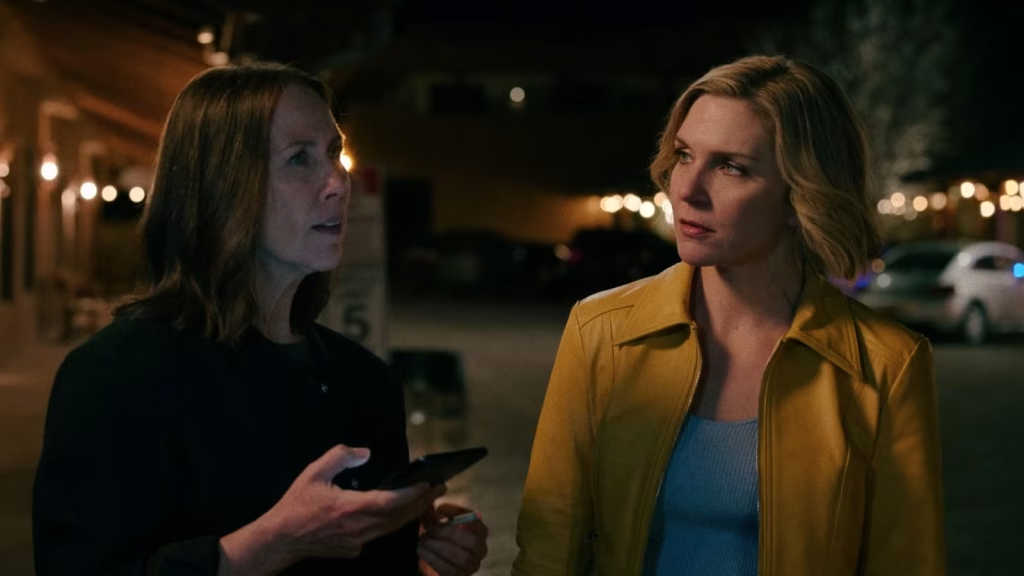
The whole engine of Pluribus is pretty simple on paper: Carol Sturka, played by Rhea Seehorn, is one of a tiny handful of humans who stays herself when an alien virus turns everyone else into a blissed-out hive mind. Humanity “joins” into one consciousness, the Others, while Carol keeps her anger, grief, and sarcasm very much intact. The twist is that her wife and manager, Helen Umstead (Miriam Shor), dies in the chaos of that joining, leaving Carol alone in every way that matters.
So the question is a sharp one: if Helen had survived, and was still present in Carol’s life in some form, would Carol have reacted the way she does? Would she still be the world’s most miserable person trying to save the planet from happiness, or would her choices soften, scatter, or stall?
To answer that, you have to pull apart three things: what Helen represents, what Carol already was before the apocalypse, and how much of Carol’s rage is grief rather than principle.
What Actually Happens to Helen
In the premiere, Carol comes home to Albuquerque after a book tour with Helen by her side. Carol is a successful fantasy romance author who openly trashes her own work; Helen is both her public-facing manager and her private partner, the person who actually believes in her.
When the alien RNA sequence gets loose and people start convulsing, Helen is one of the bodies on the floor. Carol drags her through a collapsing city, into a hospital that’s already flooded with the newly joined, and watches her convulse again as the hive mind takes over. Helen dies in the middle of that transition.
The show keeps worrying that wound. In later episodes, the Others replay Helen’s memories back at Carol, use Helen-specific details to “comfort” her, and treat Helen’s mind as just another data set in the cloud of the collective. When Carol has a breakdown in episode three because Zosia (Karolina Wydra) and the hive won’t stop bringing Helen up, it’s less about the memories themselves and more about the way they’ve been stolen and repackaged.
Carol’s Grief Is Gasoline on an Already Lit Fire

Carol’s personality before the outbreak is not exactly sunshine either. Flashbacks show her on a dream trip with Helen at an ice hotel in Norway, and she spends most of it complaining about the cold and the conditions. Even in their romantic life, she’s prickly, dyspeptic, and more comfortable picking things apart than soaking anything in.
In other words, the virus doesn’t create her misery. It amplifies it.
After Helen’s death, that misery turns radioactive. Carol learns that her negative emotions are literally lethal to the hive mind. When she screams at Zosia, the Others across the planet seize, and millions die; early coverage puts the number the hive quotes at around 11 million deaths from one outburst.
If Helen Lived: Ally, Hostage, or Both?
Let’s imagine a version of Pluribus where Helen survives the joining and continues existing inside the hive mind. Maybe she’s fully submerged like everyone else, maybe she’s a little more individuated, but she’s there. What changes?
The first and most obvious shift is Carol’s willingness to use her emotions as a weapon. It’s one thing to scream at Zosia and accidentally kill strangers. It’s another thing to know that every spike of rage could also hurt the person you love, who’s now wired into that same global nervous system.
Carol already hesitates once she understands the body count attached to her anger. If Helen’s consciousness is inside that network, you can imagine her treating her own emotions like a loaded gun pointed at Helen’s head. She might become more repressed, more careful, maybe even more willing to let the hive shape her environment if that’s what keeps Helen “safe.”
Would Carol Still Become the Hive’s Nuclear Option?

The show hinges on the idea that Carol’s very existence is dangerous to the Others. Her negative emotional spikes send the hive into seizures; her choices can accidentally cause global mass death.
In the timeline we see, that horror pushes her into self-loathing and avoidance. She goes home and hides. She bargains, complains, and demands things like a restocked supermarket or a literal hand grenade, testing the hive’s limits out of a mix of rage, guilt, and curiosity.
So, Would She Have Reacted the Same Way?
On a surface level, no. A Carol whose wife survives the joining is not the same Carol who is loading Helen’s body into a truck and screaming at the sky. That loss is what turns her abstract misery into something sharp enough to cut the world.
Without that bereavement, her first impulses would probably skew less apocalyptic. She’d still be suspicious, still resentful of being singled out, still cracking bitter jokes at the President on the TV. But the specific flavor of her rage, and the sheer recklessness of some of her choices, are rooted in that moment in the ER.
At a deeper level, though, the answer is more uncomfortable. The show keeps telling us that Carol was always fighting something. She was prickly at the ice hotel and belittled her own career. She rolled her eyes at the world long before the world changed. Helen’s survival might have channelled that anger into different conversations, but it wouldn’t have erased it.
So Carol with a living, joined Helen would probably still clash with the hive. She would still hate being managed, still question the ethics of enforced happiness, still resist assimilation on principle. The difference is that she’d be fighting with less open fury and more strategic restraint. The person she loves would be sitting on the other side of the blast radius.

Rachel Sikkema is a New Zealand-based writer and creative entrepreneur who explores the intersection of film, culture, and modern relationships. Through her articles, she examines how stories shape the way we connect, love and see ourselves – all for God’s glory. When she’s not writing about film and television, she’s watching Dexter and The White Lotus for the third time.