One of the funniest things about rewatching Stranger Things is realizing how often the show tells you what’s coming, then dares you to ignore it. The Duffer Brothers have never been subtle in a clunky way, but they are subtle in a “we put the answer right there and you looked past it because you were busy panicking about Demogorgons” way.
As Season 5 lands in the middle of all that accumulated mythology, the real magic is not that every detail was preplanned. It’s that the storytelling keeps feeling intentional even when it’s evolving.
They Turn Kids’ Hobbies Into a Warning System
The show’s most reliable crystal ball is the thing the characters treat as escapism: Dungeons & Dragons. When Mike Wheeler (Finn Wolfhard), Will Byers (Noah Schnapp), Dustin Henderson (Gaten Matarazzo), and Lucas Sinclair (Caleb McLaughlin) sit down at the table, the Duffers are never only doing nostalgia. They’re setting the tone, naming the shape of the threat, and planting the idea that imagination can be survival.
They Make Names Do Double Duty
When the kids label horrors with D&D language, the naming is more than a cute reference. It’s a storytelling trick that turns a scattered set of strange events into one coherent idea. “Demogorgon,” “Mind Flayer,” and “Vecna” operate like file folders in the audience’s brain. Once a monster has a name, it has rules. Once it has rules, you start anticipating patterns.
That’s how the show keeps the mystery approachable without deflating it. You don’t need a lore spreadsheet to follow along, because the characters build a shared vocabulary in real time. They’re basically doing narrative customer service for us, and I mean that as a compliment.
They Repeat an Image Until It Becomes a Threat
The Duffers love a motif that starts as set dressing and ends as a warning siren. Season 4 made this especially obvious with the grandfather clock. At first, it feels like spooky atmosphere. Then it becomes a recurring signal that someone’s about to get targeted, and the sound design trains you to tense up before anything happens.
What’s clever is how the show uses repetition to create inevitability. Christmas lights, flickering bulbs, Walkie Talkies, locked doors, vines creeping like veins, the camera lingering on a familiar hallway: these elements don’t just build vibe. They build expectation. By the time Season 4 leans into clocks and chimes, the audience is already conditioned to believe that Hawkins communicates in signs.
They Hide Mythology Inside “Character Business”
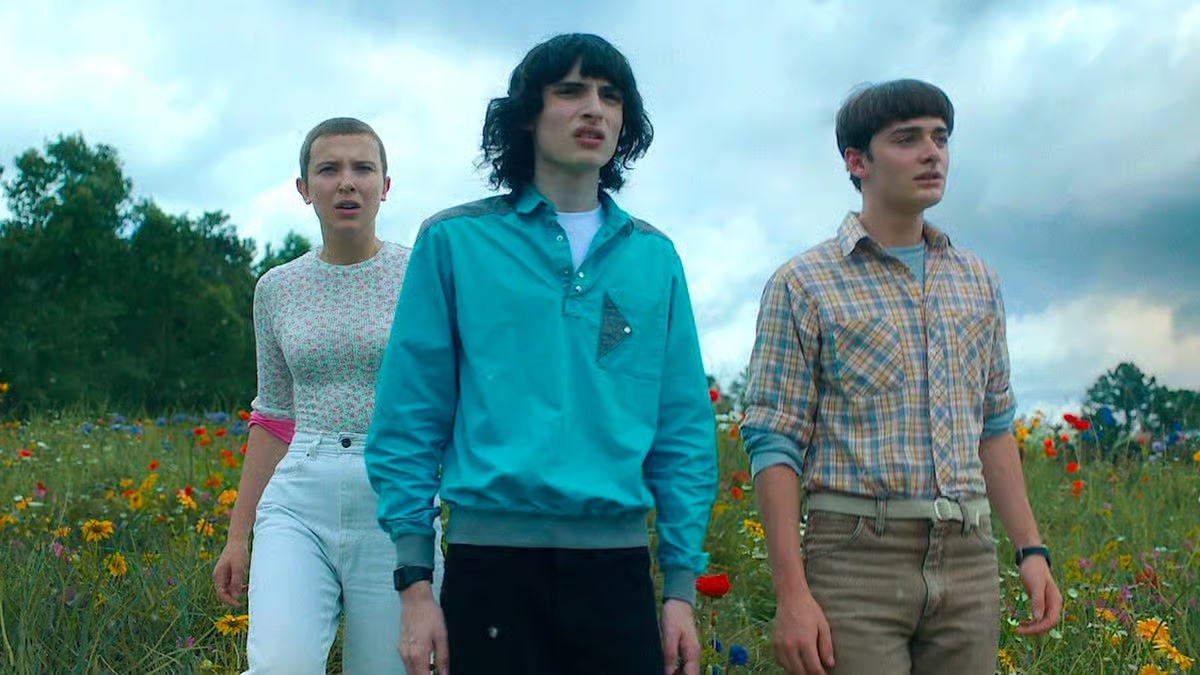
A lot of Stranger Things foreshadowing wears a human mask. The show spends time on crushes, jealousy, boredom, and those painfully specific teenage humiliations, then uses them as delivery systems for bigger reveals. The emotional pressure is rarely separate from the supernatural pressure. It’s the same engine.
Think about how often the series links vulnerability to invasion. Will’s sensitivity becomes a conduit. Max Mayfield’s (Sadie Sink) grief becomes a target. Billy Hargrove’s (Dacre Montgomery) rage becomes a doorway. The Duffers don’t always announce this as “foreshadowing,” because it reads like character work first. Then later you realize the show has been sketching a threat map using people’s inner lives as coordinates.
They Build “Rules” Early So Later Twists Feel Fair
The Duffers are good at teaching you the boundaries of the world before they shove someone through those boundaries. They do it with science class chatter, practical problem-solving, and repeated cause-and-effect. Heat matters. Sound matters. Doors matter. Memory matters. Music matters. The show doesn’t always say “this is a rule,” but it shows the same solutions working again and again until your brain accepts them as physics.
That matters because Stranger Things loves an escalation. Season 1 is a missing-kid story with a monster. By Season 4, the villain has a face, a philosophy, and a sense of theatrical timing. The bridge between those modes works because the storytelling has been quietly building a toolkit all along.
The Duffers have also described how they approached major backstory reveals, including how they had the broader Upside Down mythology written down early, while still needing to pace when to reveal it so it lands with urgency. That’s basically foreshadowing as restraint.
They Plant the Ending Inside the Beginning
Season 4’s reveal that the Upside Down appears “frozen” on a specific 1983 date is one of those details that instantly reframes everything around it. Suddenly, the Upside Down isn’t only an evil dimension. It’s a snapshot. It’s a memory. It’s a place with a timestamp, which is an extremely Duffer-like way to make the setting itself feel like a clue.
That’s also the kind of twist that functions like retroactive foreshadowing. You start replaying earlier seasons in your head, looking for moments that now read differently.
They Plan a “North Star,” Then Let the Path Get Messy

Here’s the part that makes the Duffers’ foreshadowing feel satisfying instead of mechanical: they don’t seem to write like accountants. They write like storytellers who know the destination, then keep finding better roads to get there. In recent conversations about the final season, they’ve described having long-held anchors for the ending and saving major mythology answers for the right moment.
That approach explains why the show’s hints often operate in layers. Some clues are literal, like recurring imagery tied to a specific villain. Some clues are tonal, like the way each season’s opening scene quietly tells you what kind of horror you’re about to watch. Some are structural, like the series circling back to Season 1 questions rather than endlessly inventing new ones. When Season 5 leans into “full circle” energy, it’s not fan service.

Rachel Sikkema is a New Zealand-based writer and creative entrepreneur who explores the intersection of film, culture, and modern relationships. Through her articles, she examines how stories shape the way we connect, love and see ourselves – all for God’s glory. When she’s not writing about film and television, she’s watching Dexter and The White Lotus for the third time.