If Stranger Things season 4 turned Hawkins into a crime scene, season 5 treats it like a circuit board. Every attack, every gate and every creeping vine feels mapped with unnerving precision. When the show lets us glimpse how Vecna, played by Jamie Campbell Bower, is arranging Hawkins in season 5, it stops feeling like random horror and starts looking like urban planning from hell.
Quick warning before we keep going: spoilers for seasons 1 to 5, volume 1.
Hawkins Keeps Getting Redrawn
Back in season 1, Hawkins looked like a normal small town that happened to sit on top of a science experiment. The first tear into the Upside Down came from Hawkins Lab, then rot spread outward, crops failed and a web of underground tunnels formed under the town.
By season 4, Vecna turned Hawkins into something closer to a ritual site. Each murder opened a specific gate at the place of death, from the Munson trailer to Lover’s Lake to the road where Max Mayfield, played by Sadie Sink, is attacked. All of those curse gates intersected at the town square, which the kids eventually realised is the physical center point of the pattern.
From Four Curse Gates to a Full Circuit
What started as four sharp pins on a map in season 4 becomes a full blown circuit in season 5. We see Vecna shifting tactics. He is no longer only opening isolated portals tied to single kills. Instead he targets multiple children around town and creates a new ring of activity that encircles Hawkins Lab in the normal world, mirroring the Upside Down’s reach.
The show underlines this when Dustin, played by Gaten Matarazzo, sketches all the new incident sites and realises the locations form a deliberate geometric pattern. The lines do not just circle the lab; they funnel back toward Creel House, the old Henry Creel family home that has always been Vecna’s psychic anchor.
The Emotional Fault Lines of Hawkins
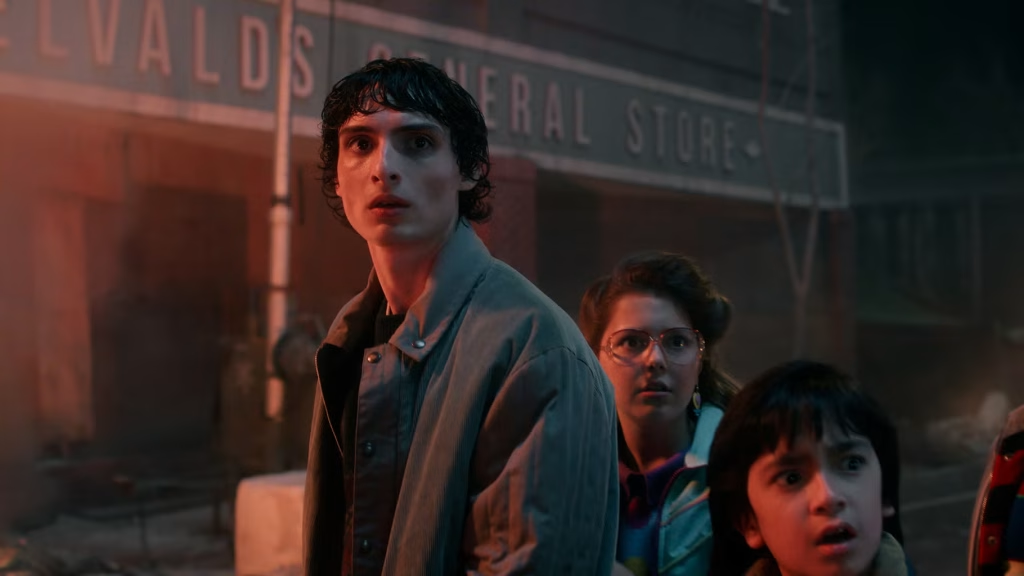
The map is not only geographical. Vecna has always hunted people whose minds are already cracked open by grief, guilt or shame. Season 4 made that explicit with Chrissy, Fred and Max, all carrying so much private pain that he could get inside their heads easily.
Season 5 repeats the pattern with new children, but the logic is sharper now. Vecna is not only looking for fragile minds. He is collecting specific emotional frequencies. The kids he stalks tend to live near key sites in the existing Upside Down network or have small connections back to the original party. A scared kid who once saw Will Byers in the woods. A student who had Miss Harris as a teacher alongside younger Holly Wheeler.
The Wormhole Theory Sitting on Top of the Map
Season 5 also leans harder into explicit sci fi. A classroom scene about wormholes explains how space can fold, and the sketch on the chalkboard almost matches Will’s artwork that seems guided by his visions.
Put that in conversation with Vecna’s ring of incidents around Hawkins Lab and his history of opening gates, and a picture emerges. He is not trying to destroy Hawkins in a messy way. He is trying to reshape it into a stable structure that can support something more ambitious, likely a controlled wormhole linking Hawkins, the Upside Down and whatever older place the show hints at when people mention experiments from the 1940s and talk of a deeper “Dimension X.”
Seen that way, Hawkins is becoming a calibrated gateway device. The map is the wiring diagram. Every child Vecna touches is one more node in the circuit, one more stabiliser that keeps his future wormhole from tearing itself apart.
Will, Eleven and Who Actually Owns the Map
The most haunting part of season 5 volume 1 is that Vecna is not the only one reading Hawkins like a map. Will Byers, played by Noah Schnapp, experiences a massive telekinetic surge in episode four that shows he can channel the same type of power Vecna has used for years.
The Duffers have framed Will’s abilities as a consequence of his tether to the Mind Flayer and Vecna, not a fresh gift. That means the map of Hawkins might exist inside Will as much as inside Vecna. He feels shifts in the Upside Down, senses when gates open and, by volume 1’s end, appears able to push back.
Eleven, played by Millie Bobby Brown, sits at the other end of this triangle. Her power originally tore the first hole, and she has spent the series trying to close what she accidentally opened. If Vecna designs the map and Will embodies it, Eleven is the one person who can redraw it. No wonder volume 1 positions the final conflict as a three way struggle between these characters rather than a simple hero versus villain faceoff.
What Vecna’s Pattern Hints About the Finale

Early chatter from interviews hints that the remaining episodes will finally spell out what the Upside Down actually is and why it locked onto Hawkins so precisely. Given what we have already seen, the answer has to connect geography, memory and design. Vecna’s map is not random. It reflects his childhood in Creel House, his obsession with repeating pain and his need to engineer a structure that can hold a more permanent tear in reality.
Whether Eleven wipes that map clean or Will flips it against its creator, Hawkins has been fully rewired by the time volume 1 ends. The streets the kids used to bike down are no longer just streets. They are lines in a sigil, coordinates in a wormhole and, maybe, the blueprint for Vecna’s final version of the world.

Rachel Sikkema is a New Zealand-based writer and creative entrepreneur who explores the intersection of film, culture, and modern relationships. Through her articles, she examines how stories shape the way we connect, love and see ourselves – all for God’s glory. When she’s not writing about film and television, she’s watching Dexter and The White Lotus for the third time.