There is a particular kind of room in Weapons that feels more dangerous than any basement, hallway, or dark stretch of suburban road.
It is the room full of parents.
That sounds backwards, maybe, because this is a horror movie with missing children, witchy rot, eerie night footage, and Aunt Gladys smiling like she wandered in from a nightmare staged by a children’s party entertainer. But the scenes where adults gather and try to make sense of the impossible have their own awful temperature. People talk over each other. Grief gets loud. Suspicion looks for a body to attach itself to. Everyone wants an answer, and the answer has to arrive fast enough to make the pain feel organized.
That is where Weapons gets mean in the best way.
Zach Cregger understands that mass panic rarely feels like chaos to the people inside it. It feels like clarity. That is the scary part. Everyone in Maybrook thinks they are seeing the obvious thing. The parents see a teacher who somehow survived a classroom vanishing. The school sees a crisis it cannot manage. The police see pressure building before they have anything solid to offer. Justine sees a town deciding what she means before she can defend herself.
Nobody feels irrational from inside their own fear.
Panic Needs A Shape
The central image in Weapons is so clean that it almost feels like a dare. A classroom of children wakes up at 2:17 in the morning and runs into the dark with their arms stretched out.
It is instantly memorable. You can describe it in one sentence and watch someone’s face change.
The brilliance of the movie is that the image does not stay pure. Once the town gets hold of it, the image starts mutating. It becomes evidence, rumor, accusation, nightmare fuel, and emotional currency. People repeat it because repetition gives them something to do. They turn it over and over, hoping meaning will fall out.
That feels painfully true.
When something awful happens, people say they want facts. A lot of them do. But panic has a hunger that facts rarely satisfy quickly enough. Panic wants pattern. It wants motive. It wants a villain with a visible face and a location on the map. The missing children create an absence, and absence is unbearable because it cannot be confronted directly.
So the town fills it.
Justine Gandy, played by Julia Garner with a raw, defensive brittleness, becomes the easiest shape for the town’s terror. She is close to the children. She is imperfect. She has enough visible mess around her that people can pretend their suspicion has texture. Garner plays her like someone whose body has already started bracing for impact before anyone says the worst thing out loud.
That is a sharp choice. Justine never floats above the movie as a spotless victim. She is prickly, exhausted, and clearly carrying her own damage. The town uses that against her because mass panic loves a complicated target. A flawless person makes accusation look ugly. A messy person makes accusation feel like investigation.
The Mob Sounds Reasonable To Itself
One of the creepiest things about Weapons is how normal the public fear sounds at first.
People ask questions. They demand accountability. They want the school to explain itself. They want the police to move faster. They want Justine to say something that can make the whole room stop shaking.
None of that is strange on its own.
The shift happens in the pressure between those demands. The parents are grieving, but they are also watching each other grieve. That changes the energy. Pain becomes communal, then competitive, then performative. A room full of frightened people starts teaching itself what the acceptable emotional response should be.
Anger becomes proof of love.
Suspicion becomes proof of intelligence.
Cruelty becomes proof that you care enough.
That is a nasty little social mechanism, and Weapons catches it without turning the parents into cardboard monsters. Josh Brolin’s Archer is the clearest example. His grief is enormous. It sits on him like wet cement. You understand every inch of his desperation, which makes his movement toward accusation more upsetting rather than less.
Brolin gives Archer the heavy, dangerous stillness of a man who has found exactly one direction to walk in. He wants his child back. He wants the universe to hand him a door he can kick open. When that door fails to appear, he starts building one out of rage.
The movie lets that be human. It also lets it be frightening.
Fear Travels Faster Than Truth
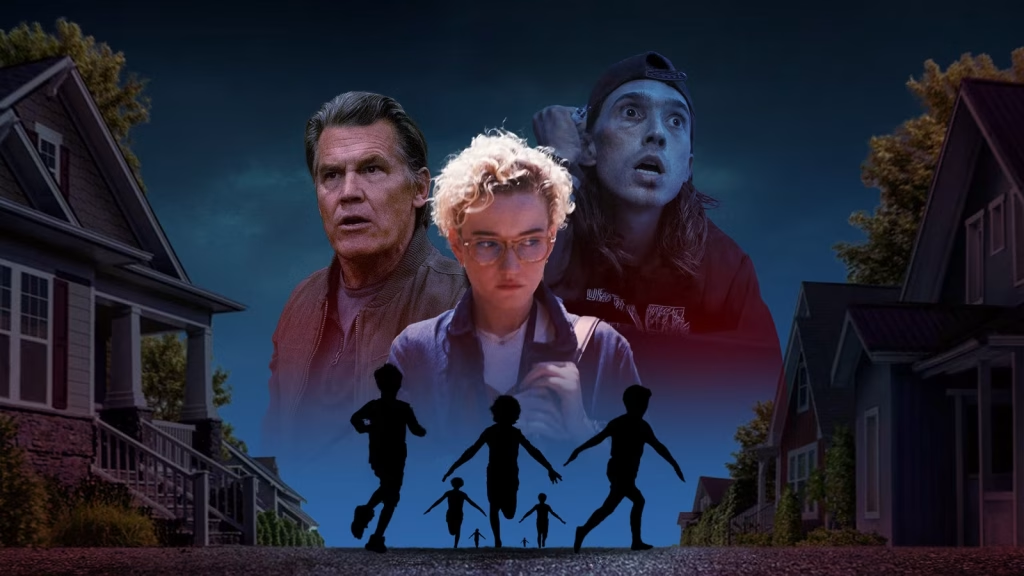
The chaptered structure of Weapons matters because mass panic lives on partial vision.
Each character gets a piece. Justine has one angle. Archer has another. Paul has his own compromised little pocket of the story. Alex carries a child’s version of knowledge, which feels more terrible because children in horror movies often understand the shape of danger before adults can admit the room has changed.
The audience keeps receiving new information, but the town itself lags behind. That gap is where the panic grows.
Maybrook becomes a place where everyone is reacting to an incomplete story at full volume. That is such a good horror engine because it mirrors the way communities actually behave under stress. People rarely wait until they have the full picture. They create a working version and start living inside it.
You can feel that in the movie’s texture. The houses look normal. The streets look normal. The school has that bland institutional sadness, all fluorescent light and public furniture. Nothing about the setting announces itself as mythic. That makes the panic feel more invasive. It slips into ordinary spaces and makes them hostile.
A hallway becomes a place where someone might be watching.
A meeting becomes a trial.
A classroom becomes a wound with desks.
Maybrook Turns Grief Into A Public Performance
The empty classroom is one of the movie’s most upsetting ideas because it gives the town a physical object for its grief.
There are no children, so everyone stares at the room.
That room becomes almost obscene. The desks are still there. The everyday school stuff remains. The shape of normal life has been preserved after the life has vanished from it. For Justine, it is a workplace turned accusation. For the parents, it is the last place where their children belonged to the public world. For the town, it is a symbol they can revisit whenever the fear starts to lose its edge.
Mass panic needs symbols. It needs images people can gather around and misread together.
That is why the classroom feels more potent than a simple scare scene. It keeps generating emotion. It gives people a shared picture, and shared pictures can be dangerous when nobody agrees on what they mean.
The children running at night create the myth. The empty classroom gives the myth a shrine.
There is something grimly funny about how quickly adults in Weapons start behaving like they are the rational ones. The kids did the impossible, but the adults are the ones who keep making the world feel less stable. Every attempt to impose order bends into another form of disorder.
Aunt Gladys Arrives After The Town Has Opened The Door
Amy Madigan’s Aunt Gladys is a gift of a performance because she enters the movie with a brightness that feels chemically wrong.
The red hair, the glasses, the lipstick, the chirpy social rhythm. She looks like she should be offering hard candy from a purse. Instead, she carries the air of someone who has studied harmlessness and turned it into a weapon.
What makes Gladys especially effective is that the town has already softened itself up for her. Maybrook is suspicious, exhausted, and desperate for meaning. Everyone is staring in the wrong direction with great conviction. Gladys benefits from that. She moves through a community already busy harming itself.
That is one of the movie’s crueler jokes.
The supernatural horror has power, sure, but the human panic creates room for it to breathe. The town’s obsession with blame becomes a distraction. People are so busy turning Justine into an answer that they miss the stranger reality creeping around the edges.
Gladys feels like the punchline to a bad communal habit. Everyone wanted the horror to make social sense. They wanted the guilty person to be someone they could gossip about, punish, recognize, and place in a tidy moral category. Then the movie gives them something much uglier and weirder.
Mass panic narrows the imagination. Weapons knows that.
The Scariest Thing Is Everyone Being So Sure
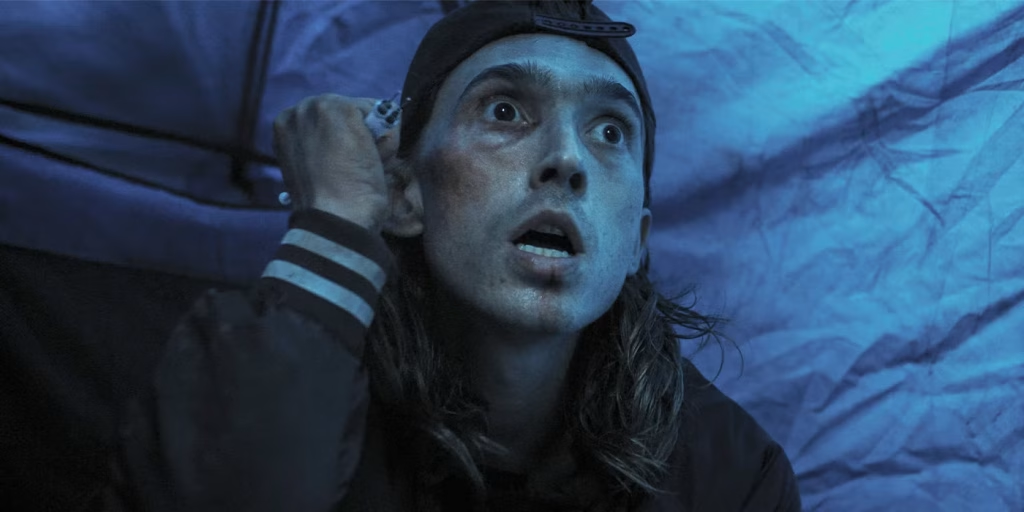
The movie lingers because it understands certainty as a horror texture.
People in Weapons are constantly reaching for certainty, and every time they grab it, they hurt someone or miss something. That feels more frightening than confusion. Confusion can leave space. Certainty closes the door and locks it from the inside.
That is why the shifting perspectives work so well. The movie keeps reminding us that everyone has enough information to be dangerous and too little information to be right. That is a brutal combination. It is also very familiar.
You see it in the way people talk after tragedy. The instant theories. The chosen villains. The sudden expertise. The moral confidence that blooms before the facts have even taken their shoes off. Weapons turns that social reflex into horror without making the film feel like a lecture.
It stays nasty and cinematic. It gives us the image of children running under streetlights. It gives us Julia Garner’s wounded stare and Josh Brolin’s grief curdling into menace. It gives us Aunt Gladys, who feels like a joke told by something with no sense of mercy.
But underneath all that, the movie keeps returning to a simple, awful idea.
Fear spreads by making people feel useful.
It gives them something to say, someone to watch, someone to blame, somewhere to aim all the pain. Maybrook becomes a town full of people trying to survive the unknown by turning it into a story. The story is wrong in pieces, seductive in pieces, and powerful enough to change how everyone behaves.
That is what Weapons understands about mass panic.
It moves like a nightmare, but it talks like common sense.

Rachel Sikkema is a New Zealand-based writer and creative entrepreneur who explores the intersection of film, culture, and modern relationships. Through her articles, she examines how stories shape the way we connect, love and see ourselves – all for God’s glory. When she’s not writing about film and television, she’s watching Dexter and The White Lotus for the third time.