There is a very specific kind of discomfort that comes from watching Michael work.
The film knows exactly where your eyes should go. It knows when to push Jaafar Jackson into a pool of light, when to let a childhood scene soften the room, when to cut to a crowd going wild so you can feel the old voltage again. It knows the glove still works. The film knows the moonwalk still works. It knows a familiar song can make an audience forgive a lot before anyone has said a word.
That is the unsettling part.
Antoine Fuqua’s Michael does plenty of ordinary biopic things. It recreates famous moments and turns studio sessions and rehearsals into milestones. It gives the audience a child prodigy, a pressured family, a lonely superstar, and a stage figure so famous he barely needs a name after the first ten minutes.
But the movie’s real subject, whether it admits this or not, is sympathy. How it gets produced and steered. How easily a film can make you feel protective toward someone before you have fully decided what you think.
That does not make Michael empty. It makes it fascinating in a slightly queasy way.
The Movie Builds Michael as a Wounded Image
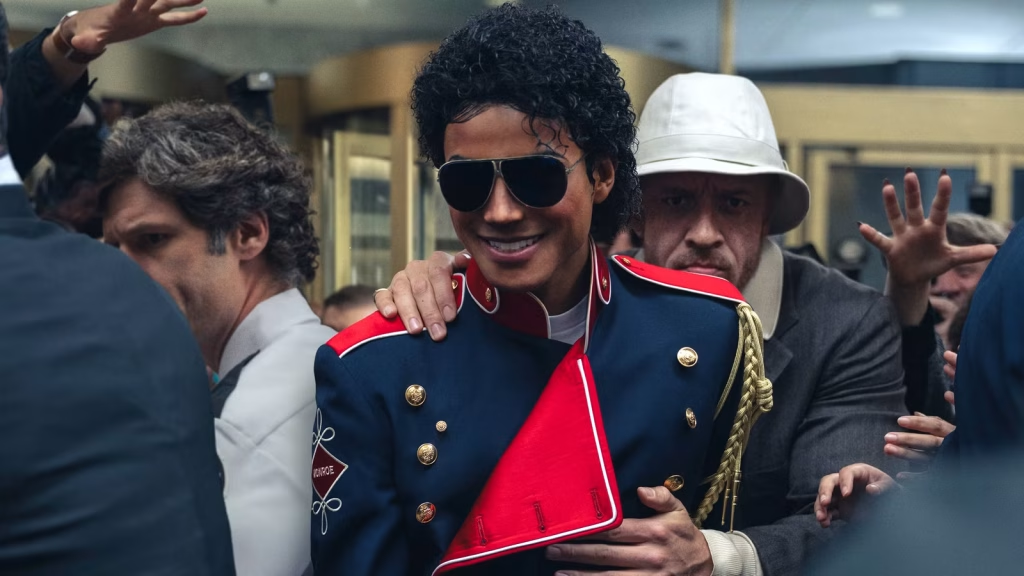
Jaafar Jackson’s performance gives the film its strongest weapon. He has the resemblance, the posture, the watchful eyes, the quick little smile that appears and disappears like someone opened a curtain for half a second. The family connection adds a strange emotional charge before the story even begins.
The film leans into that hard.
It often frames Michael as someone being looked at before he gets to look back. As a child, he is scrutinized by adults. As a star, he is swallowed by crowds. When he’s an adult, he moves through rooms where everyone seems to want something from him. Money. Perfection. Access. A miracle on cue.
That framing does a lot of work. It makes Michael feel vulnerable even when he has enormous power. It turns fame into a trap and the performer into the person caught inside it. The camera keeps finding him in reflective surfaces, backstage spaces, dressing rooms, hallways. Transitional places. Places where a person can breathe for three seconds before the machine starts again.
It is effective. Very effective, actually.
It also keeps nudging you toward one emotional position. Look how much he carried and how young he was. Look how little privacy survived the applause.
The Performance Scenes Become Emotional Evidence
A Michael Jackson performance scene comes with built-in force. You cannot stage “Billie Jean” or “Thriller” like some neutral piece of biography. Those images already live in people’s bodies. The audience remembers where the thrill is supposed to land.
Michael uses that memory with a surgeon’s confidence.
When Jaafar slides into a familiar pose, the movie lets recognition bloom before it asks you to think. That tiny delay matters. You feel first. The thought arrives later, sometimes looking a little underdressed.
The concert scenes become more than spectacle. They act like evidence in Michael’s favor. See the genius and the discipline. See the crowds and the body doing something that looks impossible and somehow clean.
That is where the control gets interesting. The film asks performance to explain character. It treats the stage as proof of inner truth. Michael can be strange, wounded, guarded, difficult to reach, but the second he performs, the movie gives him clarity. The music resolves him.
I get why that works. Pop stardom does feel like that from the outside. A performer walks onstage and all the mess gets converted into light.
Still, the conversion feels a little too smooth. The movie knows that awe can tidy up discomfort.
Everyone Around Him Becomes Part of the Pressure

The supporting characters often orbit Michael as sources of strain, misunderstanding, or extraction. Colman Domingo’s Joe Jackson carries the brutal edge of parental ambition. Miles Teller’s John Branca brings the business machinery. The family scenes have warmth, but they also keep returning to pressure. Pressure to perform, earn and stay loyal. Pressure to become a brand before childhood has even finished packing its bags.
This approach gives the film a clear emotional shape. Michael becomes the center of a system that uses him, praises him, disciplines him, and then demands more.
That shape makes sense for a biopic about a child star. It also narrows the audience’s path. Again and again, the movie positions Michael as the person acted upon. The world pushes. Michael absorbs.
Even when he makes choices, the film often wraps those choices in stress, loneliness, or misunderstanding. You can feel the storytelling hand on your shoulder. Gently, constantly, almost politely. It keeps guiding you back toward compassion.
Compassion has value. Compassion also has direction here.
The Film Knows When to Look Away
The most revealing thing about Michael may be its sense of timing. It knows when to linger and when to move.
It fixates on talent and childhood pain. It focuses on the shock of transformation, the price of rehearsal, the eerie beauty of a famous silhouette coming together under lights.
Then there are places where the film becomes more careful. More selective. It gestures toward controversy and public scrutiny, but its strongest cinematic language belongs to the material that makes Michael legible as wounded, gifted, and besieged.
That imbalance gives the film its strange moral texture. It never feels random. It feels arranged.
Every biopic arranges reality. That is the deal. A life has too much stuff in it, so a movie chooses a path and trims the rest. But with a subject as complicated as Michael Jackson, selection becomes the whole argument. The scenes a movie softens can say as much as the scenes it plays loud.
Michael plays suffering loud. It plays genius louder. It plays ambiguity with a much lighter touch.
Jaafar Jackson Makes the Control Harder to Resist
If the lead performance were weak, the film’s sympathy machine would be easier to resent. Jaafar makes that difficult.
He gives Michael a skittishness that feels lived-in. His eyes often seem to arrive before the rest of his face. He listens in a way that suggests calculation and fear at the same time. Onstage, his body snaps into myth. Offstage, it looks like it has learned to fold itself smaller.
That contrast is the film’s emotional engine.
The eerie resemblance deepens the effect. When Jaafar smiles in a red jacket or leans into a microphone under stage lights, the movie can tap into the audience’s memory without doing much extra work. It feels like watching an old cultural photograph breathe.
Of course that creates sympathy. How could it not? The image comes preloaded with grief, nostalgia, fandom, and unfinished arguments.
Jaafar’s performance lets the film blur tribute and resurrection. That blur is powerful. It is also a little dangerous because it can make emotional recognition feel like understanding.
The Movie Turns Vulnerability Into a Rhythm

By the halfway point, you can feel how Michael wants you to breathe.
A hard scene. A private wound. A burst of performance. A reminder of isolation. A song you already love. The rhythm repeats until sympathy becomes almost physical.
That rhythm is not clumsy. Fuqua has too much craft for that. The movie has polish, momentum, and a sincere belief in Michael as an artist. It also has a habit of cushioning him in pain whenever the story approaches harder terrain.
The result is a film that feels less like it is asking for your sympathy and more like it is managing the conditions under which sympathy appears.
That is the unsettling thing. Not the fact that it cares about Michael. A biopic usually cares about its subject. The tension comes from how carefully it decides what kind of care you are allowed to feel.
The film gives you the lonely child, the impossible performer, the hunted celebrity, the man trapped inside his own iconography. It gives you every emotional key in the right order. By the time the credits approach, you may find yourself moved and suspicious of the machinery that moved you.
Honestly, that tension might be the most interesting part of the whole movie.
Michael wants to restore awe. It wants to make the King of Pop feel enormous again. In many scenes, it succeeds. The songs still hit. The silhouette still cuts through the dark. Jaafar Jackson gives the role a haunted softness that keeps pulling the eye back to him.
But the film’s real aftertaste comes from the question it leaves behind. How much of what you felt was yours, and how much did the movie hand to you already shaped, polished, and lit from the perfect angle?

Rachel Sikkema is a New Zealand-based writer and creative entrepreneur who explores the intersection of film, culture, and modern relationships. Through her articles, she examines how stories shape the way we connect, love and see ourselves – all for God’s glory. When she’s not writing about film and television, she’s watching Dexter and The White Lotus for the third time.