The best way to watch Barbarian is with the kind of trust that feels slightly stupid at first.
You press play because someone told you to. You know the title. Maybe you know Bill Skarsgard is in it, which already feels like a threat because horror has trained us to look at his face and start doing mental paperwork. You know there is a rental house. That is enough. Honestly, that may be too much.
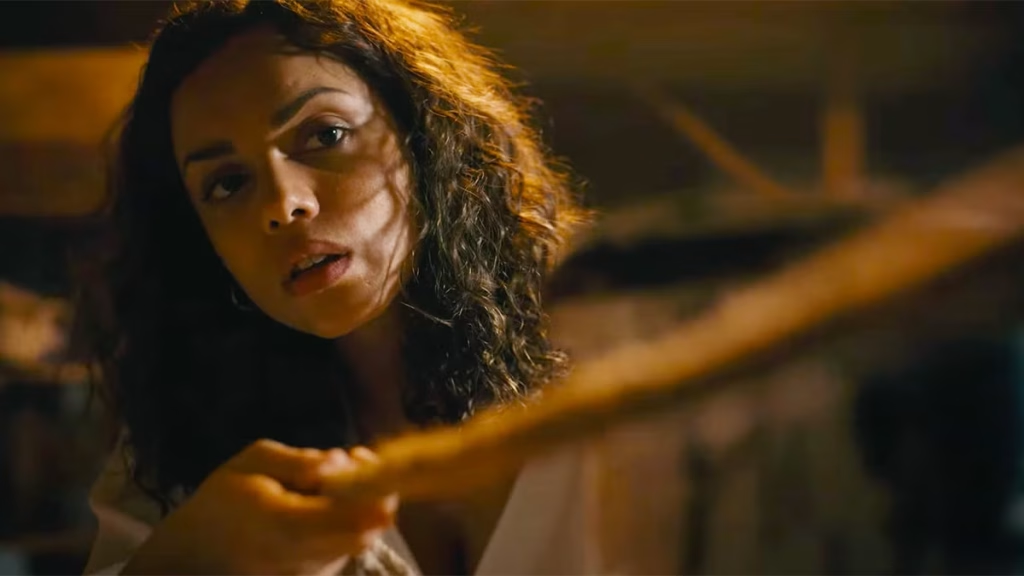
Zach Cregger’s 2022 horror film has one of those rare modern setups that feels clean enough to be a campfire story. Tess, played by Georgina Campbell with a wonderfully alert kind of restraint, arrives at an Airbnb in a dead Detroit neighborhood during a rainstorm. The key is gone. The house is already occupied by Keith, played by Skarsgard, who seems helpful in exactly the way that makes every nerve in your body file a complaint.
That is the hook. Two strangers. One house. Bad weather. Bad vibes.
The trick is that Barbarian keeps making you think you have identified the movie, then calmly opens a different door.
The Movie Weaponizes Your Own Confidence
Horror fans love to believe they are hard to fool. We have seen the creepy basement and know about the guy who offers tea too politely. We notice when a room has a tape measure, a stained mattress, and the sort of lighting that says a real estate agent would simply pass away during the showing.
Barbarian knows that too. It practically invites you to play along.
The early stretch is so tense because Keith feels suspicious by genre association. Skarsgard’s casting does half the work before he even speaks. He has a softness here, a shy smile, a little too much eagerness to prove he is safe. The movie lets you sit with that discomfort until every ordinary gesture feels loaded. A bottle of wine. A bedroom door. A polite offer to sleep on the couch.
Campbell is perfect in these scenes because Tess keeps making choices that feel human rather than conveniently brave. She hesitates, checks, and weighs risk with the exhausted practicality of someone who has already had a miserable night. She wants to be fair, but she also knows fairness can get a woman killed.
That tension lands harder when you arrive with limited information. If you know the movie’s major turns, the opening becomes a clever construction. If you know almost nothing, it becomes a negotiation with your own instincts.
You keep thinking, is this the danger, or is the movie baiting me with the obvious danger?
That question is the movie’s first trap.
Spoilers Flatten the Weird Pleasure of Being Wrong
Some horror movies can survive total summary. You can know the monster, the killer, the twist, the final image, and still have a great time because the craft lives in the chase. Halloween still works when you know Michael Myers is standing across the street. Jaws still works when you know the shark has scheduling issues and a taste for beach tourism.
Barbarian belongs to a more delicate species. Its pleasure comes from being rearranged while you are watching it.
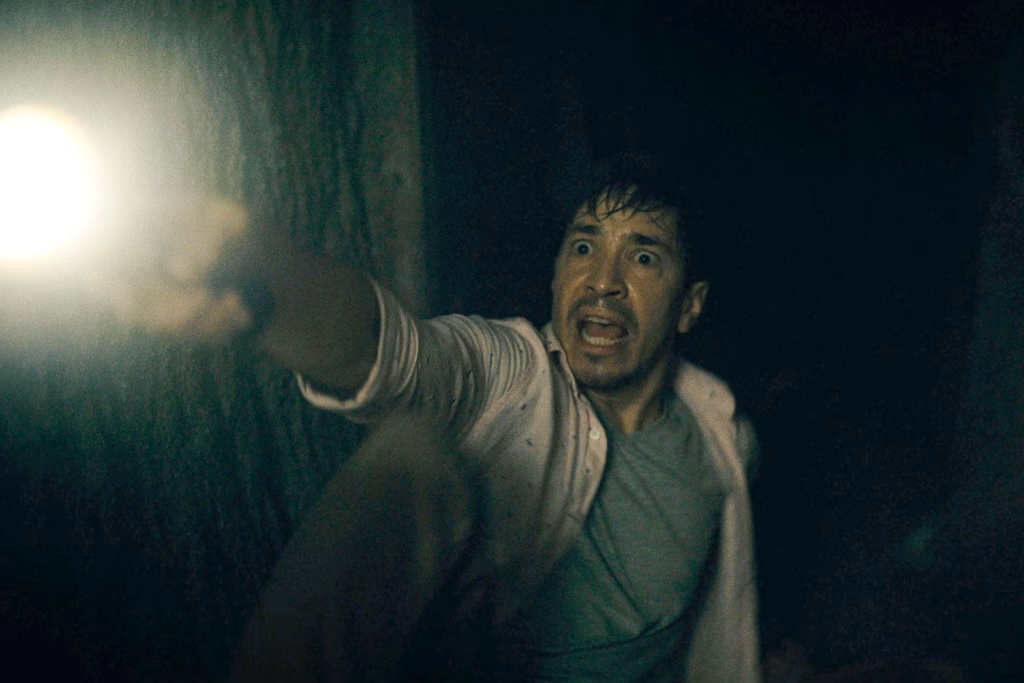
The movie changes shape with almost rude confidence. It starts as a chamber thriller, turns into something grimier and more subterranean, then suddenly throws you into the orbit of Justin Long’s AJ, a sitcom-bright Hollywood actor having the worst career day imaginable. The transition is hilarious the first time because it feels like somebody sat on the remote. You go from damp dread to convertible sunshine, from a basement hallway to a man singing along in his car while his life collapses offscreen.
Long understands exactly what movie he has entered. AJ is funny because he keeps trying to narrate himself into decency. He is all reflexive entitlement and self-pity, the kind of guy who can turn a moral crisis into an inconvenience with breathtaking speed. Watching him measure square footage in a nightmare tunnel is one of the great sick jokes of recent horror. He sees horror and thinks about property value. A cursed little miracle.
That tonal swerve works best when it ambushes you. On paper, it sounds messy. In the movie, it feels exhilarating because Cregger has earned enough trust by then to make the wrong turn feel intentional. You laugh partly because the cut is funny, and partly because your brain has to dump the old map.
Knowing that shift in advance softens the jolt. You can still admire it, sure. But admiration is a cooler temperature than surprise.
The House Keeps Getting Worse

A huge part of Barbarian’s magic sits in the physical space of the house. The first floor has that sterile short-term-rental blandness, all neutral colors and fake comfort. It feels designed by someone who bought “cozy” items in bulk. Then the basement introduces another language entirely.
That first hidden room is awful in a way that makes the stomach tighten before the plot explains anything. The camera gives you enough detail to understand the situation and then lets your imagination do the heavier lifting. The stained mattress. The camera. The bucket. The room feels like evidence.
Then the movie keeps going down.
That downward movement matters. It creates a feeling that the house has swallowed several crimes and simply built new architecture around them. Every hallway suggests an older horror beneath the current one. The deeper Tess goes, the more the movie pulls away from ordinary threat and into something almost mythic, though it stays filthy and concrete. You can smell the damp drywall.
Watching that descent with fresh eyes gives the movie its best rhythm. Discovery, denial, discovery, worse denial. You keep wanting the house to reach its final secret so the story can stabilize. It refuses. It has more.
Spoilers turn those spaces into landmarks. Without spoilers, they feel like wounds opening.
The Humor Needs the Dread Around It
People sometimes talk about Barbarian as if its comedy and horror are separate engines. The comedy break happens, the horror resumes, everyone gets their allotted lane. That feels too tidy for the actual movie.
The humor works because the dread has already tuned you to the wrong frequency. AJ’s scenes are funny, but they are funny inside a world where you already know something rotten waits below. His obliviousness has a fuse attached. Every selfish thought he has becomes funnier because the house has no patience for his brand of nonsense.
Cregger came out of sketch comedy, and you can feel that timing in the film’s sharpest turns. He knows how long to hold on an absurd choice and the value of a reaction that arrives half a beat too late. He also knows that comedy can make a horror audience lower its guard, which is a mean and useful trick.
The movie never becomes smug about its jokes. It lets AJ be ridiculous, then lets that ridiculousness expose him. His funniest moments are also character evidence. The measuring tape gag gets a laugh because it is outrageous, then a second darker laugh because of course this man would think that way. Of course he would.
That kind of comic horror plays best when you have no stable expectation of tone. If someone tells you exactly how funny the movie gets, you start waiting for the bit. Waiting is poison for this one. You need to be caught mid-flinch when the joke lands.
The Monster Is Scarier Before She Becomes Familiar
The Mother, played by Matthew Patrick Davis, is one of the more memorable horror figures of the last few years. The design is blunt, tragic, and physically overwhelming. The movie presents her first as pure nightmare movement, a naked pale body appearing where a body should never be, rushing through darkness with a force that feels almost impossible inside those tight spaces.
Again, the less you know, the better the first encounter plays.
That first glimpse has a nasty, primal charge because the movie gives you no clean category. Person, monster, victim, threat, consequence. Your brain reaches for a label and comes back with static. The film later complicates her with a sadder context, and that context gives the ending its bruised feeling. But the first impact depends on confusion.
Modern horror marketing loves an icon. Posters, trailers, thumbnails, Halloween costumes, collectible figures. Barbarian benefits from resisting that treatment on a first viewing. The Mother should arrive as a rupture, not as the character you came to see.
Once you know her, the movie gains a different texture. You can notice the pathos earlier. You can read the story’s cruelty with more shape. That second viewing has value. But the first viewing has a wildness that cannot be rebuilt once the image is already in your head.
The Movie Trusts Implication More Than Explanation
For all its shocks, Barbarian is impressively lean about backstory. It gives you enough to understand the horror under the house, then leaves the full emotional sewage of it sitting there. Richard Brake’s Frank appears in flashback with a casual evil that chills precisely because the movie refuses to turn him into a grand villain. He is mundane. Frank buys supplies and walks through the neighborhood in broad daylight. He looks like a man who has benefited from being unremarkable.
That is one of the film’s ugliest ideas. The scariest history in the house grew in plain sight while the neighborhood decayed around it.
The Detroit setting adds a real bitterness to that. Empty streets, abandoned houses, the eerie isolation around one maintained rental property. The film uses that landscape as more than spooky wallpaper. It suggests neglect as cover, a place where people vanish because systems have already decided to look elsewhere.
Still, Barbarian avoids turning every implication into dialogue. It leaves room for the viewer to connect the moral rot. That restraint helps the movie linger after the immediate thrills fade.
Going in blind makes those implications feel discovered rather than delivered. You assemble the meaning from the house, the neighborhood, AJ’s selfishness, Tess’s caution, Frank’s banality, and the terrible body left behind by years of abuse. The movie gives you pieces with sharp edges. It trusts you to bleed a little.
A Blind Watch Turns the Movie Into a Dare
The strongest argument for knowing almost nothing about Barbarian is simple. The movie is built like a dare, and dares lose power when someone hands you the rules.
It wants you uncertain and suspicious of the wrong person. Then, embarrassed by your certainty and suspicious of the next thing. Then laughing when you should be scared, then scared when you thought the movie had become a joke. It wants you leaning away from the screen and leaning closer at the same time.
That experience has become harder to find because so much movie culture now happens before the movie. Trailers explain. Headlines spoil. Social feeds turn surprises into vocabulary. Even praise can give too much away when a film depends on misdirection.
So with Barbarian, the best recommendation is almost annoyingly brief. Watch it. Read nothing. Let the first half hour make you uncomfortable and the cut to AJ make you wonder whether the projectionist has lost interest in your wellbeing. Let the basement keep getting worse.
The movie has plenty to offer on rewatch, especially once you can see how carefully it lays out its traps. But the first viewing is the prize. That is when Barbarian feels least like a plotted object and most like a bad decision you somehow agreed to enter.
Perfect horror weather, really.

Rachel Sikkema is a New Zealand-based writer and creative entrepreneur who explores the intersection of film, culture, and modern relationships. Through her articles, she examines how stories shape the way we connect, love and see ourselves – all for God’s glory. When she’s not writing about film and television, she’s watching Dexter and The White Lotus for the third time.