The first time through Weapons, 2.17 A.M. does most of the work.
That time sits on the movie like a cold hand. Seventeen children from the same class wake up, leave their homes, and run into the dark with their arms stretched out. One kid remains. One teacher takes the heat. One town starts turning grief into a weapon before anyone has enough facts to hold.
On a first watch, the question is simple and awful. Where did the children go?
On a second watch, the better question starts creeping in. Why did everyone look in the wrong place for so long?
That is where Zach Cregger’s movie gets meaner, funnier, and oddly more impressive. Weapons has a big answer, yes. Aunt Gladys, played by Amy Madigan with a smile that feels like a bad smell wearing lipstick, sits at the center of the horror. The children have been taken, controlled, and hidden through a kind of domestic nightmare magic. Alex Lilly, played by Cary Christopher, understands more than anyone realizes. The final stretch turns the whole mystery inside out.
A lot of horror movies shrink once you know the trick. Weapons starts expanding.
The Answer Changes the Shape of Every Scene
The first watch belongs to suspicion.
Justine Gandy, played by Julia Garner, seems trapped inside the town’s worst possible story about her. She is the teacher whose class disappeared. She is young enough, guarded enough, and messy enough for people to decide she must have done something. Garner plays her with this tight, exhausted defensiveness that makes every conversation feel like cross-examination.
Archer Graff, played by Josh Brolin, moves through the movie with grief hardening in real time. He wants the answer so badly that he starts treating certainty like proof. Brolin has always been good at making stubbornness look physical. Here, it sits in his jaw, his shoulders, the way he charges into rooms already halfway convinced.
The first time, you watch these people hunt for the source of the horror.
The second time, you watch them miss it.
That is a very different pleasure. A cruel one, maybe, but horror has never been a charity. Once you know Gladys is the rot in the walls, the early scenes gain a sick little charge. Every accusation pointed at Justine feels more absurd. Every adult argument feels more useless. Everyone keeps trying to solve a supernatural invasion with the tools of gossip, policing, school bureaucracy, and parental rage.
Good luck with that, Maybrook.
Aunt Gladys Gets Scarier After the Reveal
Amy Madigan’s Aunt Gladys is the kind of horror character who makes more sense the less normal she tries to be.
On a first watch, she feels wrong in a loud way. The red hair. The glasses. The over-bright wardrobe. The strange cheeriness that seems to enter rooms before she does. She has the energy of someone who learned human behavior from greeting cards and poison labels.
After the reveal, those choices become sharper. Gladys is theatrical because theatricality protects her. People notice the oddness, but they do not know what to do with it. She looks ridiculous enough for adults to file her away as eccentric. She weaponizes the social discomfort of dealing with a weird older woman.
That is nasty. Also, sadly believable.
Madigan makes Gladys funny without draining the danger. Her performance has this buoyant wrongness, like she is always delighted by a joke only she can hear. Once you know what she has done to Alex’s household, her brightness feels even worse. She turns care into captivity. She turns family language into camouflage.
The answer gives her more weight because the movie stops treating her as a jump-scare oddity and reveals her as a domestic tyrant. She has been sitting inside the story’s blind spot the whole time.
The Movie Is Really About Misdirected Blame
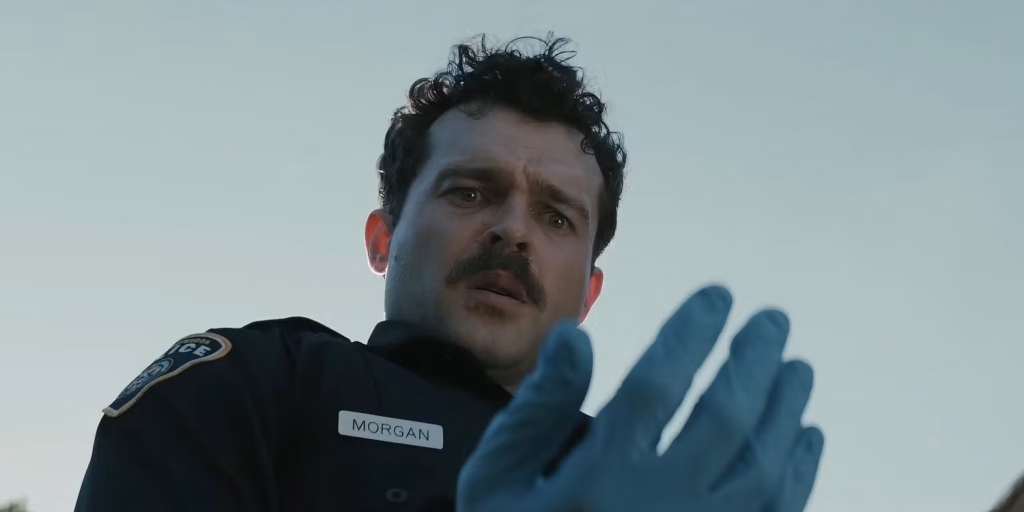
The missing children are the hook, but blame is the bloodstream.
Maybrook needs someone to punish. That need arrives before understanding. It arrives before evidence. It arrives before anyone has time to admit how scared they are.
Justine becomes useful because she is visible. The classroom belongs to her during the day, so the town drags the night into her lap. The logic has holes big enough to drive through, but pain has never cared much about clean reasoning.
This is one reason Weapons improves once the answer is clear. Knowing Gladys did it makes the town’s behavior more revealing. The mystery no longer hides the social horror. It exposes it.
Archer’s anger becomes sadder too. His pain makes sense. His direction does not. That tension gives Brolin some of the movie’s best unease. You can feel how badly he wants his grief to become action because action feels stronger than helplessness. He wants the world to give him a target.
The movie gives him the wrong ones first.
That is a grim little joke, and Cregger lets it sit there.
Alex Becomes the Real Center
Cary Christopher’s Alex is easy to read as the leftover child on a first watch. He is the one who stayed. The strange exception. The kid at the desk while the whole town stares at the empty spaces around him.
Once you know the answer, Alex becomes the movie’s hidden spine.
His silence changes texture. His isolation feels less like a clue and more like a survival tactic. He is living inside the answer while everyone else performs panic around him. That is horrible in a quieter way than the images of children running through the night.
The final act makes him active, but the second watch lets you see the cost before the payoff. Alex has been watching, absorbing, calculating. Children in horror are often symbols of innocence or danger. Alex gets to be something more specific. He is a kid forced to learn the rules of an adult nightmare because the adults are too busy blaming each other.
That makes the ending hit harder. His turn against Gladys has the kick of a crowd-pleaser, but it also carries exhaustion. The kid has had to become clever in a house where cleverness is the only tool left.
The Comedy Lands Harder With Context
Cregger’s Barbarian already proved he likes taking a hard left turn and daring the audience to keep up. Weapons has that same odd pulse. It knows when to be ugly, when to be ridiculous, and when to let both feelings share the same room.
The answer helps the comedy instead of flattening it.
Gladys is absurd. Some of the chaos around the finale is absurd. The adult incompetence has a bitter comic edge. The town meeting energy, the suspicious glances, the clumsy authority figures, the frantic attempts to make the impossible behave like a normal case file. All of that gets funnier once you know the truth has been hiding in a place nobody wants to inspect closely.
The film’s humor works because it comes from human miscalculation. People keep choosing the wrong emotional tool for the job. They yell when they should listen. People investigate when they should notice. They accuse when they should be afraid.
It is bleak comedy, sure. Still comedy.
The Structure Rewards a Second Look
The chaptered perspective structure could have felt like a gimmick. Instead, it becomes one of the reasons the movie holds up after the reveal.
Each section gives you a person with a partial truth. Justine has the burden of public suspicion. Archer has grief. Paul, James, Marcus, and the others carry their own little pieces of damage and misread information. The movie keeps shifting because no single person can see the whole thing.
That matters more once you know the full answer.
On a rewatch, the structure feels less like delay and more like diagnosis. Maybrook is a town full of isolated perspectives. Everyone has a private fear and a theory. Everyone wants their angle to be the angle.
The answer sits above all of them, almost laughing.
Cregger’s camera helps too. He has a way of making ordinary spaces look quietly contaminated. Classrooms, kitchens, sidewalks, offices, bedrooms. Places with fluorescent lights and institutional carpets. Places where nothing should feel mythic. The second watch lets you see how early the movie starts turning everyday rooms into hiding places.
The Monster Was the Story People Refused to Tell

Once Aunt Gladys becomes the answer, Weapons becomes less mysterious and more upsetting.
The horror moves from the unknown to the overlooked. That is a stronger place for it to live. The movie begins as a puzzle about vanished children, then reveals a story about manipulation, control, and a community that mistakes loud emotion for insight.
That is why knowing the answer improves the movie. The reveal does not close the door. It opens the house.
You start noticing how often people confuse proximity with guilt. How easily grief becomes social permission. How quickly a town can build a story around the most convenient woman in the room while the actual danger smiles somewhere else.
Gladys is frightening because she has power. Maybrook is frightening because it gives her room.
That is the part that stays sour.
The Ending Gives Pleasure Without Cleaning up the Dread
The finale has a wild, cathartic kick. The kind of ending that makes a theater wake up. There is real pleasure in watching Gladys lose control of the very force she used to dominate everyone else. Horror audiences deserve a little nasty satisfaction now and then. We are simple people. We see a nightmare aunt get what is coming and we clap internally.
Maybe externally too. No judgment.
But the movie keeps a residue.
The children can be found. Gladys can be stopped. The town still revealed itself. The adults still failed in ways that cannot be blamed on magic. Justine still had to absorb suspicion. Alex still had to survive the house. Archer still had to face the ugly shape of his grief.
That is why Weapons has replay value. The answer gives you the plot. The rewatch gives you the damage.
Some horror movies are built to protect a secret until the final minutes. Once the secret comes out, the whole machine winds down. Weapons has a different trick. It lets the answer sharpen everything that came before it.
The first time, you watch to find out what happened at 2.17 A.M.
The next time, you watch everyone prove how badly they needed the wrong answer first.

Rachel Sikkema is a New Zealand-based writer and creative entrepreneur who explores the intersection of film, culture, and modern relationships. Through her articles, she examines how stories shape the way we connect, love and see ourselves – all for God’s glory. When she’s not writing about film and television, she’s watching Dexter and The White Lotus for the third time.