There is something especially nasty about the way Weapons refuses to belong to one person.
A lot of horror movies pick a viewpoint and lock us inside it. A final girl. A doomed family. A detective who keeps finding worse rooms. That can be great. It gives panic a clean shape. We know whose fear we are borrowing.
Weapons does something messier.
It lets the nightmare spread.
The missing children are the hook, obviously. A whole classroom gets up at 2:17 in the morning and runs into the dark with their arms stretched out like they are answering a signal no adult can hear. It is one of those images that lodges in the brain immediately. Kids in pajamas. Empty streets. The awful calm of a suburban night doing nothing to stop them.
But the reason the movie keeps feeling so wrong is not only the image itself. It is the way the image keeps changing depending on who is looking at it.
Everyone in Maybrook has their own version of what happened. Everyone has a partial view and is scared enough to mistake that partial view for truth.
That is what makes Weapons feel less like a story being told by one character and more like a nightmare being passed around town.
Weapons Turns The Whole Town Into A Witness
The smartest thing Zach Cregger does is treat Maybrook like more than a backdrop.
The town has a mood. It has pressure. It has bad lighting in public rooms and that special small-community talent for turning concern into surveillance. People look at each other too long. They talk as if they are gathering facts, but half the time they are just sharpening suspicion.
This matters because Weapons is not only about the children disappearing. It is about what happens after a community loses the ability to sit with uncertainty.
Nobody knows enough. That is the engine.
Parents know their children vanished from inside their own homes. Justine knows she taught those children and somehow became the face of the disaster. Archer knows his kid is gone and his grief needs somewhere to go before it eats him alive. The school knows it has no comforting answer. The police know less than everyone wants them to know.
So the town starts filling in the gaps.
That is where the movie gets cruel. Maybrook becomes a machine for turning fear into stories. Bad stories. Useful stories. Stories that let people feel, briefly, like the world still has rules.
The town meeting scenes hit so hard because they feel painfully recognizable. The parents are devastated, yes, but they are also performing devastation in front of each other. They need someone to blame, and Justine is standing right there. She is visible and connected. She is imperfect enough to be useful.
The whole room begins to feel like a courtroom that forgot to wait for evidence.
The Horror Comes From Broken Viewpoints
Weapons has that chaptered structure where the story keeps shifting from one person to another, and in a weaker movie that could feel like a trick. Here it feels like the point.
Every character is trapped inside their own little tunnel.
Justine’s tunnel is shame and accusation. She knows she has become suspicious in a way she cannot fully answer, because how do you defend yourself from a nightmare? Archer’s tunnel is grief. His pain is real, but real pain can still make a person dangerous. Paul has his own frightened, compromised angle. Alex carries the kind of knowledge no child should have to carry.
Then Aunt Gladys slides into the picture like the movie has been saving its most obscene punchline.
The structure makes Maybrook feel infected. Not in a zombie-movie way. More like a rumor. A sickness of interpretation. Each person has one piece of the horror, and every piece is jagged enough to cut them.
That is why the movie feels so unstable. The truth keeps moving. Not because the film is cheating, but because the characters keep experiencing the same event from different emotional weather systems.
A terrified parent sees a conspiracy. A teacher sees a mob. A child sees a trap. An outsider might see a town turning itself inside out.
Put all those together and the movie becomes something stranger than a mystery. It becomes a portrait of collective panic.
Justine Becomes The Town’s Easiest Answer

Justine Gandy is one of the reasons the multi-perspective structure works so well.
Julia Garner plays her with this defensive brittleness that makes her fascinating to watch. Justine never feels like a clean saint, which is important. She is not written as the perfectly innocent victim floating above the ugliness. She is tense, messy, tired, sometimes sharp. You can see why people might find her difficult.
That is exactly what makes the town’s suspicion feel so believable.
Communities rarely choose perfect strangers as scapegoats. They choose people with texture. People who have made someone uncomfortable. People with a rumor attached, who have visible flaws that can be rearranged into a fake pattern.
Justine becomes useful because she is close enough to the children for people to aim at her.
Weapons understands something mean about fear. Fear wants a face. It wants someone across the room, someone who can be watched and judged and whispered about. A missing child is an absence. Justine is a person. That makes her easier to punish.
The movie’s treatment of her connects nicely with the bigger idea in why the missing kids are only part of the nightmare, because the children’s disappearance creates the horror, but the adults keep feeding it.
They turn the unknown into a social event.
Archer Shows Grief Becoming A Weapon
Josh Brolin’s Archer gives the movie its rawest version of parental terror.
He moves like a man who has been hollowed out and filled with hot wire. You understand him. That is the uncomfortable part. Of course he cannot sleep or behave normally. Of course every unanswered question feels like an insult.
His child is gone.
Weapons never asks us to dismiss that pain. It lets the pain take up space. Then it shows what happens when pain starts calling itself justice.
Archer’s grief keeps looking for permission. Permission to push and accuse. Permission to cross lines. He is not some cartoonish angry dad stomping through the plot. He is more frightening because his behavior grows from something sympathetic.
That is one of the movie’s better tricks. It keeps making you understand people right before they do something ugly.
Maybrook is full of that energy. Everyone has a reason and a wound. Everyone can explain why they are acting this way. The explanations do not make the damage vanish.
That is why the town-wide nightmare works. The horror is not only that evil exists somewhere in the story. It is that ordinary people keep becoming more available to it.
The Empty Classroom Is A Community Wound
The empty classroom is such a brutal image because it turns absence into architecture.
Rows of desks. No children. A teacher left with a room that now looks accusatory just by existing. It is quieter than a monster attack and somehow more upsetting.
That scene works because it belongs to everyone. For Justine, the classroom is a wound and a trap. As for the parents, it is evidence of a world that failed them. With the school, it is a disaster site pretending to be a workplace. For the town, it is a symbol people can keep returning to whenever they need their fear refreshed.
That is why the empty classroom scene feels scarier than something lunging out of the dark. It has no release valve. You cannot stab it. You cannot run from it. It just sits there, asking where the children went.
The image also explains why Weapons feels so communal. A monster can belong to one victim. An empty classroom belongs to everybody.
The town gathers around that absence and starts making meaning out of it. Bad meaning, mostly. Desperate meaning. The kind people invent when silence becomes unbearable.
That is also why the movie’s scariest ideas line up so well with the empty classroom scene. It is not just a creepy visual. It is the place where the town’s fear becomes public.
Aunt Gladys Feels Like The Nightmare’s Punchline
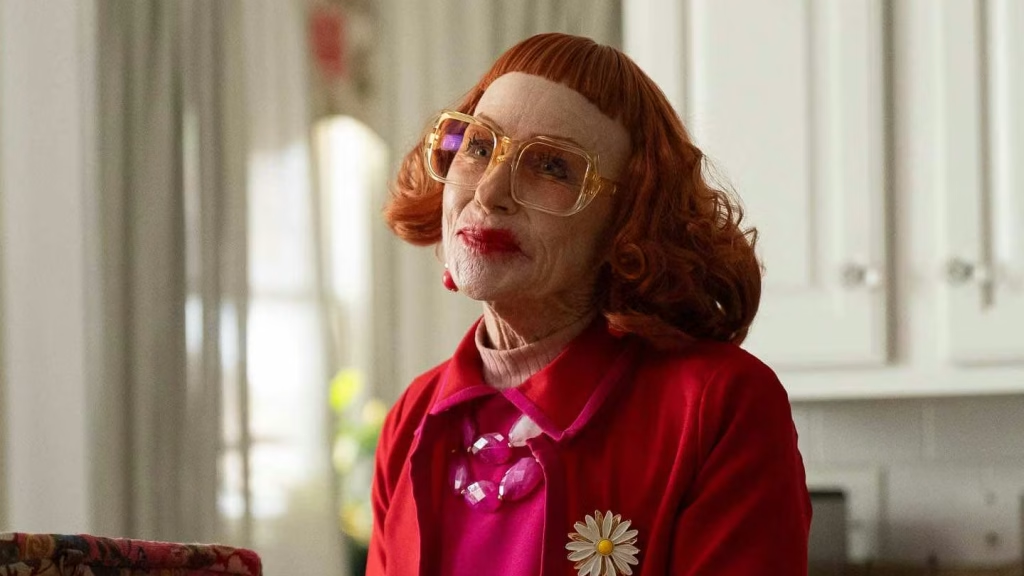
Then there is Aunt Gladys.
Amy Madigan plays her with this bright, rancid cheer that makes the whole movie tilt. She feels funny for about half a second, and then your body catches up. The hair, the makeup, the smile, the horrible little social performance of her. She looks like someone’s idea of a harmless old eccentric after the idea has curdled in a basement.
Gladys works because she enters a town already primed to misread itself.
That is the part I keep coming back to. She is terrifying, but she also benefits from Maybrook’s existing chaos. The parents are already suspicious. The school is already defensive. The community is already addicted to the wrong questions. Gladys does not have to create every crack. She only has to press on them.
In that sense, she feels like the nightmare’s punchline. The town spends so much energy looking for a human-sized explanation that it misses the stranger shape of the truth.
Gladys brings in something much uglier. She makes the town’s obsession with blame look pathetic, because the real danger has been moving through the gaps their panic created.
No wonder the Aunt Gladys prequel sounds so tempting. She feels less like a single villain and more like a door into a whole other rotten logic.
The Movie Feels Like A Rumor You Cannot Stop Hearing
Weapons lingers because it has the shape of a rumor.
Not a neat ghost story. Not a clean procedural. A rumor.
Something happened. Someone saw something and heard something. Someone knows a detail but not the context and lies because they are scared. Somebody tells the truth in a way that sounds insane. Somebody becomes guilty because enough people need them to be.
That is how the movie gets under the skin. It understands that communities can become haunted by interpretation.
The children running into the night give Weapons its unforgettable image. The shifting perspectives give it its pulse. Maybrook gives it its sickness.
By the end, the town feels like it has been telling the story to itself the whole time, badly and loudly and with trembling hands. Every character adds a piece. Every piece changes the shape. Nobody gets the comfort of a complete view until the damage has already spread.
That is the real nightmare.
Not just that the children disappear.
That the whole town starts dreaming the same terrible dream, and every person wakes up convinced their version is the truth.

Rachel Sikkema is a New Zealand-based writer and creative entrepreneur who explores the intersection of film, culture, and modern relationships. Through her articles, she examines how stories shape the way we connect, love and see ourselves – all for God’s glory. When she’s not writing about film and television, she’s watching Dexter and The White Lotus for the third time.