Stranger Things has always loved a monster. There is the Demogorgon, the Mind Flayer, an entire ecosystem of teeth, vines, and unsettling slime. Season 4 ups the ante by giving us something more intimate and much more unnerving: Vecna, played with eerie precision by Jamie Campbell Bower.
He is not a distant creature lurking in the dark. He knows you, listens, and waits until you are already alone in your own head, then he moves in. That is what makes him work so well, both as a horror villain and as a mirror for the show’s obsession with grief, shame, and growing up.
From Henry Creel to Vecna: A Monster With a Logic
Season 4 finally lays out Henry Creel’s journey from troubled boy to Subject 001 to the twisted ruler of the Upside Down. We learn that Henry was different long before Hawkins Lab. At the lab he becomes One, the template for the entire experiment that gives Eleven her own powers. Instead of being “cured,” his worldview hardens.
When Eleven (Milly Bobby Brown) rejects his offer and sends him hurtling into the Upside Down, the experience scars and reshapes him into Vecna. The point is that Vecna is not random chaos. He is the natural end point of Henry’s old philosophy, supercharged by the environment of the Upside Down and years of festering resentment.
Because we understand Henry first, Vecna never feels like a new boss dropped in from nowhere. He feels like a distorted continuation of everything the show has been hinting at since season 1.
Why He Targets Guilt Instead of Simple Fear

Look at Vecna’s victims in Hawkins. Chrissy (Grace Van Dien) is drowning in body shame and family pressure. Fred is haunted by a deadly car accident. Patrick wrestles with secrets and anger. Max Mayfield (Sadie Sink) carries the complicated grief of Billy’s death and the unspoken belief that some part of her is glad he is gone. These are not generic nightmares. They are very specific stories about kids who cannot forgive themselves.
Vecna’s curse is basically weaponized guilt. He does not stalk random townsfolk. He selects people whose inner voices are already cruel, then amplifies those voices until they break. The ticking clock, the visions, the way he appears in places tied to painful memories all work like a supernatural panic attack. Screen-focused analysis has pointed out how often the show frames him as a manifestation of trauma and mental distress, and that tracks with what we see on screen.
The genius of this setup is that it makes Vecna feel familiar. Most viewers will not face a psychic spider man from another dimension, but many know the feeling of replaying something awful late at night and thinking, “This is my fault.” Vecna’s powers make that inner loop visible and literal, which is why his scenes land with such weight.
Max and the “Inside Job” Horror
Sadie Sink’s performance as Max is the emotional center of this design. When Vecna marks her, the horror does not start with upside down vines or a floating body. It starts with her zoning out on the bleachers, avoiding Lucas, disconnecting from her friends, and living in a world where grief has turned everything gray.
The famous “Running Up That Hill” sequence works because of that setup. The visual of Max sprinting through red mist toward memories of her friends would not hit as hard if we had not already watched her refuse their help for several episodes. The idea that music can disrupt Vecna’s hold and reconnect someone to life feels less like a gimmick and more like an illustration of how small anchors – favorite songs, shared memories, stupid inside jokes – can cut through depressive fog for a moment.
A Villain Who Behaves Like an Abuser
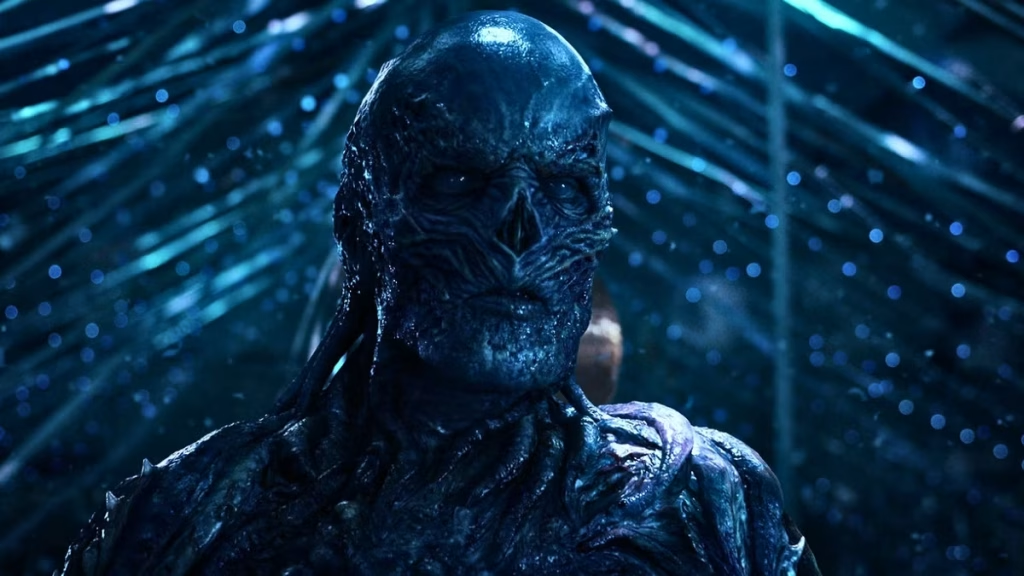
There is another layer to Vecna’s psychology that makes him so uncomfortable. He behaves less like a classic movie monster and more like an abuser or cult leader. He also reframes destruction as mercy. When he tells Chrissy or Max that it is time for their suffering to end, he is not lying in his own mind.
From Henry’s perspective, human feelings and messy moral compromise are weaknesses. Ending a life that is “corrupted” by grief or guilt feels like clearing the board. That belief is chilling because it is coherent. He is horrifying, but he makes sense on his own terms.
The Horror Influences That Shape Him
The Duffers have talked openly about how Vecna was inspired by classic horror icons like Freddy Krueger and Pinhead, villains who were not just creatures but talkative, psychologically invasive forces.
You can see that in season 4’s structure. Vecna functions a bit like Freddy, attacking in liminal spaces where reality blurs, using clocks, hallways, and childhood rooms as staging grounds. At the same time, he has a quasi religious zeal that feels closer to Pinhead, with his monologues about humanity’s sickness and his mission to bring a new kind of order.
The twist, of course, is that Stranger Things folds those influences back into its ongoing story. Vecna is not just a genre nod. By tying him to Henry Creel and the lab, the show turns him into a sort of living thesis about what happens when a child with radical beliefs is pushed through a system that only deepens his alienation.
So why does Vecna stick in your head after the season is over? Part of it is the visuals and the performance. Jamie Campbell Bower’s voice alone could peel paint. The other part is that Stranger Things uses him to literalize something a lot of people already know too well: the feeling that your own mind is out to get you.

Rachel Sikkema is a New Zealand-based writer and creative entrepreneur who explores the intersection of film, culture, and modern relationships. Through her articles, she examines how stories shape the way we connect, love and see ourselves – all for God’s glory. When she’s not writing about film and television, she’s watching Dexter and The White Lotus for the third time.