One of the sneakiest tricks Smile 2 pulls is that it lets you think you’re watching a fairly straightforward curse sequel, then gradually nudges you into a bigger, messier question. What even is this thing? Is it a creature operating by a set of biological rules? A straight-up demon with a flair for theatrical cruelty? Or is it the external shape of guilt and trauma, a horror metaphor that has learned how to wear human skin?
Parker Finn doesn’t hand us a clean label. He gives us behavior, consequences, and a protagonist whose life is already cracking at the seams. The result is a monster that can be read in multiple ways without feeling like a cop-out. It feels like a deliberate provocation, especially because Smile 2 puts the curse inside a pop-star machine where image, shame, and performance are already their own kind of haunting.
What the Sequel Tells Us About the Rules
Smile 2 opens in the direct aftermath of the first film’s tragedy, with Joel (Kyle Gallner) trying to offload the curse. The transfer goes sideways, and the infection jumps to Lewis (Lukas Gage), who becomes the doomed doorway into Skye Riley’s nightmare.
Skye, played by Naomi Scott with a rawness that sells every inch of the descent, is a superstar preparing for a comeback tour after public addiction struggles and the car crash that killed her boyfriend, Paul Hudson (Ray Nicholson). Her mother and manager Elizabeth (Rosemarie DeWitt) and assistant Joshua (Miles Gutierrez-Riley) try to keep the comeback on track, but the entity’s pattern is ruthless. Hallucinations escalate, relationships collapse, and Skye’s reality becomes a manipulated maze.
The Parasite Theory Is Not Just Fan Logic
The film practically invites the “parasite” label through Morris (Peter Jacobson), an ER nurse who has tracked the entity’s pattern after it destroyed his brother. He treats the curse like something with survival needs. His theory hinges on the idea that the entity requires a living host and might be killed if that host briefly dies and is revived. The plan is grim, but it’s presented as clinical, desperate logic, not occult lore.
That framing shifts how you interpret the entity’s behavior. It “feeds” on trauma like a parasite feeds on weakness, it doesn’t just haunt for fun. It cultivates conditions that keep the host unstable, terrified, and socially stranded. Then it moves on, almost like a virus that needs the next body to stay alive.
The Demon Reading Fits the Imagery and the Cruelty

Still, Smile 2 isn’t shy about going full supernatural. The entity’s presence is not subtle symbolism only. It becomes embodied, physical, and grotesque in the finale, revealing a monstrous form that pushes the story into classic demonic possession territory.
The way it toys with Skye also feels less like biology and more like sadism. The entity mocks hope. It disguises itself as safety. It creates a fake path to freedom and then yanks the floor away when the emotional stakes are at their highest. The stage setting at the fictional Herald Square Garden turns the final act into a ritual of public ruin. This is an evil that wants spectacle, not just survival.
In other words, if a parasite reading explains the method, a demon reading explains the personality.
The Guilt Reading Is the Emotional Engine
Here’s the part that makes Smile 2 feel meaner and more intimate than many sequels. Skye isn’t just a random new victim. Her backstory is built on shame, addiction history, and the kind of grief that gets flattened into headlines. The entity doesn’t need to fabricate a “worst fear” from scratch. Skye already lives with a version of it.
The movie keeps returning to the clash between her polished persona and her private self. The smiling motif lands differently in a celebrity story because her job has always included performing okay-ness. The horror isn’t only that people smile before they die. It’s that Skye is expected to smile while her life unravels.
The Best Answer Might Be “All Three”
The smartest way to read the Smile Entity after Smile 2 is that Finn has designed it to operate on multiple registers at once. In-world, it behaves like a predatory force with rules, a host-to-host contagion that punishes proximity and witness. That supports the parasite angle.
Aesthetically and narratively, it functions like a demon. It is an ancient-feeling evil with a taste for psychological torture and grand finales.
And emotionally, it is absolutely a manifestation of guilt, addiction, and unresolved trauma. That’s why the story hits hardest when you stop thinking about what the entity “is” and start thinking about what it “does” to someone like Skye.
Finn has also suggested a preference for keeping the entity’s nature mysterious, and the sequel’s ending leans into that meta discomfort about audiences watching a woman’s destruction as entertainment. That self-awareness makes the ambiguity feel intentional rather than unfinished.
Why This Question Keeps the Franchise Alive
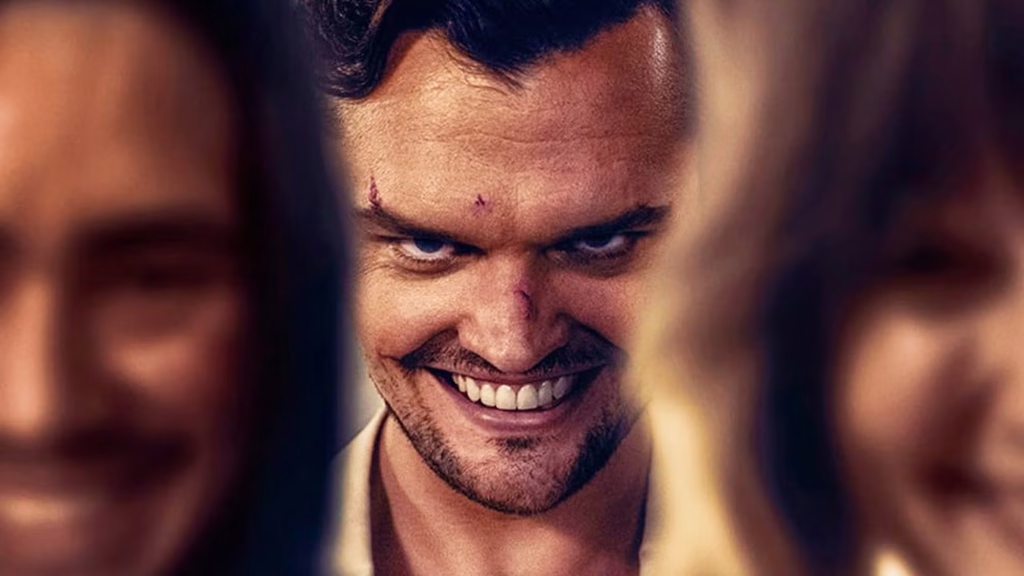
Horror franchises often stall when they over-explain their monsters. The Smile films are doing the opposite. They’re letting the entity remain a shape-shifter in meaning, even as the mechanics stay consistent. Smile 2 expands the sandbox by dropping the curse into a high-visibility world where public image is already a kind of nightmare.
That’s why the parasite-demon-guilt triangle matters. Each interpretation highlights a different fear. The parasite angle is about helplessness and contagion. The demon angle is about cosmic cruelty. The guilt angle is about the most unbearable possibility of all, that the monster lives inside you and only needed a mask to come out.
Smile 2 doesn’t force you to pick one. It dares you to hold all three in your head at once, like a grin you can’t quite tell is human or not. And that unresolved tension is exactly what makes the entity so hard to shake long after the credits roll.

Rachel Sikkema is a New Zealand-based writer and creative entrepreneur who explores the intersection of film, culture, and modern relationships. Through her articles, she examines how stories shape the way we connect, love and see ourselves – all for God’s glory. When she’s not writing about film and television, she’s watching Dexter and The White Lotus for the third time.