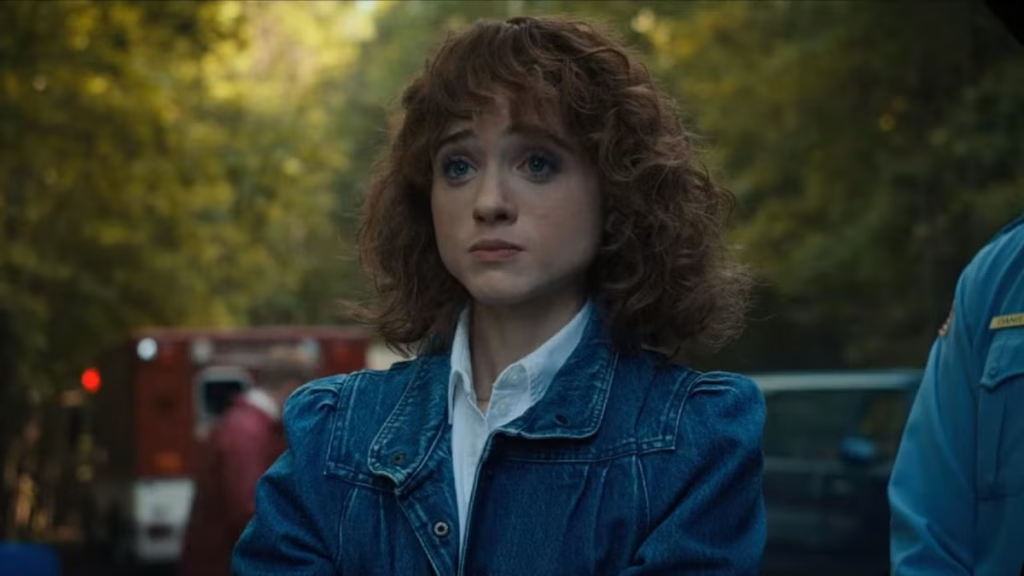
It is easy to watch Stranger Things season 4 and focus on Max and Vecna (Jamie Campbell Bower), or on Hopper’s prison epic, or on Eddie’s guitar solo. But quietly holding the Hawkins side of the story together is Nancy Wheeler, played by Natalia Dyer, who walks around season 4 behaving as if moral facts are real, knowable, and binding.
She is not just brave or clever. She is someone who acts like there is a right thing to do even when nobody else wants to hear it, and that is exactly what makes her feel like a moral realist in a town that prefers comforting stories to hard truths.
What Moral Realism Even Looks Like in Hawkins
You do not need a philosophy degree to get what moral realism means. It is the idea that right and wrong exist whether you feel like accepting them or not. That is basically Nancy’s whole deal.
From the beginning, the show frames her as an aspiring journalist, the kind of person who believes that facts matter and that exposing them has value in itself. By season 3 she has been through a sexist newsroom and come out more determined to prove that the truth about Hawkins deserves daylight. Season 4 picks that thread back up and throws her straight into the town’s latest moral panic.
Investigating Vecna as a Belief in Facts
Season 4 opens with a dead cheerleader, a town on edge, and the kind of rumor mill that can swallow a scapegoat whole. Nancy refuses to treat Chrissy’s death as just another gruesome headline. She goes looking for leads, tracks the pattern of the strange killings, and pushes past the easy story about Eddie Munson (Joseph Quinn) being a satanic cult leader.
Barb, Guilt, and the Weight of Consequences

Nancy’s moral seriousness in season 4 still grows out of Barb. The show never lets her fully off the hook for her friend’s death back in season 1. Her grief has softened from raw guilt into a more settled belief that she owes something to the dead. Vecna knows this. When he drags her into his mind, he takes her back to Barb’s rotting body at the bottom of a pool and uses that guilt as a doorway.
The Pennhurst sequence is one of the most fun stretches of the season, but it also says a lot about how Nancy sees right and wrong. She and Robin show up in pastel outfits, pretending to be psychology students so they can interview Victor Creel about the killings.
Leadership, Strategy, and Non Negotiable Duties
By the time the season heads into its multi front finale, Nancy has stopped hovering at the edge of the action. She is designing the plan. Fans have pointed out that she essentially leads the whole Hawkins crew against Vecna, shotgun and all, which is a lot for a teenager who once drifted through parties and exams.
It is Nancy who takes Vecna’s vision and turns it into strategy. She walks through the Creel House, maps out positions, studies the geography of the Upside Down, and figures out how to turn an ordinary house into a makeshift fortress.
Nancy, Jason, and Competing Moral Stories
Season 4 is full of characters trying to impose their own moral frameworks on events. Jason sees the Hellfire Club as a satanic death cult and gives the town permission to hunt people. Nancy is one of the few who refuses that hysteria. Her version of the story is simple. Kids are dying, the pattern is supernatural, and blaming Eddie is both wrong and lazy.
Love Triangles and the Smaller, Awkward Choices
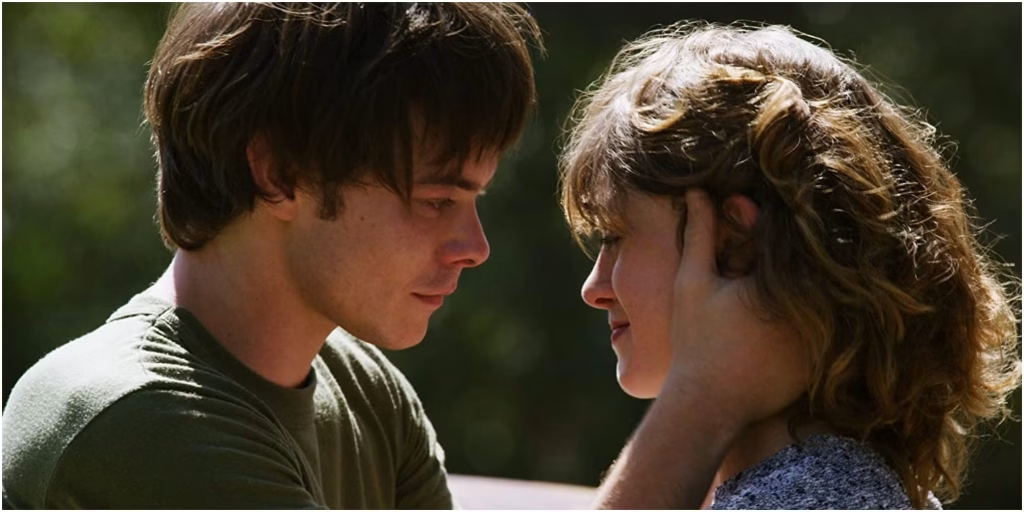
Nancy’s ethics are not limited to life or death quests. The season keeps nudging at her romantic life with Jonathan and Steve, and while the triangle draws plenty of fandom noise, there is something quietly moral about how she tries to handle it.
She clearly still cares about Jonathan. She clearly still has unresolved chemistry with Steve. The easy route would be to drift into an emotional affair and shrug it off as apocalypse logic. Instead, she keeps trying to talk herself into clarity. She asks hard questions about shared futures, about who actually shows up when Hawkins is in danger, about what kind of partner she wants to be. Even when she fails, you can see her belief that relationships have real stakes, that loyalty and honesty are not just costume jewelry you take off when monsters show up.
Why Nancy’s Realism Matters to the Bigger Story
Season 4 pushes the supernatural mythology into new territory, yet it keeps returning to how ordinary people choose to respond. Vecna is essentially a walking argument that morality is a lie and suffering is destiny. Nancy is one of the characters who refuses that worldview on every level.
She insists that Barb’s death matters and that Chrissy and Fred deserve better than rumor. She insists that Hawkins can and should fight back instead of folding into apathy or denial. The show could have kept her as a love interest who holds the flashlight while other people talk. Instead, it turns her into the person who draws the map, loads the gun, and argues that some lines cannot be crossed even when your town is literally cracking apart.
Nancy Wheeler may never get the flashy powers or the poster art that Eleven (Milly Bobby Brown) does, but in season 4 she becomes something just as important. She is the character who behaves as if moral reality is solid, even in a story where walls bleed and clocks float in the air. That quiet conviction helps anchor the whole season, and it will matter even more when Hawkins faces whatever comes next.

Rachel Sikkema is a New Zealand-based writer and creative entrepreneur who explores the intersection of film, culture, and modern relationships. Through her articles, she examines how stories shape the way we connect, love and see ourselves – all for God’s glory. When she’s not writing about film and television, she’s watching Dexter and The White Lotus for the third time.