
One of the sneakiest pleasures of Better Call Saul is how it runs on two kinds of energy at once. On the surface, it’s a character drama about Jimmy McGill (Bob Odenkirk) becoming Saul Goodman, with Kim Wexler (Rhea Seehorn) as both co-pilot and conscience. Underneath, it’s also a workplace story about people who treat crime like a job, complete with project timelines, personnel issues, and the occasional catastrophic “miscommunication” that ends in a shallow grave.
That’s where Mike Ehrmantraut (Jonathan Banks) and Gus Fring (Giancarlo Esposito) come in. They don’t float above the madness. They manage it. In a world where ego keeps grabbing the wheel, they’re the guys quietly checking the tires, topping up the oil, and moving the body before anyone notices the smell.
The Show Treats Ego Like a Contagious Illness
Better Call Saul is stuffed with characters who mistake pride for principle. Chuck McGill (Michael McKean) can’t tolerate being wrong, even when being right costs him everything. The Salamanca side of the cartel, from Hector (Mark Margolis) to Lalo (Tony Dalton), treats disrespect as a capital offense because their self-image is the real product they’re protecting.
Even Jimmy’s greatest talent, his ability to talk his way out of a locked room, often comes down to ego dressed as charisma. He wants to win the room, win the argument, win the moment. He rarely asks whether the win is worth the mess it leaves behind.
Mike’s Pragmatism Comes From Grief, Not Ambition
Mike’s vibe is “competent guy who would like everyone to stop making things harder than they need to be.” That sounds simple until the show shows you the machinery underneath. Mike is a former Philadelphia cop who ends up in Albuquerque as a courthouse parking attendant, and the series makes his backstory feel less like trivia and more like a bruise you keep pressing to see if it still hurts.
In “Five-O,” the pragmatism isn’t cool-guy minimalism. It’s survival. Mike’s son, Matt, is dead, and Mike carries the kind of guilt that turns your personality into a set of rules. He becomes a man who believes in procedures because emotions have failed him.
Gus Runs on Discipline, but It’s Not the Same as Purity

Gus is the franchise’s master of the calm face. He’s a legitimate businessman on paper, a drug kingpin in practice, and a control freak by temperament. He doesn’t raise his voice because he doesn’t need to. The threat is baked into the calm.
What makes Gus fascinating in Better Call Saul is that the show refuses to treat his discipline like sainthood. He’s pragmatic, yes, but his pragmatism serves something darker than “good business.” He’s building a long game. He wants independence from the cartel, control over production, and leverage that can’t be taken away with a single phone call from Don Eladio.
Their Partnership Is Built on Process, Not Trust
Mike and Gus don’t bond over feelings. They bond over competence. Gus sees that Mike can assess a situation without theatrics. Mike sees that Gus plans like a chess player, not a brawler. In a universe full of loud men trying to prove something, that’s practically romance.
A lot of their relationship plays like a corporate thriller. Gus assigns. Mike executes. They debrief. They adjust. And then someone with a reckless streak blows up the schedule.
The superlab storyline is the clearest example. Gus hires specialists, including the engineer Werner Ziegler (Rainer Bock), to build an underground lab with secrecy as the main ingredient. When Werner breaks protocol, it isn’t framed as a naughty mistake. It’s framed as an existential threat to the entire operation, because ego doesn’t respect boundaries and boundaries are the whole point.
Ego Is Louder Than Violence in This Universe
It’s tempting to define the franchise by brutality, but the real engine is humiliation. People kill over wounded pride more often than they kill over money. Lalo’s charm has teeth because he’s always testing who thinks they can outsmart him. Hector’s rage is basically ego with a pulse. Jimmy and Kim’s games with Howard begin as a thrill and end as a tragedy because they can’t stop once it becomes a question of who’s smarter.
Mike and Gus recognize this pattern like seasoned workers who’ve seen the same disaster in different offices. Ego walks into a room and starts rearranging the furniture. Pragmatism walks in and asks where the exits are.
The Twist Is That Pragmatism Can Become Its Own Kind of Ego
Here’s the uncomfortable part: Mike and Gus aren’t immune to the thing they manage.
Mike’s code gives him structure, but it also lets him tell himself he’s different from the worst people around him. He draws lines, and sometimes those lines look suspiciously convenient. He’ll do terrible things, then soothe himself with the idea that he did them “the right way.” That’s a form of ego, too. It’s moral ego, which can be even harder to interrogate because it feels like responsibility.
Why This Matters to Jimmy’s Story
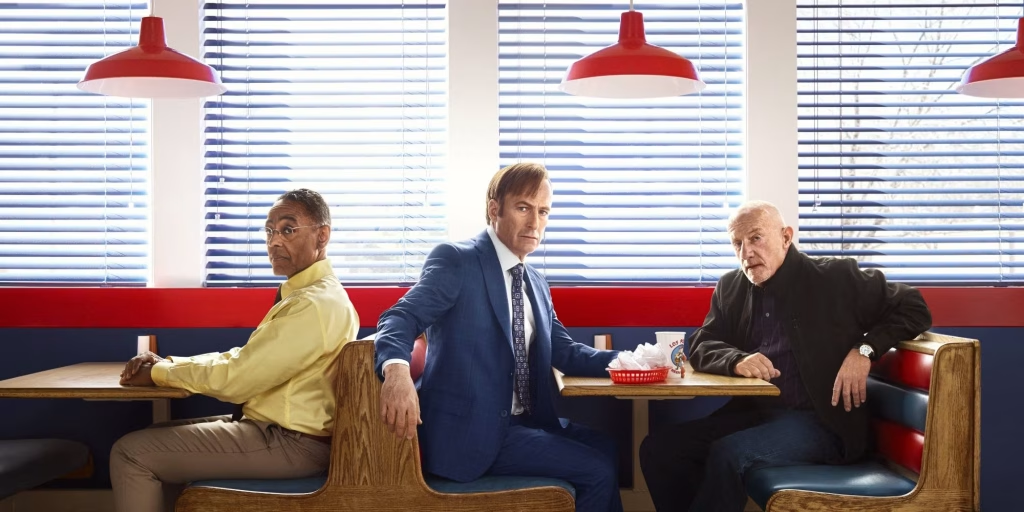
Mike and Gus don’t exist in Better Call Saul as side quests. They’re thematic pressure. They show what happens when you build your life around function instead of feeling. Jimmy is the opposite: he builds his life around feeling and uses function as an accessory when it’s useful.
Watching Mike and Gus operate gives the viewer a strange sensation. You don’t approve of them, but you understand the appeal. The world is chaotic. Ego is everywhere. Wouldn’t it be easier to be the person with the plan?
Mike and Gus survive longer than most people in this universe because they’re disciplined adults in a room full of swaggering children. But Better Call Saul never lets you forget the cost of that discipline. It keeps asking a quiet question that hangs over every efficient decision: what parts of you did you have to kill to become this practical?

Rachel Sikkema is a New Zealand-based writer and creative entrepreneur who explores the intersection of film, culture, and modern relationships. Through her articles, she examines how stories shape the way we connect, love and see ourselves – all for God’s glory. When she’s not writing about film and television, she’s watching Dexter and The White Lotus for the third time.