Ryan Coogler’s Sinners starts with a setup that feels almost deceptively simple. Twin brothers Smoke and Stack, both played by Michael B. Jordan, come back to Mississippi hoping to start over, only to find that the place they left still has its claws in them.
The film is set in 1932 in the Mississippi Delta, with Miles Caton’s Sammie Moore pulled into their orbit alongside Annie, Mary, Remmick, Delta Slim, and the rest of a community trying to carve out one good night for itself. That premise gives Sinners its horror engine, but the movie’s real obsession is older, heavier, and much harder to kill. It is about the way history keeps reappearing, whether people invite it in or not.
What makes that idea hit so hard is that Sinners never treats the past like background decoration. This is not one of those period movies where the costumes look great, the music sounds amazing, and history politely stays in the corner. Coogler builds the whole story around a world shaped by slavery’s aftermath, Jim Crow violence, poverty, migration, spiritual inheritance, and the birth of the blues. Even before the supernatural threat fully takes over, the film makes it clear that these characters are already living inside history’s pressure cooker.
The clearest example is the twins themselves. Smoke and Stack return thinking movement equals escape. They have been to Chicago, they have seen more of the world, and they have enough swagger to believe they can build something of their own. But Sinners is deeply suspicious of the fantasy that a person can outrun what made them. The brothers bring their past back with them in every sense: old loves, old grief, old violence, old survival instincts. The film keeps asking a brutal question. Can you begin again if the world that damaged you is still standing exactly where you left it? By the time the movie answers, it is not feeling optimistic.
The Movie Turns History Into a Living Threat
One of the smartest things Sinners does is refuse to separate its monsters from its history. The vampires are not random horror decoration dropped into a Southern period piece because somebody thought that sounded cool, though to be fair it does sound cool. They function as an extension of the movie’s real fears.
Reviewers and critics repeatedly read the film’s supernatural turn as an allegory for historical violence, exploitation, and the predatory forces surrounding Black art and Black life. Coogler’s film frames evil as something that finds the community from the outside, attaches itself to music, memory, desire, and pain, then tries to consume all of it.
That matters because it shifts the movie away from the usual “buried secret comes back” formula. In Sinners, the past is not buried badly. It was never buried in the first place. It is still active in the land, in the social order, in the way people speak to each other, in who gets to move safely through public space, and in the bargains characters think they have to make to survive. The supernatural horror only gives visible teeth to what was already there.
Music Becomes Memory You Can Hear

Sammie is central to this reading. He is not just the gifted younger relative with raw talent and big dreams. He is the film’s clearest symbol of what the past can do when it moves through art. The movie presents his music as something spiritually charged, capable of bringing people together while also summoning danger.
Coogler and several critics describe the film’s worldview as one where extraordinary music carries healing power for a community but also attracts destructive forces. That makes blues music in Sinners more than atmosphere. It becomes memory in audible form.
This is where the title becomes more interesting too. The “sins” in Sinners are not just personal moral failures. They are inherited wounds, social crimes, buried grief, and survival choices people make in compromised worlds. The film understands that communities carry history in their bodies and in their art.
So when Sammie plays, he is not expressing himself in a neat modern sense. He is opening a channel. He is pulling the dead, the living, and the not-yet-here into the same room. That is beautiful. It is also, in classic horror fashion, a terrible idea if anything hungry is listening.
The Film Knows Memory Can Comfort and Trap You
What gives Sinners its emotional pull is that it never acts as though the past is only destructive. The same history that haunts these characters also gives them identity, ritual, and connection. Annie, played by Wunmi Mosaku, carries spiritual knowledge that links survival to tradition.
Mary, played by Hailee Steinfeld, embodies another kind of dangerous historical tension through her racial passing and the risks attached to it. The Chows, Grace and Bo, remind the audience that the Delta’s history is not socially simple or racially tidy. Coogler keeps widening the frame so the town feels dense with overlapping memories rather than reduced to one symbolic conflict.
That is why the film lands as more than a stylish horror story about oppression. It is also about longing. People want the past to stay alive when it contains love, belonging, music, family, and some trace of who they really are. The problem is that memory never arrives as a carefully curated highlight reel. It brings the beauty and the damage together.
Smoke and Stack cannot reclaim home without also reopening every wound attached to home. Sammie cannot step into his gift without inheriting the weight that gift carries. The community cannot create one free, joyous space without drawing the attention of forces determined to feed on it.
The Real Horror Is That History Keeps Adapting
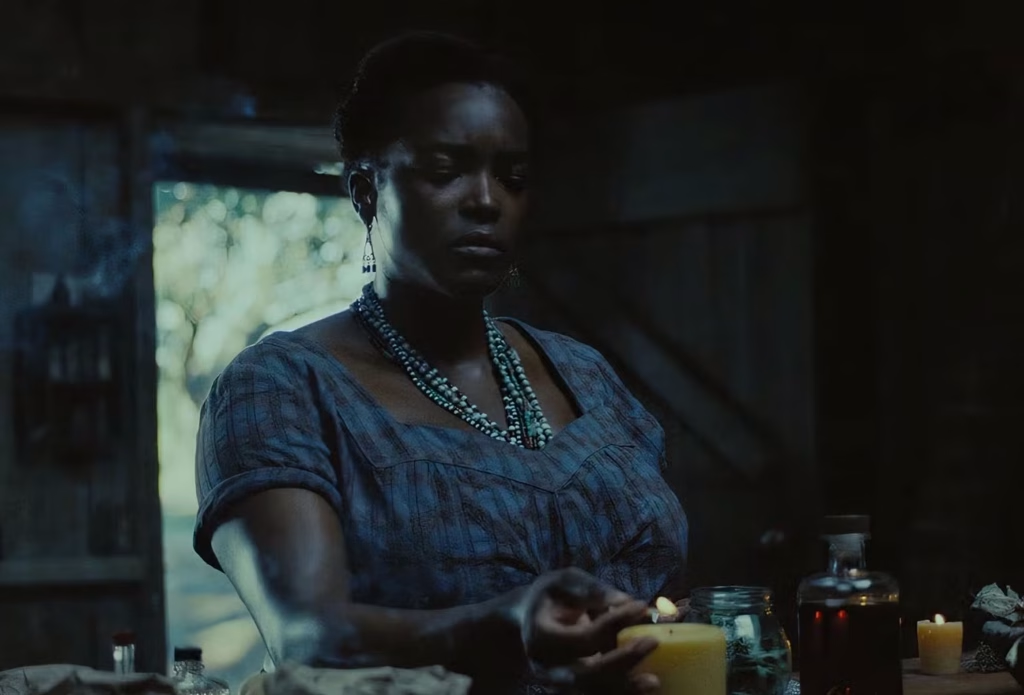
What Sinners ultimately understands, and why it sticks in the mind, is that the past is rarely content to remain in museum form. It changes shape and updates its methods. It finds new hosts. Sometimes it looks like explicit racial terror. Sometimes it looks smoother, friendlier, more seductive.
The film’s use of Remmick and the vampire mythology points directly at that idea. Exploitation in Sinners can arrive with violence, but it can also arrive smiling, flattering, offering access, promising togetherness, and asking only for your soul in return. That is a nasty little insight, and the movie knows exactly how nasty it is.
Sinners is saying the past never stays buried because it lives in structures, stories, music, bloodlines, desires, and unfinished grief. People carry it. Places carry it. Nations definitely carry it. Coogler wraps that truth in a genre film full of heat, dread, and music, but the idea underneath is painfully real. The dead are never just dead here. History is never just over. And Sinners knows that the scariest thing of all is how often the past shows up pretending to be the future.

Rachel Sikkema is a New Zealand-based writer and creative entrepreneur who explores the intersection of film, culture, and modern relationships. Through her articles, she examines how stories shape the way we connect, love and see ourselves – all for God’s glory. When she’s not writing about film and television, she’s watching Dexter and The White Lotus for the third time.