At first glance, Sinners looks like the kind of movie people will file under horror and move on. It has the sort of nightmarish tension that makes every doorway feel like bad news. But that label only gets you so far. Ryan Coogler sets the story in 1932 Mississippi. He builds it around twin brothers Smoke and Stack, both played by Michael B. Jordan, as they return home hoping to create something of their own. What follows has horror mechanics, sure, but the deeper engine is identity. Who gets to belong, who gets consumed, and who gets to define themselves before the world does it for them.
The horror in Sinners matters because it gives those questions teeth. This is a film about people trying to claim space, memory, music, and selfhood in a world built to deny all four. The monsters are real, but so is the pressure to split yourself apart just to survive. That is what makes the movie stick. It is not only scary. It is personal.
The Movie Starts With a Fight Over Who These People Are
Smoke and Stack come back to Mississippi carrying more than money and trouble. They return with history on them. They have been shaped by war, by Chicago, by crime, and by distance. Home is supposed to be familiar, yet it no longer fits cleanly. That tension gives the film its emotional weight long before the supernatural side fully takes over.
Michael B. Jordan playing both brothers is not just a casting flex. The dual role turns identity into something visual. Smoke and Stack share a face, but they do not move through the world in the same way. One feels heavier, more rooted in grief and responsibility. The other feels slicker, more adaptive. More willing to slide between versions of himself if it helps him survive. They are brothers. However, they also feel like two competing responses to the same wound.
That matters because Sinners keeps asking what a person has to become in order to live under pressure. Do you harden and perform? Do you disappear into the role people expect from you? The film keeps circling those questions through character rather than speechifying, which is one reason it lands.
Sammie Carries the Movie’s Real Argument
If Smoke and Stack give the film its fractured mirror, Sammie gives it a soul. Miles Caton plays him as a young musician whose gift feels bigger than simple talent. Sammie is pulled between faith, family expectation, desire, and artistic calling. In a lesser film, that would be a side plot. Here, it is the point.
Sammie’s music is not treated as decoration. It is memory, inheritance, and self-recognition. The movie presents music as something that can summon the past, connect communities, and open doors that probably ought to stay closed. That is where the identity theme becomes impossible to miss. Sammie is not simply choosing whether to sing. He is choosing whether to become himself in full view of a world that fears what that might mean.
That is a far richer conflict than “will the vampires get him?” Even when the danger escalates, the bigger issue remains the same. Who owns his voice? His father wants one answer. The world of the juke joint offers another. The supernatural threat offers a third, and it is the creepiest one of all because it dresses theft up as acceptance.
The Vampires Are Really About Assimilation and Appetite
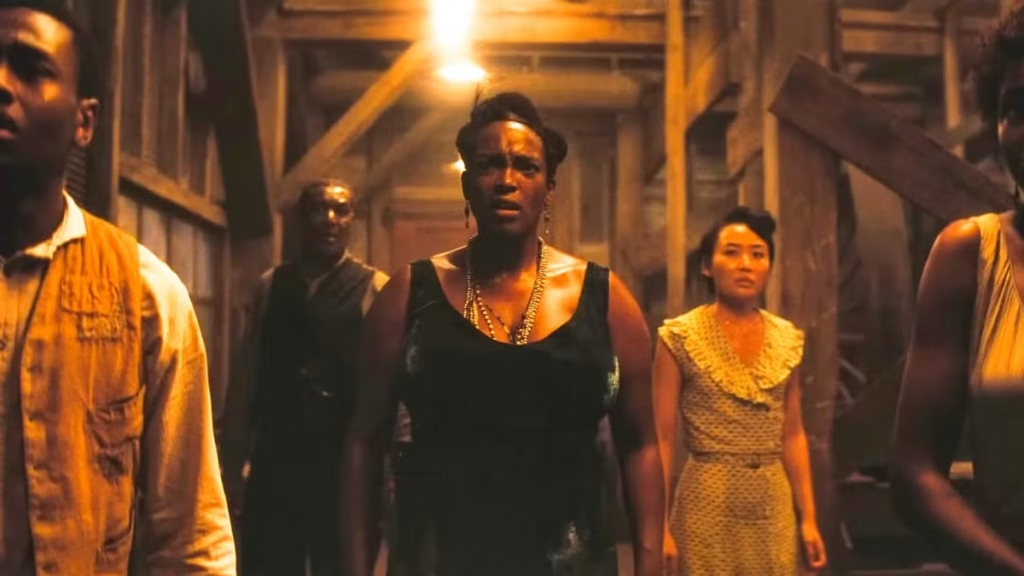
One of the smartest things Sinners does is make vampirism feel less like random genre business and more like a twisted promise. Remmick, played by Jack O’Connell, is not frightening only because he is violent. He is frightening because he offers a version of belonging that comes at the cost of selfhood.
That is why the movie’s identity angle matters more than the gore. Remmick does not simply attack bodies. He absorbs people into a collective. The pitch is seductive: no loneliness, no separation, no exclusion. But the price is that your distinct self gets flattened into something else. It is community with a trap door under it.
That idea connects beautifully to the film’s larger setting. In Jim Crow Mississippi, identity is already policed from the outside. Race, class, respectability, religion, and survival are all tangled together. So when the vampire mythology enters the picture, it does not feel imported from a different movie. It feels like an extension of the same pressure. How much of yourself can you keep when every system around you wants access to it?
The Film Cares Deeply About Passing and Performance
Hailee Steinfeld’s Mary becomes especially important here. Her presence sharpens the movie’s interest in how identity can be read, misread, hidden, or strategically performed. Sinners is fascinated by the unstable line between who someone is and how they are seen. That is one of the reasons the film feels so alive even in its quieter scenes. Everyone is managing perception all the time.
And that is also why the horror hits harder than it would in a more straightforward vampire story. A bite is not only a bite. An invitation is not only an invitation. The film keeps turning social realities into supernatural rules. Who can enter and who must be welcomed? It is a very old horror trick, but Coogler uses it for something more specific and more painful.
Even the juke joint itself becomes part of this argument. It is not merely a setting for chaos later on. It is a handmade space where Black identity, joy, labor, style, desire, and music can exist on their own terms for a few precious hours. No wonder the movie treats it like something sacred. No wonder the forces outside it want in.
The Scariest Thing in Sinners Is Erasure

For all its blood and spectacle, Sinners keeps returning to the fear of being erased. Annie, played by Wunmi Mosaku, understands this in spiritual terms. Smoke understands it through grief. Sammie understands it through music. Stack understands it through performance and reinvention. They are all wrestling with versions of the same problem. How do you remain yourself when history keeps trying to rewrite you?
That is why the movie’s wild genre blend works better than it probably should. Crime drama, Southern Gothic, musical, supernatural horror, historical reckoning. On paper, that sounds like a film that should collapse under its own ambition. Instead, it feels unified because everything points back to identity. The horror is not a distraction from that theme. It is the delivery system.
So yes, Sinners is a horror movie. It has fangs, blood, and more than one moment that earns a full-body wince. But the reason people keep talking about it is not just because it scares them. It is because underneath all that dread is a story about selfhood and inheritance. That is the part that lingers after the credits. Frankly, it is the part with the deepest bite.

Rachel Sikkema is a New Zealand-based writer and creative entrepreneur who explores the intersection of film, culture, and modern relationships. Through her articles, she examines how stories shape the way we connect, love and see ourselves – all for God’s glory. When she’s not writing about film and television, she’s watching Dexter and The White Lotus for the third time.