By Rachel Sikkema
Published November 19, 2026

Moira’s apparent death hits so hard because Slow Horses takes someone we associate with office irritation and puts her at the mercy of people who treat murder as another job. Joanna Scanlan makes Moira feel wonderfully familiar. We know her fussiness, her professional pride and her determination to put Slough House behind her. Watching that familiar person become a target feels horribly unfair.
One correction matters before going further. Moira survives. Episode 3 confirms that Catherine Standish, Shirley Dander and Louisa Guy reach her in time after the attack at her home. Episode 2 leaves us with an apparent death, and the emotional force of that moment deserves discussing on those terms.
Spoilers for Season 6 Episodes 2 and 3 follow.
The shock comes from how quickly Moira’s ordinary world becomes dangerous. Someone arrives at her door with a plausible explanation. She lets them inside. Suddenly, the woman whose greatest ambition seemed to involve getting away from Lamb’s dreadful workplace is caught in the same violence as everyone else.
And you realise how much you wanted her to carry on being mildly unbearable.
Moira Had Earned the Right to Annoy Everyone for Years
There’s a particular affection that grows around a supporting character like Moira. She turns up, changes the temperature of a conversation and leaves everyone slightly more irritated than she found them. That becomes part of the pleasure of watching.
Scanlan understands the comedy of someone who considers herself entirely reasonable. Moira’s confidence in her own standards gives her exchanges their bite. She can make a routine professional interaction feel like an inspection you have already failed.
Put that personality anywhere near Jackson Lamb and the friction practically writes itself.
Gary Oldman’s Lamb inhabits his own squalor with a commitment that borders on artistic. Moira carries the conviction that things ought to be done properly. You can enjoy her disapproval while also recognising that she has a point. Working around Lamb would be appalling. Most of us would last until lunchtime.
That familiarity creates a quiet expectation. Moira will keep returning. There will be another awkward conversation, another piece of bureaucratic manoeuvring, another opportunity for Scanlan to make a small grievance sound urgent.
The attack cuts straight through that expectation. For a moment, all those future scenes seem to disappear.
The Front Door Makes the Danger Feel Personal
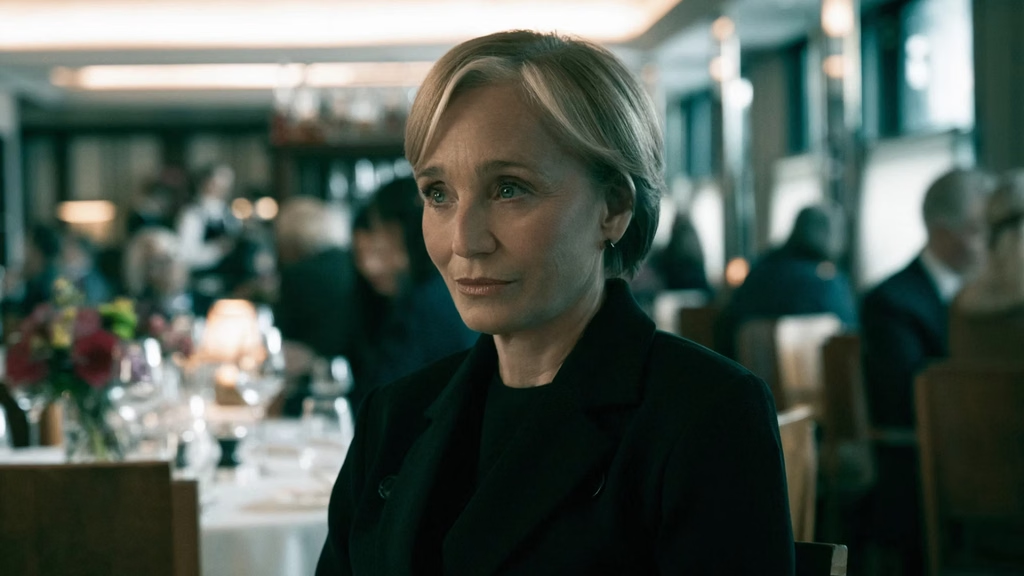
Jim and Jane gain access to Moira’s home by posing as gas workers. They incapacitate her and arrange the scene to resemble an accident. The disguise matters because it uses a recognisable domestic concern to get them close. Moira answers her door and makes a decision plenty of people would make.
That is an unpleasant little thought to sit with.
We expect River Cartwright to find trouble. Jack Lowden has spent years playing a man whose determination regularly outruns his judgement. When River heads towards danger, there’s often a moment when you want to reach through the screen and suggest that he wait for someone.
Moira is at home.
The setting strips away the reassuring distance of a spy thriller. There’s a doorstep and a convincing explanation. The threat arrives through the sort of interruption that could happen during an otherwise forgettable afternoon.
Her intelligence background offers little comfort in that situation. Knowing that dangerous people exist leaves you with the same practical problem as everyone else. Eventually, you have to decide whether to open the door.
The scene makes that tiny act of trust feel frighteningly expensive.
Her Escape From Slough House Was Supposed to Mean Something
Moira’s desire to distance herself from Slough House is part of her comic appeal. She considers the place a professional embarrassment. Getting back to the Park gives her something to cling to, a sense that an unpleasant chapter can be closed.
The attack makes that ambition look painfully fragile.
From her perspective, the distinction between her current position and her time with Lamb matters enormously. She has a career to think about. She has an idea of where she belongs.
To the people targeting former Slow Horses, her past connection is sufficient.
There’s a nasty emotional imbalance there. Moira has invested so much importance in escaping a workplace that other people can still use to define her. Her own understanding of her life carries very little weight once somebody else decides she belongs on a list.
That feels especially cruel for a character whose personality depends on maintaining a degree of control. She can insist on procedure. She can be particular about how things should work. The attack leaves her with almost no room to exercise any of it.
All that professional self-possession suddenly looks very human.
Joanna Scanlan Makes the Affection Sneak up on You
Moira benefits from the kind of performance that can be easy to take for granted while you’re enjoying it.
Scanlan gives her enough conviction to exist beyond whatever joke a scene needs. You can imagine Moira having strongly held opinions about a meeting that happened six months ago. You can imagine the version of events she would tell a friend afterwards. Naturally, she would have behaved impeccably.
That imagined life matters when she’s threatened.
A recurring character becomes precious through accumulated contact. We learn their habits. We anticipate their response. Sometimes we start smiling before they have said anything because we know exactly how badly they’ll take the situation.
Moira has that quality.
Her vulnerability brings the affection into focus. The irritation was part of what made her enjoyable company. Take away the possibility of hearing it again and the programme suddenly feels poorer.
I think that is the sharpest part of the scene. You discover your attachment at almost the same instant the show appears ready to take her away.
Surviving Leaves the Scare With Something Useful to Do

Moira’s survival changes how the sequence plays in retrospect. There’s relief, obviously. Scanlan gets to remain part of this wonderfully difficult collection of people.
It also gives Moira’s connection to Slough House a different emotional weight.
Catherine, Shirley and Louisa coming to her aid makes that connection practical. The people associated with a chapter she wanted to escape are the people who reach her when she needs help. Their intervention gives the workplace bond substance.
For Moira, accepting that bond is an awkward prospect. Her pride has spent considerable time arguing in the other direction. That awkwardness is precisely what makes it interesting.
The apparent death hurts because we’ve become attached to the person underneath the professional fuss. Her rescue lets that person continue, carrying an experience that her usual certainty will struggle to accommodate.
Mostly, though, there’s the simple relief of getting Moira back. Let her be particular. Let her object to something trivial. After seeing her left helpless in her own home, another thoroughly unnecessary complaint sounds lovely.

Rachel Sikkema is a New Zealand-based writer and creative entrepreneur who explores the intersection of film, culture, and modern relationships. Through her articles, she examines how stories shape the way we connect, love and see ourselves – all for God’s glory. When she’s not writing about film and television, she’s watching Dexter and The White Lotus for the third time.