By Rachel Sikkema
Published October 22, 2026

The whale in Whalefall is terrifying because Jay Gardiner’s life matters desperately to Jay and means nothing to the animal that swallows him. His fear changes nothing about its needs. His grief earns him no special consideration. Somewhere inside this enormous living creature is a young man with dwindling oxygen, and the creature carries on being a whale.
That is a horrible arrangement. It is also the most interesting thing about the film’s premise.
Jay, played by Austin Abrams, enters the water searching for his late father’s remains. Being swallowed by a sperm whale turns that deeply personal mission into a survival emergency. Everything he brings into the ocean, including the emotional weight of his relationship with his father, becomes irrelevant to the animal now containing him.
A monster with a grudge would at least acknowledge his existence. Whalefall finds something nastier in the possibility that its central creature could destroy a person without ever understanding what it has done.
Hatred Would Give Jay Something to Work With
Movie villains make fear feel personal. They choose targets. They enjoy reactions. Even a creature that stalks its prey gives the audience a relationship to follow, however unpleasant that relationship might be.
We start looking for patterns. What attracts its attention? When does it attack? How can someone exploit its behaviour?
There is a peculiar comfort in that process. An enemy becomes a problem with intentions, and intentions suggest possible mistakes. Vanity might create an opening. Anger might make it careless. A sadistic villain might spend so long enjoying the moment that someone finally finds the car keys.
Good luck waiting for a whale to get cocky.
Jay’s predicament operates at the level of biology. The animal has a body doing what bodies do. His survival depends on negotiating conditions that have developed without any regard for whether a human being could endure them.
The lack of malice makes the situation harder to mentally organise. We want suffering to have an author, preferably someone who can be stopped. Here, assigning blame would do very little for the air supply.
That is where the premise gets under the skin. Jay has every reason to experience the whale as an enemy. The whale has no corresponding reason to experience Jay as anything at all.
Being Swallowed Takes Away the Usual Escape Route
The ocean already gives filmmakers an unfair advantage. Put a human figure against all that water and the difference in scale does half the work. A diver carries a tiny pocket of breathable air into an environment that can kill them simply by remaining itself.
Whalefall pushes that vulnerability into an especially unpleasant space.
Once Jay is inside the whale, the threat surrounds him. The animal’s body becomes the place where he has to think and act. Every attempt to help himself happens within another organism’s continued existence.
That is far more intimate than watching a shape move beneath a boat.
Being pursued still allows you to imagine distance. You can picture a shoreline or a door that might hold. Being swallowed makes the boundary of your prison flesh. The very idea is disgusting before the film has to supply a single additional complication.
There is something particularly upsetting about an enclosure that is alive. We understand a room as a relatively stable object. Walls generally have the decency to stay where someone built them. Inside an animal, the space belongs to a body with its own movements and processes.
Jay is occupying somewhere a person has no business occupying. His presence does nothing to convert it into a place fit for him.
The whale can be healthy while Jay is dying. Sit with that for a second.
The Whale Stays an Animal
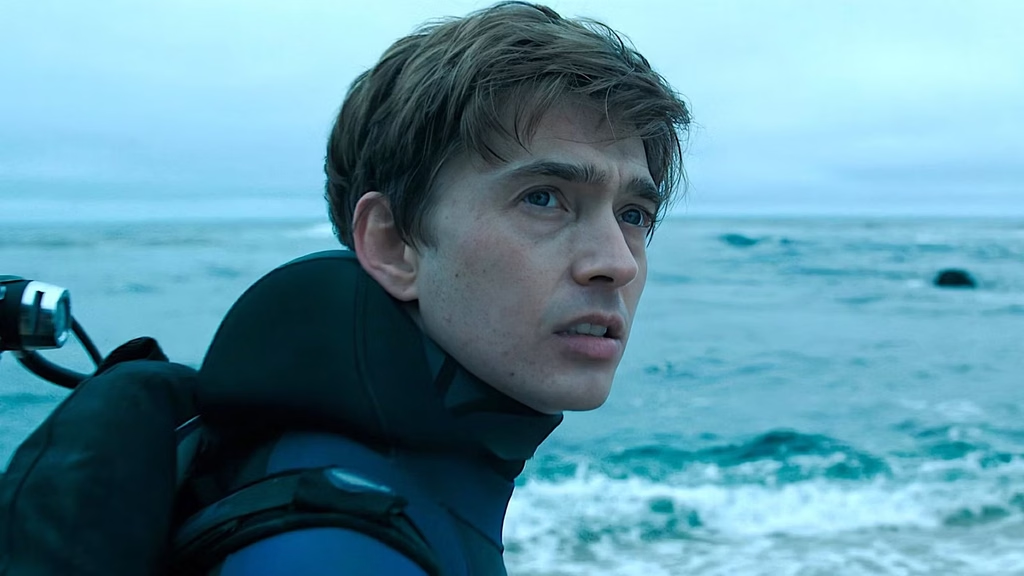
I find creature horror more unsettling when the animal keeps some distance from human ideas of evil. Give it too much spite and it starts behaving like a murderer wearing an expensive costume.
A whale brings a different set of associations. There is grandeur there. Curiosity, too. We are used to seeing these animals as astonishing evidence of how much life exists beyond our daily experience.
Whalefall puts that sense of wonder under pressure. An animal can deserve our fascination while being catastrophically dangerous to the person caught in its path. Jay’s terror can be completely justified without requiring the whale to become morally guilty.
Holding those thoughts together gives the premise its bite.
The audience wants Jay to get out. Of course it does. We are attached to the vulnerable human body and the rapidly disappearing time available to save it. Yet the creature enclosing him remains an animal whose existence extends beyond this encounter.
That complicates the familiar pleasure of watching a hero defeat a monster. Escape becomes the urgent desire. Jay needs a way back into conditions his body can survive.
The whale owes him nothing, which feels outrageous when you are imagining yourself in his position. Human panic has a habit of turning helplessness into an argument about fairness.
The ocean is a poor place to make that argument.
Grief Makes the Indifference Hurt More
Jay’s search for his father gives this encounter a particular emotional cruelty. He goes into the water carrying a human need for meaning. Finding remains might give loss a location, something tangible to reach for when the person himself is gone.
Then the ocean hands him an emergency.
That collision matters. Grief can consume someone’s entire inner life while barely disturbing the world around them. People still need lunch. Traffic still moves. An ordinary day keeps happening with almost offensive efficiency.
The whale gives that experience a physical scale big enough to become horror.
Jay’s father, played by Josh Brolin, remains important through the lessons that may help his son survive. Memory has practical value here. Something passed between two people can still guide a hand or shape a decision after one of them has died.
All of that significance belongs to Jay’s side of the encounter.
The whale cannot recognise the emotional importance of a lesson remembered at the right moment. It cannot appreciate why this particular young man deserves another chance to reach the surface. The audience supplies that investment, painfully aware of everything the animal cannot know.
We care more because care is so unevenly distributed.
Surviving Something That Will Never Understand

There is a satisfying order to a story where a monster recognises its defeat. The thing that caused the suffering gets a moment to understand that its victim has escaped.
The fear driving Whalefall comes from a much colder possibility. Whatever Jay achieves, the whale may never comprehend the struggle taking place inside it.
Every small decision can matter enormously to him while registering as nothing meaningful to the creature. He has to keep making those decisions anyway. Waiting for recognition would use up oxygen.
That is the sharpest emotional point for me. Jay’s life has value even in an environment incapable of acknowledging it. His fear matters to us. The things he remembers matter to him. None of that requires the whale’s agreement.
The animal can continue through the water with an entire human catastrophe inside its body. It has somewhere to go. Jay has to find a way out.

Rachel Sikkema is a New Zealand-based writer and creative entrepreneur who explores the intersection of film, culture, and modern relationships. Through her articles, she examines how stories shape the way we connect, love and see ourselves – all for God’s glory. When she’s not writing about film and television, she’s watching Dexter and The White Lotus for the third time.