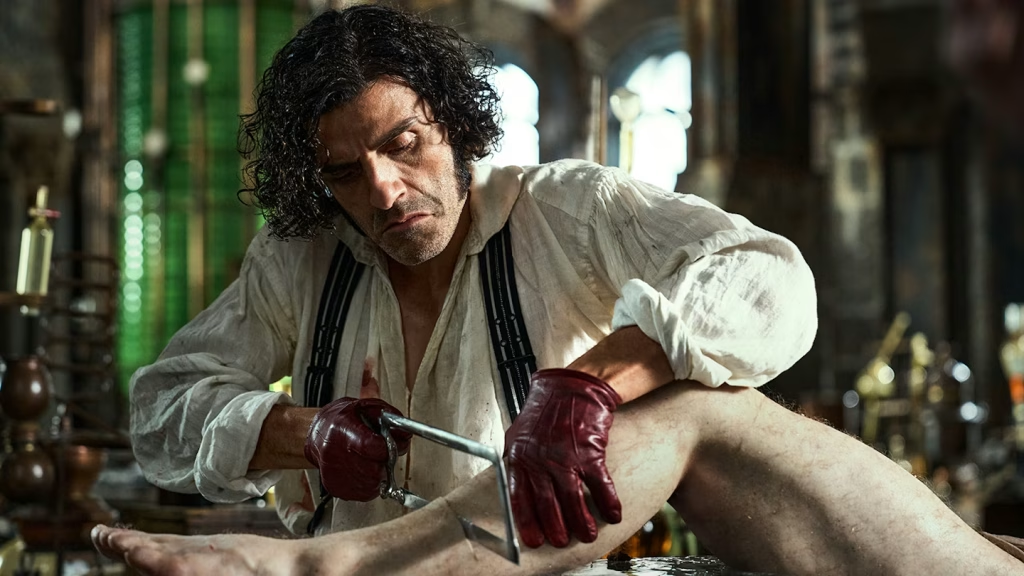
Guillermo del Toro’s Frankenstein plays like a beautifully mounted monster movie on the surface, but the real nightmare lives in Oscar Isaac’s version of Victor. His Baron Frankenstein is not just “a mad scientist”; he is a man who sharpens himself into a scalpel and then points it at everyone he loves, all in the name of doing something flawlessly.
The film turns perfectionism into a gothic curse. It is in the way Victor studies bodies as puzzles to be solved, in the way he treats his Creature as a failed project, and in the way his own life collapses when the world refuses to fit the pristine pattern in his head.
Victor as a Perfectionist Before He Is a Monster
From the start, Victor is framed as an egotistical, brilliant surgeon who believes death is a problem that can be fixed if he works hard enough. As a boy, he watches his mother Claire die on the operating table, an image that haunts him and feeds his obsession with “curing” mortality. His father Leopold, a celebrated doctor himself, responds not with tenderness but with cruelty. Victor grows up in that pressure cooker of status and shame, determined to outdo the man who belittles him.
By the time he reaches Edinburgh, Victor is already treating medicine like a competition. He performs daring procedures, pushes past ethical lines, and eventually gets expelled for reanimating corpses in front of horrified colleagues. Isaac plays these scenes with a kind of precise arrogance. You can see him notice every detail in the room, clock every weakness, and then decide his intellect makes him untouchable. The perfectionism here is not about clean handwriting or tidy shelves. It is about a belief that if he is smart enough and ruthless enough, the universe will surrender.
Harlander’s Tower as a Perfectionist Playground
When arms dealer Henrich Harlander, played with oily charm by Christoph Waltz, offers Victor a private laboratory and unlimited funds, it feels like the worst possible wish granted. Now Victor has an isolated tower, rivers of money, and no institutional rules. He can chase his perfect experiment without any brakes.
He designs his Creature as a kind of ultimate body and chooses limbs from soldiers and criminals, builds a towering frame, and plans a lightning-fueled procedure that will run electricity through the lymphatic system. It is elaborate, theatrical, and meticulously designed. You can feel how much he wants every moment of it to go exactly right, from the timing of the storm to the position of each clamp.
A Creation That Refuses to Be a Perfect Product

When the Creature, played with startling vulnerability by Jacob Elordi, finally wakes, Victor reacts like a man who has opened a luxury watch and found that the gears clank instead of purring. The being in front of him is enormous, healing too fast to dissect, and emotionally present in a way Victor never prepared for. The only word Victor manages to teach him at first is “Victor,” and he treats that as a failure, not a starting point.
Perfectionism Turning Victor Into a Terrible Parent
Del Toro structures the movie so you first get “Victor’s tale” and then “the Creature’s tale,” a deliberate split that exposes how much Victor edits his own failures. In Victor’s version, he is a tortured genius who went too far. In the Creature’s version, he is an abusive parent whose demand for control destroys everyone in the blast radius.
Victor abandons his creation in a burning tower rather than live with the shame of imperfection. He lies to his younger brother William about Harlander’s death. He tries to reclaim Elizabeth’s romantic attention even though she is engaged to William, as if her feelings should bend toward the “correct” choice of the more extraordinary brother. His perfectionism extends past the laboratory into every relationship, warping them all.
The Creature as Victor’s Inner Perfectionist, Made Literal
Oscar Isaac himself has described Victor and the Creature as two halves of the same soul. He calls the creation an “inner abandoned child” that comes back to pursue and judge the man who left him. It is a very psychological take, and it gives the perfectionism angle even more weight.
If the Creature is Victor’s inner self, then what we are watching is a man who exiles everything messy and vulnerable in himself until it rises up as something he cannot ignore. The Creature wants connection, softness, stories read aloud by the Blind Man in the woods. He learns to speak through gentle tutoring and kindness. Those scenes feel like the antidote to Victor’s harsh training.
The Arctic Ending and the Collapse of a Perfect Plan

By the time the story reaches the frozen ship in the Arctic, Victor’s life plan lies in ruins. He is maimed, exhausted, and fueled only by the need to finish what he started. Captain Anderson and his crew listen as Victor tells a version of events that still centers his intentions rather than the consequences. Then the Creature arrives to correct the record.
Why This Version of Frankenstein Feels So Modern
Part of what makes this adaptation land with such a sting is how recognizable Victor’s mindset feels. You might not be sewing together corpses in a Crimean War tower, but the instinct is familiar. If you can just get the work, the body, the family, the reputation exactly right, then the grief will stay quiet.
Oscar Isaac plays Victor as someone who keeps sacrificing reality for the fantasy of a perfect outcome, right up until his fantasy kills the people who loved him. The film treats that not as tragic romance but as a cautionary tale. The real horror is not lightning or stitched flesh. It is what happens when you value flawless achievement more than messy, unpredictable life.

Rachel Sikkema is a New Zealand-based writer and creative entrepreneur who explores the intersection of film, culture, and modern relationships. Through her articles, she examines how stories shape the way we connect, love and see ourselves – all for God’s glory. When she’s not writing about film and television, she’s watching Dexter and The White Lotus for the third time.