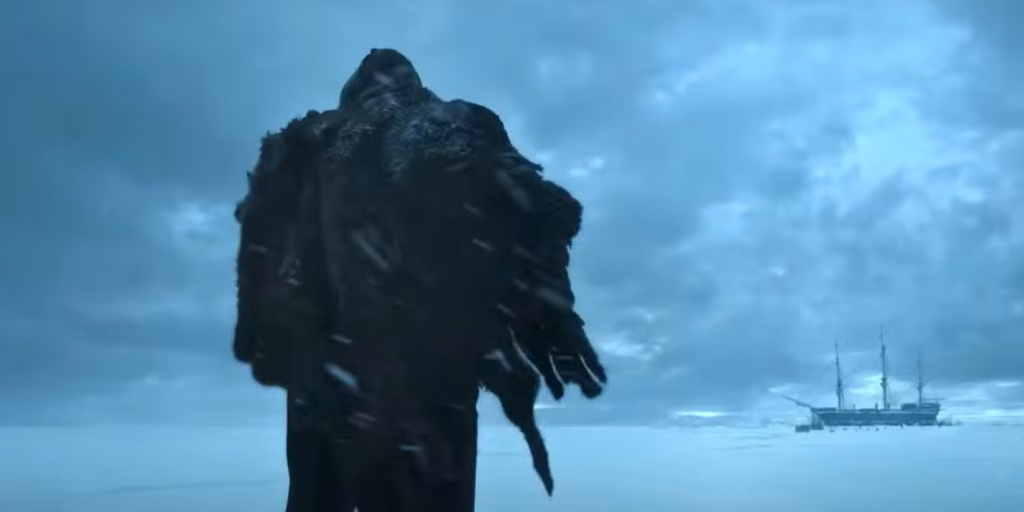
Guillermo del Toro’s Frankenstein finishes on a quiet, aching note that can feel almost confusing after two and a half hours of lightning, surgery, and screaming in the snow. Instead of a big showdown, you get apologies, forgiveness, and a single figure walking into the Arctic light. If you reached the credits wondering, “So… what actually happened there?” you are not alone.
This breakdown walks through the final act, what it means for Victor Frankenstein (Oscar Isaac), the Creature (Jacob Elordi), and why that last image sticks in your head long after the Netflix app closes.
Where the Ending Picks Back Up
The ending returns to the frame story from the opening. A Royal Danish Navy ship, the Horisont, is trapped in polar ice when Captain Anderson (Lars Mikkelsen) finds a half-frozen Victor Frankenstein on the ice and drags him aboard. Victor tells Anderson how he tried to conquer death and built a “perfect” being out of corpses, then lost control of what he created.
What Actually Happens in the Final Scenes
After the Arctic chase, Victor is badly injured. Anderson shelters him in his cabin while the ship remains trapped in the ice. The Creature returns, and instead of tearing Victor apart, he forces one last conversation.
Victor finally admits what the film has been circling the whole time. He treated the Creature as an experiment, not a person. He made a son and then abused and abandoned him. In a reversal of their first meeting in the tower, Victor is the one pleading now, asking for forgiveness rather than obedience.
The Creature could easily answer with violence. Instead, he listens. He remembers Elizabeth (Mia Goth), the blind man who taught him to read, and the brief moments of kindness he was given. He chooses mercy. He forgives Victor, not because Victor deserves it, but because carrying rage forever would turn eternity into a prison.
Does the Creature Die at the End?

The short answer is no. The film makes it clear the Creature’s body heals from almost anything. He survives a gunshot from the farming family who blame him for their grandfather’s death. He survives the tower explosion. He survives dynamite in the Arctic. Immortality is his curse.
In the final moments, Captain Anderson allows the Creature to leave instead of trying to kill him again. In return, the Creature uses his enormous strength to push the Horisont free from the ice, literally shoving the ship back into open water. That act breaks the cycle of pursuit between man and monster. Anderson chooses his crew over glory, and the Creature chooses rescue over revenge.
Victor’s Death and the Film’s Fatherhood Story
Victor’s death in the cabin is not only the end of his body, it is the end of a particular fantasy. Throughout the film he sees himself as a brilliant savior of humanity, a man justified in any cruelty if it serves “progress.” The plot keeps puncturing that self-image.
His father abused him; he repeats that cruelty on the Creature. He lusts after Elizabeth, then lies about Harlander’s death, then tries to burn his own experiment alive. When his younger brother William (Felix Kammerer) dies on his wedding night, he uses his last breaths to tell Victor: “You are the monster.”
Why Captain Anderson and the Ship Matter
If Victor represents obsession, Captain Anderson is the counter-example the film offers. At the start, he is tempted by Victor’s story, the thrill of chasing a legendary creature across the ice. The whole expedition is already halfway to disaster when the Creature attacks the ship and proves that this is not a romantic tale of science but a very real, very dangerous conflict.
In the finale, once the Creature has freed the Horisont, Anderson makes a simple decision: they are going home. He tells his men the chase is over. It is the choice Victor never made. Anderson steps away from the myth of glory and chooses survival and responsibility. By placing that choice right after Victor’s death, the film quietly suggests another way of living with ambition and curiosity that does not require sacrificing everyone around you.
The Lord Byron Quote and the Mood of the Last Shot
After the final Arctic image, the film closes with a line from Lord Byron: “The heart will break and yet brokenly live on.” Contemporary commentary has already picked up on how pointed that choice feels. Byron was part of the real-life literary circle that sparked Mary Shelley’s original novel, and the quote describes both Victor and the Creature with eerie precision.
How the Ending Reworks Mary Shelley’s Original

Del Toro is clearly in conversation with Shelley’s novel. Both stories use an Arctic frame, both end with the Creature disappearing into the frozen horizon after his creator dies, and both question who the real monster is.
Where this version diverges is in tone. Early reactions from the filmmakers emphasize that the ending was designed to leave a small ember of hope. Instead of a Creature walking toward a funeral pyre, we have a Creature capable of healing, forgiving, and choosing compassion after everything. The feud ends not because one side wins, but because one side decides to stop playing.
Why the Ending Lingers
The reason the ending of Frankenstein feels so haunting is that nothing “fixes” what happened. Victor dies, but not as a triumphant martyr. The Creature lives, but not as a neat hero. Everyone has to sit with the damage done.
What the finale offers instead of tidy justice is a simple, difficult act: forgiveness. The Creature lets go of his hatred. Captain Anderson lets go of the chase. Victor lets go of his denial. The film leaves you in that quiet space with them, watching a being who cannot die decide to live anyway. For a monster movie, that is a surprisingly human place to end.

Rachel Sikkema is a New Zealand-based writer and creative entrepreneur who explores the intersection of film, culture, and modern relationships. Through her articles, she examines how stories shape the way we connect, love and see ourselves – all for God’s glory. When she’s not writing about film and television, she’s watching Dexter and The White Lotus for the third time.