For a lot of people, One Battle After Another plays like a two-hour rush of chaos before it finally comes into focus on that desert highway. You sit through prison breaks, raids, rooftop escapes in Baktan Cross, and guerilla slapstick, and it is all entertaining, but also slightly slippery.
Once the final act kicks in, though, the movie quietly admits what it has really been about the whole time: not just revolution, but how parents hand stories about struggle down to their kids, and how those stories can save or break them.
The Messy Origin Story Looks Very Different in Hindsight
On paper, the early section is a wild political cartoon. “Ghetto” Pat Calhoun, played by Leonardo DiCaprio, and Perfidia Beverly Hills, played by Teyana Taylor, are part of the far-left French 75, blowing up infrastructure, humiliating Colonel Steven J. Lockjaw, and staging jailbreaks like they are performance art. Perfidia and Lockjaw’s encounter, her betrayal of the group, and the way witness protection gets weaponised turn the revolution into something sleazy and transactional rather than noble.
When Pat and his daughter Charlene disappear into hiding as “Bob” and “Willa” Ferguson in Baktan Cross sixteen years later, the film pivots hard into a scuzzy domestic dramedy. He is a paranoid stoner dad. She is a restless teenager who thinks he is overreacting and useless. The old battles feel like distant legend, the kind of thing a washed-up parent exaggerates to impress a kid.
The Desert Chase Turns the Movie Into Willa’s Story
The final movement really starts when Avanti Q, the indigenous bounty hunter, refuses to turn Willa over to the far-right militia and dies gunning them down so she can escape. Up to that point, he has functioned as a hired tool of the system hunting Bob and his old comrades. In one decision, he flips sides, and the film quietly shifts allegiance with him, away from abstract ideology and toward the protection of a teenager who never asked for any of this.
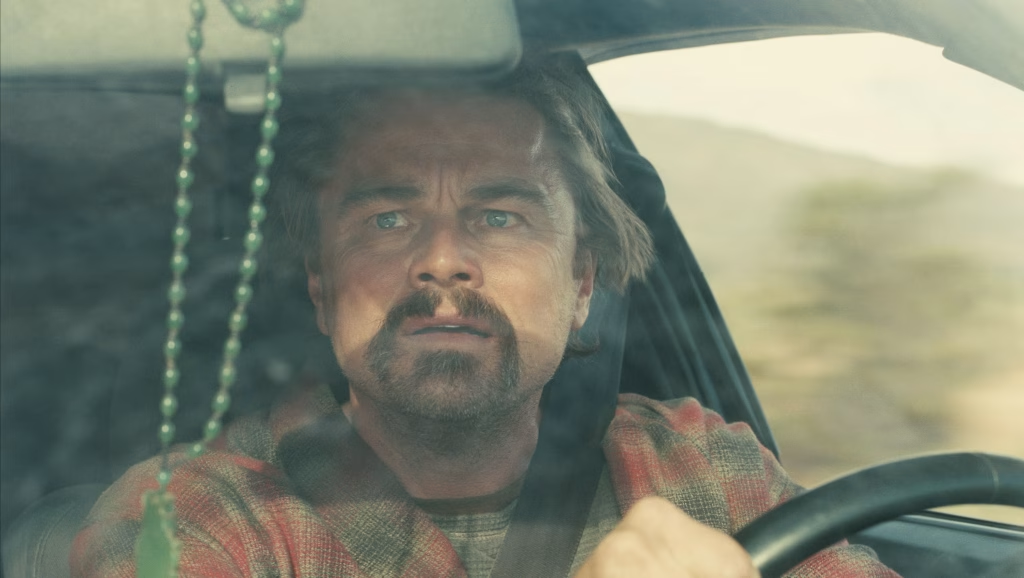
What follows is that hypnotic three-car sequence across the hills: Willa (Chase Infiniti) driving Avanti’s car, Tim from the Christmas Adventurers Club tailing her, and Bob desperately trying to catch up. Early marketing sold One Battle After Another as a big, old-fashioned action spectacle, and this is where it cashes that promise. The editing keeps all three cars in play, but the emotional point of view stays locked on Willa, figuring out the topography, exploiting the blind summit, and literally steering herself out of the trap the adults built around her.
The Politics of Every Earlier Battle Get Rewritten
Once you sit with that, the earlier action scenes stop feeling like cool revolutionary chaos and start looking like the training ground for this exact moment. The French 75 raids, the Otay Mesa breakout, the noisy attacks on the power grid, even the rooftop scramble with Sergio’s students are all about who is “inside” and who is “other.” The movement teaches everyone to sort people by code words, passwords and allegiance long before Willa points a gun at Tim.
Fathers, Daughters and the Price of Staying in the Fight
The reason this hits so hard is that One Battle After Another keeps tying every political gesture back to the parent-child relationship at its core. Bob’s failures as a father in Baktan Cross look, early on, like typical slacker-dad stuff. He gets high, forgets the resistance password, and leaves Willa to stew in frustration. In the last act, those same traits read differently. His paranoia was grounded in real danger. His refusal to explain everything was not only about secrecy, it was about shame.
Willa pointing a gun at him and demanding the countersign is the nightmare version of every scene where he shrugs off her questions. The revolution that once felt like a romantic backstory now sits between them as a wall. When she finally lowers the gun, the hug that follows is not neat forgiveness. It is two people agreeing, in a single moment, to stop living by other people’s battle rules.
That Last Image Changes How You Remember Everything

The film’s quiet closing stretch, with Bob sending Willa off to a protest in Oakland with his blessing, is not a simple “next generation takes up the fight” button. After everything we have seen, the choice to show her leaving peacefully, rather than in a blaze of gunfire, suggests a different idea of resistance. She still believes in struggle. She just no longer believes that it has to look like French 75 bombings or Lockjaw’s paramilitary crusade.
When you replay the movie in your head, that ending infects the earlier action with a bittersweet tinge. The jailbreaks and stand-offs in the first half sit next to the car chase and countersign execution in the third, and you can feel the cost of every “cool” moment. Each battle built a world where a teenage girl could only recognise safety through a password and a gun. The final act is where she chooses to carry the politics forward but leave the template behind.
That is why the ending has so much staying power. It does not tidy the story up. Lockjaw dies for the wrong reasons. The systems that created him are still intact. The revolutionaries are scattered. What has changed is Willa’s sense of what a battle can look like. Once you feel that shift, the title of the film stops sounding like an exhausted complaint and starts to feel like a challenge: if the fights keep coming, what are you going to teach the next kid about how to meet them?

Rachel Sikkema is a New Zealand-based writer and creative entrepreneur who explores the intersection of film, culture, and modern relationships. Through her articles, she examines how stories shape the way we connect, love and see ourselves – all for God’s glory. When she’s not writing about film and television, she’s watching Dexter and The White Lotus for the third time.