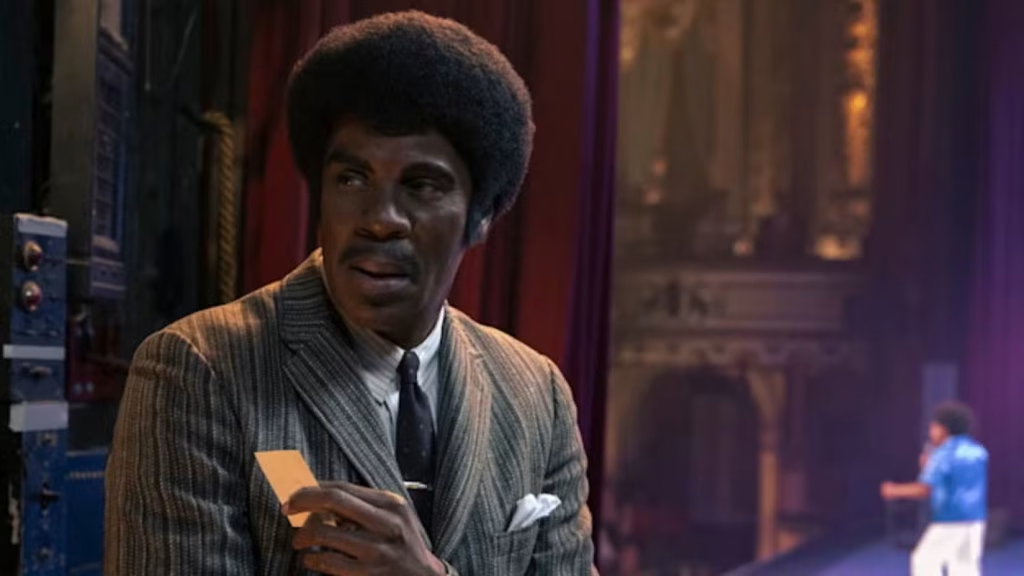
There is a version of Michael Jackson that only exists under stage lights. In Michael, that version arrives with the old familiar voltage. The hat. The socks. The sharp little pause before the body moves. Jaafar Jackson knows how to make those seconds feel charged, like the room has leaned forward before anyone has been asked to clap.
The film understands that part of fame very well. It understands the spell. It understands how a crowd can turn a person into weather. It understands how a child with a gift can become a family business, then a national obsession, then a global symbol that nobody fully controls anymore.
Where Michael gets more complicated is in what it chooses to polish. The movie has a lovely shine to it, sometimes too lovely. It can make pressure look elegant. It can make damage look purposeful. It can turn a life full of jagged edges into a glowing hallway of performance milestones.
That tension is where the movie becomes most interesting. It knows fame is a machine. It also keeps oiling the machine.
The Film Gets the Loneliness of Being Watched
The best thing about Michael is the way it treats visibility as a kind of pressure. Fame here feels less like a prize than a room with no door.
Jaafar Jackson often plays Michael as someone who has learned to be careful in his own skin. His speaking voice sits low and soft. His posture can look almost folded away. Then the music starts, and the body snaps into precision. The contrast gives the performance a pulse.
That is where the movie finds something honest. Michael becomes huge in public and small in private. The film keeps returning to that strange split, the performer who can command a stadium but seems almost swallowed by ordinary conversation.
There are moments where Jaafar’s face does the work the script only gestures toward. A smile held a beat too long. A glance that dodges the room. The sense of a person already managing how he will be remembered while still living through it.
That is a sharp observation about fame. It teaches you to perform even when the song has stopped.
Childhood Becomes the First Business Deal
The early Jackson 5 material gives Michael its clearest emotional line. A child discovers that his talent makes adults rearrange the room around him. That should be thrilling. In the film, it often feels frightening.
Colman Domingo gives Joe Jackson a hard, practical gravity. He sees the gift and treats it like a resource. The movie does allow tenderness around the family, but it never fully lets you forget the transaction underneath it. Michael sings, the family rises, the dream expands, and childhood gets trimmed to fit the schedule.
That material works because the stakes are simple and awful. A little boy becomes valuable before he becomes free. Every rehearsal carries the feeling of an unpaid debt.
The film understands how early fame can confuse love with performance. Applause becomes approval. Perfection becomes safety. A missed note becomes a threat to the whole fragile thing.
You can feel the adult Michael being built in those scenes. The control, the work ethic, the hunger to make every gesture exact. Also the loneliness. Especially the loneliness.
The Performance Scenes Are Both Thrilling and Suspicious

When Michael recreates famous performances, the movie comes alive in a way that is almost unfair. The music does a lot of heavy lifting, sure, but Jaafar’s physical commitment gives the scenes a real charge. He has the snap, the speed, the floating quality that made Michael Jackson look slightly unreal even when cameras caught him in full light.
Those sequences are made to stir the audience, and they do. The movie knows how to use recognition. A jacket appears. A pose lands. The choreography locks in. Suddenly the audience brings decades of memory into the scene without being asked.
That is also where the film gets slippery.
The performances sometimes feel like evidence being submitted in Michael’s defense. Look at the talent. Look at the discipline. Look at the genius. The movie keeps returning to the stage as if the stage can settle every harder question waiting beyond it.
That makes the concert scenes fascinating. They are spectacular, but they also feel loaded. The more dazzling the film becomes, the more aware you are of its desire to keep the spotlight exactly where it wants it.
Fame Looks Like a Cage With Velvet Lining
The film’s strongest visual idea is that fame can be beautiful and suffocating at the same time. The costumes glow. The stages are enormous. The crowds become oceans of arms and faces. Yet the person at the center feels trapped by the scale of his own image.
This is where Antoine Fuqua’s glossy style helps. The movie has the sweep of a big studio biopic, but that polish can work in its favor when it shows Michael being absorbed by the machinery around him. The shimmer becomes part of the trap.
There is a real sadness in watching someone become too famous to be approached normally. Everyone wants something. A song, a photograph, a miracle, a piece of him. Even admiration starts to look invasive.
The movie understands that fame does strange things to the body. It turns clothes into armor. It turns a glove into a relic. It turns hair, posture, voice, and movement into public property.
Michael Jackson was one of the rare artists whose image became as famous as the music. Michael knows that image has weight. It also knows we still want to look at it.
The Movie Smooths Over the Cost of Protection
Here is where the film gets frustrating. Michael understands the loneliness of fame, but it often treats that loneliness as a softening agent. Pain becomes atmosphere. Isolation becomes tragedy. Controversy becomes something hovering near the edges rather than something the drama truly wants to wrestle.
The film seems most comfortable when Michael is being shaped by forces around him. Family pressure. Industry pressure. Media pressure. Public hunger. Those forces are real, and the movie is right to take them seriously. But the frame becomes narrower whenever the story needs more friction.
A life like Michael Jackson’s asks for discomfort. The movie gives us plenty of sorrow, plenty of spectacle, plenty of longing. It gives less space to the ways power changes accountability. It lets fame wound him, then keeps its own hands very clean.
That is the smoothing. The movie sands down the roughest parts until the surface catches the light.
Jaafar Jackson Keeps Finding the Human Being

The reason the film still works in stretches is Jaafar Jackson. He keeps pulling the character back from the monument.
There is an obvious danger in casting a family member. The performance could have felt like preservation work, a careful act of legacy maintenance. Sometimes the film around him does feel exactly that controlled. Yet Jaafar has moments of odd, specific vulnerability that cut through the approved shape.
He plays Michael’s gentleness with care, but he also gives it a hint of strategy. The softness can feel real and practiced at once. That ambiguity matters. Famous people learn how to survive rooms. They learn what version of themselves gets the safest response.
His performance is strongest when he lets Michael seem difficult to reach. You can see the boy who performed because he had to, and the adult who performs because the world has left him no other language.
That is a far more interesting portrait than simple sainthood.
The Film Wants Celebration More Than Interrogation
There is no mystery about the movie’s deepest desire. Michael wants to celebrate. It wants the audience to remember the genius, the songs, the work, the cultural force. It wants to place Michael Jackson back inside the glow.
At times, that desire is moving. Pop history has a way of flattening people into arguments, and the film clearly wants to restore some wonder. It wants to remember how impossible he seemed when he moved. It wants to remind younger viewers that the hysteria had a source beyond marketing.
Still, celebration has a cost when it takes up too much oxygen.
The film understands fame as spectacle and captivity. It understands how a gifted child can be turned into a global product. It understands how an artist can become both powerful and deeply trapped by the image he created.
What it smooths over is the harder question of what happens after that image becomes untouchable. The movie looks straight at the cage, then grows careful about the person inside it.
That carefulness may be the most revealing thing about Michael. It makes the film feel haunted by the story it can tell and the story it keeps just out of frame. The music still lands. Jaafar still gives it a beating heart. The stage lights still do their old magic.
But every so often, you can feel the movie tidying up the room while everyone is still standing in it.

Rachel Sikkema is a New Zealand-based writer and creative entrepreneur who explores the intersection of film, culture, and modern relationships. Through her articles, she examines how stories shape the way we connect, love and see ourselves – all for God’s glory. When she’s not writing about film and television, she’s watching Dexter and The White Lotus for the third time.