
The childhood scenes in Michael have a sharpness the adult sections keep trying to recover.
You can feel it whenever young Michael is framed inside a room that already feels too small for him. A living room rehearsal. A family space turned into a pressure chamber. A child’s face lit by adult expectation before he has the language to push any of it away. The movie seems most alive when it watches talent arrive as both a gift and a problem.
That is where Michael finds its clearest emotional pulse. It understands the weird cruelty of a prodigy story. Everybody wants the miracle. Nobody quite knows what the miracle costs the child who has to keep producing it.
The adult material has bigger music, bigger crowds, and a more instantly recognizable silhouette. Jaafar Jackson gives those scenes a haunted charge, especially when he slips into the posture and iconography we already know. But the movie’s adult Michael often feels more carefully arranged than fully examined.
The childhood scenes breathe more. Or maybe they ache more cleanly.
The Young Michael Scenes Have a Stronger Point of View
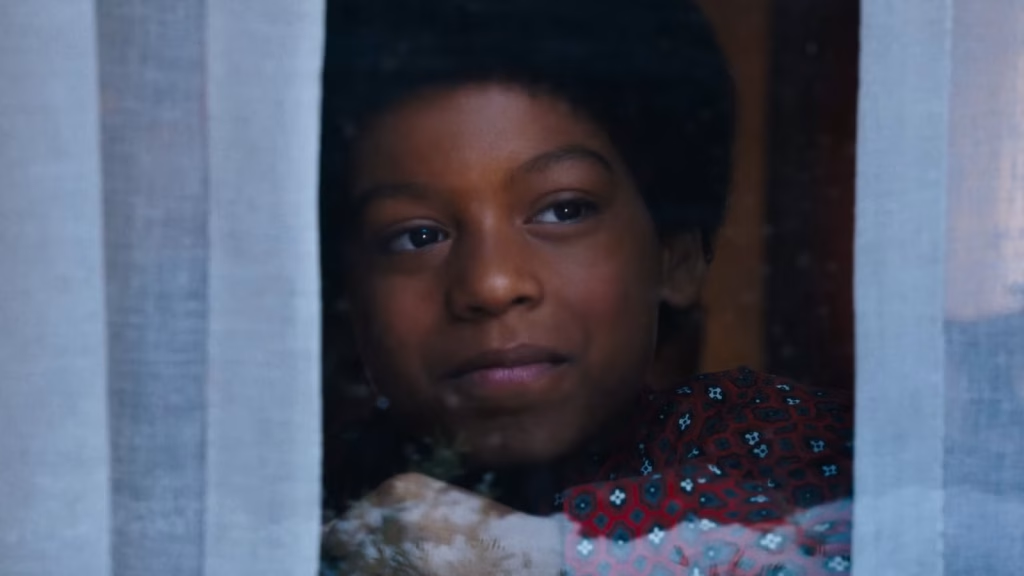
The film’s early stretch works because it knows exactly what it wants us to notice. Young Michael, played by Juliano Krue Valdi, carries the story with an openness that can feel almost painful. He smiles like a kid, performs like a veteran, and absorbs tension like someone already learning how to read the room for survival.
Those scenes do not need much explanation. The camera can simply hold on his face while the adults talk about success, discipline, money, opportunity, and the future. He is right there, yet already being turned into something larger than himself.
That is a strong biopic image. A child standing inside the machinery before he has any idea how big the machinery will become.
The Jackson 5 scenes also give the movie a useful structure. There is a family unit, a rehearsal rhythm, a clear pressure source, and a visible transformation from domestic life into show business. The music has joy in it, but the joy has a clenched jaw. The film lets those two feelings sit together without sanding them down.
That is more than the adult sections always manage.
Joe Jackson Gives the Childhood Story Friction
Colman Domingo’s Joe Jackson gives the early material its hardest edge. The film has to walk a tricky line with Joe, since he is both the man pushing the family toward success and the father whose discipline casts a long shadow over Michael’s life.
Domingo plays him with force, but also with enough human detail to keep him from turning into a simple villain. His Joe believes in work. He believes in toughness. He believes the world will eat his children alive unless they become sharper than the people waiting to exploit them.
That belief does not soften the damage. It just gives the damage a context.
The childhood scenes work because Joe’s pressure has a clear effect on the room. You can feel the kids adjusting around him. You can feel Michael learning that love and performance may arrive tangled together. Applause becomes approval. Perfection becomes safety. A missed step becomes more than a missed step.
That is devastating because the movie barely has to underline it.
When adult Michael later chases impossible standards, the childhood scenes have already planted the root. They make his perfectionism feel learned, not decorative. They show the wound before the legend covers it in rhinestones.
Fame Feels Stranger When It Happens to a Child

The film has an easier time making childhood fame feel disturbing because childhood gives the story a natural imbalance. Adults make choices. Children adapt to them.
That imbalance gives the early scenes moral weight. We watch young Michael become the focal point of everyone else’s ambition. His talent is real, obviously. The joy of singing is real too. But the movie is smart enough to show how quickly joy can become duty once the adults start counting on it.
There is something quietly brutal about a child being praised for seeming older than he is. That is one of the film’s best observations. Michael performs with astonishing control, and the world rewards him for losing access to ordinary childhood.
The adult sections keep returning to that idea, but they often do it through familiar biopic shorthand. Lonely hallways. Hushed business meetings. Crowds pressing against barriers. Flashbulbs. Mirrors. Big empty rooms after big loud concerts.
Those images are effective, but they are also expected. The childhood scenes feel less canned because the contradiction is rawer. The kid is brilliant. The kid is trapped. Both truths are visible in the same shot.
Adult Michael Arrives as an Icon First
Once Jaafar Jackson takes over, Michael gains a jolt of uncanny electricity. His resemblance to his uncle gives the film an advantage that no amount of prosthetics could create. He has the eyes, the smile, the physical line. When the stage lights hit him, the movie can almost coast on recognition.
Sometimes it does.
That is the central issue with the adult half. The film becomes so invested in presenting Michael as an icon that it has less room to make him messy in a truly revealing way. The glove, the fedora, the military jackets, the curls, the spotlight, the scream of the crowd. These images arrive with such cultural force that they start doing the emotional work for the movie.
Jaafar is good. Often very good. His body language has that tense softness, the sense of someone both commanding the room and retreating from it. He can make a still moment feel watched from all sides.
But the film often frames adult Michael as a figure to be understood through pressure and genius. That creates sympathy, but it also narrows the field. The adult scenes keep guiding us toward awe, pity, or both.
The childhood scenes feel more open to discomfort.
The Movie Gets Cautious When the Life Gets Complicated
The adult years force Michael into harder territory, and you can feel the film become more guarded. It wants to honor the performer, dramatize the cost of fame, and preserve the emotional sweep of a big musical biopic. It also has to deal with a public life full of conflicts that cannot be solved by a perfect performance sequence.
That tension sits under the adult sections like a hum.
The movie is strongest when it shows adult Michael as someone shaped by childhood pressure. It becomes shakier when it treats that pressure as the main explanation for everything. Pain can explain a lot. It cannot tidy an entire life.
The film clearly knows how to make Michael vulnerable. It knows how to make him lonely, brilliant, pursued, misunderstood, and almost spectral inside his own fame. What it handles less comfortably is the adult Michael as an active, complicated person whose choices carry weight beyond the tragedy of being famous.
That is why the childhood material feels more persuasive. The young Michael has limited power. The adult Michael has immense power, even inside his isolation. The movie sometimes seems nervous about sitting with that contradiction for too long.
The Best Adult Scenes Still Echo the Childhood Ones
The adult half works best when it remembers the child inside the icon without turning that idea into a soft excuse.
A rehearsal scene can suddenly feel like an old family room with better lighting. A manager’s demand can rhyme with Joe’s discipline. A stage entrance can look triumphant and lonely because the film has already shown us the boy who learned to earn love through performance.
That is the movie’s cleanest emotional bridge.
Jaafar Jackson understands this connection. He often plays adult Michael as someone still carrying old instructions in his body. Stand this way. Smile now. Hit the mark. Hide the fear. Make the impossible look effortless. His performance is full of tiny delays, as if every reaction has to pass through years of training before it can reach the surface.
That is compelling. It gives the adult scenes an ache they badly need.
The problem comes when the movie lets the iconography overpower the psychology. The more famous the image, the easier the film reaches for spectacle. The childhood scenes stay closer to cause and effect. The adult scenes sometimes drift into shrine-making.
Childhood Gives the Movie Its Real Tragedy
The most moving idea in Michael is simple. Michael Jackson’s greatness did not arrive separate from his wounds. The film shows that most clearly when he is young.
A child sings, and everyone hears money, escape, pride, destiny. A child dances, and adults see a future they can build around him. A child becomes extraordinary, and ordinary life begins slipping away before anyone calls it a loss.
That is tragic in a way the movie understands deeply.
By comparison, the adult sections often have to compete with the audience’s preloaded feelings about Michael Jackson. The memories are too big. The arguments are too loud. The image has been repeated too many times. Every fedora tilt arrives with history attached.
The childhood scenes sneak past that noise. They show a smaller Michael before the world turned him into an argument. That does not make them simple. It makes them sharper.
Michael may sell itself on the spectacle of the King of Pop, and fair enough. People will come for the moonwalk, the glove, the songs, the eerie thrill of watching Jaafar Jackson step into that impossible silhouette.
But the film’s best work lives earlier than that. It lives in the rooms where Michael is still a child, still smiling, still learning that talent can open doors and close others forever. That is where the movie feels most honest. That is where it hurts.

Rachel Sikkema is a New Zealand-based writer and creative entrepreneur who explores the intersection of film, culture, and modern relationships. Through her articles, she examines how stories shape the way we connect, love and see ourselves – all for God’s glory. When she’s not writing about film and television, she’s watching Dexter and The White Lotus for the third time.