
At first glance, The Housemaid looks like it wants to be filed under “twisty domestic thriller” and forgotten the minute the credits roll. There’s a live-in job, a too-perfect house, a rich couple with strange vibes, and a young woman who needs money badly enough to ignore every red flag waving in her face. That setup practically begs you to focus on the crime. Who’s lying, who’s dangerous? Who’s going to snap?
But the longer you sit with the movie, the clearer it gets: the most brutal violence here is social. The “thriller” machinery is real, sure. Yet what sticks is how the film uses a house and its rules to show you a class system in miniature, and how easy it is to trap someone when you own the space, the story, and the consequences.
If you’re still piecing together the film’s biggest turns, start with our guides to The Housemaid ending, the small detail that changes everything, and who really holds the power in the Winchester house.
Sydney Sweeney plays Millie Calloway, a young woman taking a live in housemaid job with the wealthy Winchesters, Nina (Amanda Seyfried) and Andrew (Brandon Sklenar), hoping to build a stable life after a rough past.
The “Good Job” That Comes With Invisible Chains
Millie’s job is sold as a fresh start, which is how these arrangements always get pitched. It’s stable and in a beautiful home. It’s a chance to “prove yourself.” If you’ve ever been broke broke, you know how persuasive that sounds.
The movie makes the trap physical early. Millie’s room in the attic, the isolation, the sense that she’s living in the house but never really part of it, all of it communicates one thing: her comfort is optional.
The House as a Class System You Can Walk Through
The Winchester home is basically a diagram. Some rooms are for performing wealth, while some rooms are for protecting wealth. Some rooms are for hiding what wealth doesn’t want seen.
Millie moves through the house like a person moving through a social hierarchy. She’s allowed in the kitchen, but not in the family’s inner life. She’s allowed to make things spotless, but not allowed to ask why things feel wrong.
That’s why the domestic setting matters so much. A mansion in this story is not a fun backdrop. It’s a weapon.
Nina Winchester and the Luxury of Being Believed

Amanda Seyfried’s Nina is fascinating because she exists in a double privilege. She has money, and she has the cultural protection that money buys. Even when she appears unstable, her instability gets absorbed into the household like expensive perfume. It lingers, it fills the rooms, and everyone adapts around it.
When Nina behaves erratically, the movie doesn’t treat it as random. It treats it as a kind of social weather that only affects the people below her. Millie has to manage Nina’s moods as part of her labor, and she has to do it without ever naming it as labor.
Andrew Winchester and the Polished Face of Entitlement
If Nina is the household’s chaos, Andrew is its control. Brandon Sklenar plays him with that particular kind of charm that feels less like warmth and more like access. He knows which version of himself plays well in each room.
Andrew is not scary because he’s obviously monstrous from the start. He’s scary because he’s plausible. He’s the guy who could ruin you without raising his voice.
In a class story, that’s the real predator. Someone who understands institutions, optics, and credibility. Someone who knows that the police, the neighbors, and the “nice people” network are more likely to protect him than a woman who cleans his sinks.
Millie’s Survival Instincts Are Shaped by Poverty, Not Plot Twists
Sydney Sweeney gives Millie a sharpness that never reads like superhero competence. It reads like practice. Millie notices details because she has to. She does quick math in her head because she has to. She takes hits to her pride because the rent is always due.
The film also understands something that a lot of thrillers fake: desperation doesn’t make you stupid. It makes you strategic. Millie doesn’t ignore red flags because she’s clueless. She ignores them because she’s calculating what she can survive, and what she can’t afford to lose.
The Film’s Biggest Twist Is Who Gets to Rewrite Reality
One of the most unsettling things The Housemaid shows is how stories get managed in wealthy spaces. Image is currency. Narrative is protection. If something awful happens, the first instinct isn’t grief. It’s containment.
Millie is constantly fighting for control of her own narrative, which is another way of saying she’s fighting for personhood. The household tries to define her as lucky, needy, unstable, untrustworthy, or ungrateful, depending on what benefits them in the moment.
That’s why the movie’s suspense works even when you can sense where certain beats are headed. The tension isn’t only “what will happen.” It’s “who will be believed about what happened.”
Why Audiences Latched Onto It So Fast
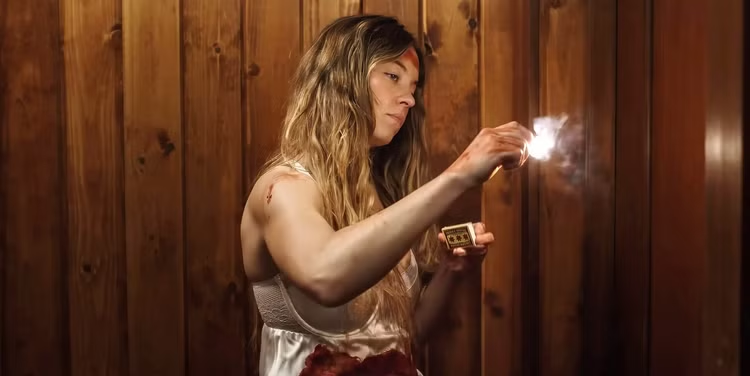
Part of The Housemaid’s impact is timing. People are primed for stories about labor, exploitation, and the lies wealthy households tell about the people who keep their lives running. The film also arrived as a buzzy adaptation of Freida McFadden’s bestselling novel, with a cast that sells tickets on name alone.
It also helps that the movie isn’t shy about being entertaining. Paul Feig directs it with a clean, glossy surface that makes the rot underneath pop even more.
The Real Horror Is How Normal It All Feels
When people call The Housemaid a crime story, they’re not wrong. Bad things happen. Violence happens. Secrets and manipulation drive the plot.
But the movie’s nastiest idea is simpler: class makes certain people disposable, and it does it with a smile. It does it through “rules.” It does it through contracts, expectations, and a thousand tiny humiliations that add up to control.
The scariest question isn’t “who committed the crime?” The scariest question is “how many Millies are out there right now, living inside someone else’s house, hoping the job that saved them doesn’t destroy them?”
That’s why The Housemaid lands. The thriller stuff keeps your pulse up, but the class stuff is what follows you home.

Rachel Sikkema is a New Zealand-based writer and creative entrepreneur who explores the intersection of film, culture, and modern relationships. Through her articles, she examines how stories shape the way we connect, love and see ourselves – all for God’s glory. When she’s not writing about film and television, she’s watching Dexter and The White Lotus for the third time.