By Rachel Sikkema
Published November 8, 2026

Wild Horse Nine makes you laugh at Chris and Lee because their friendship feels familiar before their morality feels bearable. John Malkovich and Sam Rockwell give these CIA agents the appeal of two men who have spent far too much time together. They know how to irritate each other. They know which complaint is coming. Martin McDonagh uses that intimacy to make dangerous company feel briefly comfortable.
That comfort is the interesting part. Once you enjoy someone’s company, you start making allowances. An ugly remark becomes another example of their terrible manners. A confession becomes a good story. The film gives that habit a particularly nasty setting by placing its central friendship in Chile in 1973, with the men caught up in American interference before the coup.
My reading is that the comedy works by making our affection run ahead of our judgment. We enjoy the rhythm of these men together. Then we have to decide how much moral weight we have accidentally given that enjoyment.
A funny man can still be a man you should keep away from power. Somehow that becomes easier to forget when he has an excellent scene partner.
Familiarity Does a Lot of the Dirty Work
There is something immediately inviting about a friendship that has worn through its polite surface. Chris and Lee have the kind of relationship where irritation itself suggests attachment. Someone else might walk away from this conversation. These two keep having it.
That gives the audience an easy way in. Most of us understand the exhausting friend whose next remark could be either brilliant or deeply embarrassing. We understand the person who has heard every story and still sticks around.
Put those habits inside a spy film and they shrink the distance between the audience and the characters. The men become recognisable through ordinary social behaviour. Their professional lives can be appalling while their conversations retain the small pleasures of people who know each other well.
McDonagh has always had an ear for affection expressed badly. Here, that talent creates an awkward advantage for his protagonists. Every entertaining exchange earns them another few minutes of our attention.
And attention has consequences. Spend enough time listening to someone explain himself and his troubles start taking up more room than the troubles he caused.
Chris Gets to Control the Temperature
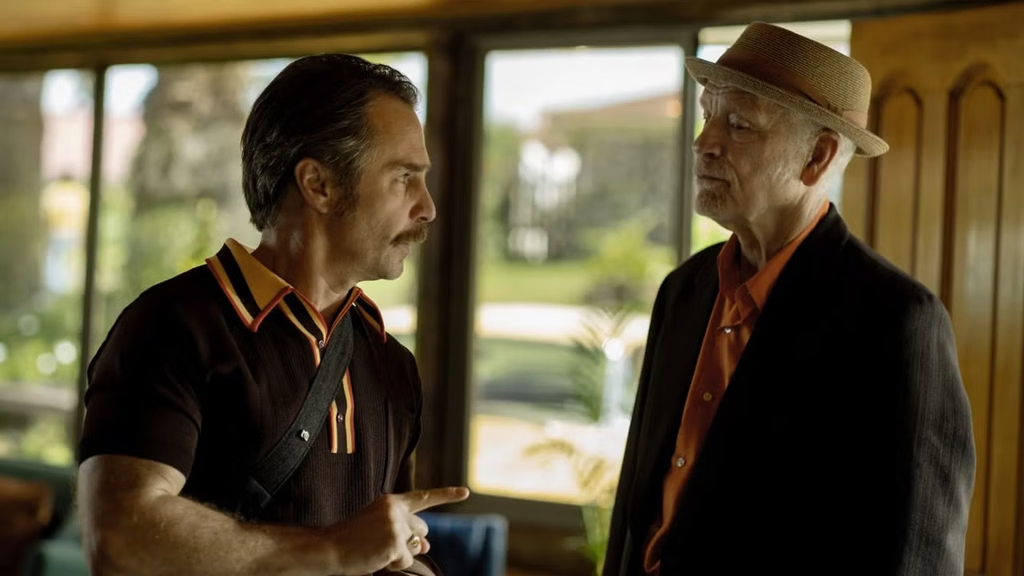
Chris’s illness gives his talk a particular urgency. He is dying of cancer, and his drifting conversation moves between personal fears and the violent career behind him. Lee has to listen while trying to work out how much of what he hears is confusion and how much is a truth finally escaping.
That situation is practically built to recruit sympathy. A person approaching death becomes vulnerable in a way an intelligence officer discussing his work may never have seemed. We recognise the fear even when we recoil from the history.
But vulnerability can also give someone control of a conversation. How hard do you challenge a dying man? How often do you interrupt his reminiscences to ask about the people missing from them?
Chris benefits from that hesitation.
The humour makes the problem sharper. A joke can move a conversation along before anyone has dealt with what was just said. Everyone gets a release. The speaker gets to continue.
This is where the film’s talk becomes more troubling than a straightforward display of villainy. Chris can make himself entertaining at precisely the moment when another person might demand an explanation. His personality keeps filling the space where an answer should go.
You can enjoy listening to him and still notice who has possession of the microphone.
Lee Makes Staying Seem Reasonable
The companion matters enormously in this kind of comedy. An outrageous character becomes easier to accept when somebody nearby appears capable of managing him.
Lee gives us that reassuring possibility. His familiarity with Chris suggests experience. He knows the man’s habits. Perhaps he can tell when a remark should worry us and when it can safely pass.
From there, the audience can fall into a very convenient arrangement. Chris supplies the disturbance. Lee supplies a way to remain in the room.
Yet being comparatively easier company tells us very little about someone’s principles. Next to the most exhausting person at dinner, almost anyone can look sensible. Give that same person a quieter scene and the judgment may change.
That is what makes the partnership worth watching beyond the insults. Lee’s attachment has its own moral weight. Friendship can involve patience and care. It can also involve years of learning which questions to leave alone.
The uncomfortable question is how much of that accommodation has become automatic. At what point does knowing someone well become a reason to stop examining him?
The History Keeps Pressing Against the Jokes
The Chile setting gives the comedy a pressure that follows the men into their private conversations. Their friendship occupies the foreground, but their work connects them to lives far beyond it.
That difference in scale matters. Two men can spend an afternoon worrying about each other while other people live with the consequences of decisions men like them have made. Their personal distress may be sincere. It still consumes an extraordinary amount of attention.
For me, this is the strongest way to read the film’s uneasy laughter. The jokes show how easily powerful people can remain absorbed in the small business of being themselves. They still get bored. They still need company. A career involving enormous harm leaves plenty of time for petty irritation.
That ordinariness is chilling.
We often expect monstrous conduct to announce itself through monstrous behaviour in every setting. Someone ought to look permanently sinister or speak in a voice that clears the room. Instead, an entertaining conversationalist can carry an appalling history.
The joke lands. The history remains.
Sometimes the Charm Deserves Suspicion Too

There is a risk in giving compromised men the best lines and the richest emotional lives. Viewers may leave remembering how sad it was to spend time with them as their world narrowed. The people harmed by that world can become distant figures.
A film earns more from this tension when it lets us feel the limits of its own affection. I find the possibility of being charmed more interesting than a simple invitation to forgive. Charm tells us something about the person experiencing it as well as the person exercising it.
We want another exchange. We want the friendship to survive the next difficult conversation. Those are ordinary responses to a well-written pair of characters.
They also help explain why judgment gets slippery. Enjoyment gives us a small personal stake in keeping the evening pleasant.
Wild Horse Nine makes that impulse hard to ignore. Chris and Lee can be funny enough to hold your attention and damaged enough to earn your concern. You can feel both responses without handing either man your trust.
The laugh arrives quickly. Deciding what you think of the person who earned it takes longer.

Rachel Sikkema is a New Zealand-based writer and creative entrepreneur who explores the intersection of film, culture, and modern relationships. Through her articles, she examines how stories shape the way we connect, love and see ourselves – all for God’s glory. When she’s not writing about film and television, she’s watching Dexter and The White Lotus for the third time.