
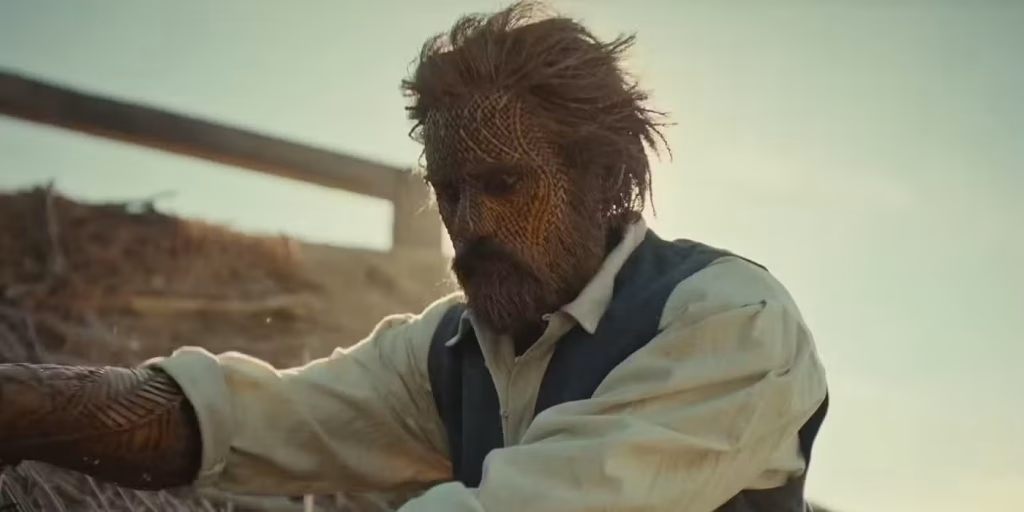
Alexander Skarsgård appears in Wicker covered from forehead to waist in tightly woven reeds. His hair looks like an abandoned bird’s nest. His chest has been basketed into heroic proportions. Olivia Colman gazes at him with the wary fascination of a woman wondering whether her dream man comes with a fire safety certificate.
A safer actor might have looked at this role and pictured months trapped inside a stiff practical suit. Skarsgård appears to have seen the words “romantic wicker husband” and reached for a pen.
That response feels entirely consistent with the career he has built. Give him a conventional leading man and he will search for the crack in the surface. Offer him a Viking berserker, a socially anxious security android or a leather-clad gay biker, and suddenly he looks delighted.
Hollywood keeps handing Skarsgård the advantages of a traditional movie star. He keeps using them to become the strangest person in the room.
The Obvious Career Was Sitting Right There
Skarsgård has the sort of face casting directors once used to launch a dozen studio romances. He is tall, handsome and capable of filling a doorway before saying a word. His early success as Eric Northman in True Blood established the full package. Here was a beautiful blond vampire with menace, wit and several centuries of sexual confidence.
A predictable career could have followed. More brooding heroes. More expensive coats. Perhaps an architect who returns to his coastal hometown at Christmas and remembers how to love.
Skarsgård chose chaos.
Even his most outwardly conventional roles tend to contain something sour. Perry Wright in Big Little Lies weaponised charm and physical beauty inside an abusive marriage. Lukas Matsson in Succession arrived as a tech billionaire who seemed assembled from expensive knitwear, private jets and an alarming lack of social brakes.
He understands that conventional masculinity becomes more interesting when the audience can feel it malfunctioning.
The handsome surface gets him through the door. Then the character begins sweating, barking, manipulating someone or behaving in a way that makes dinner uncomfortable.
He Treats His Body Like a Strange Prop
Plenty of actors build careers around maintaining a recognisable image. Skarsgård seems more interested in discovering how thoroughly that image can be disrupted.
Robert Eggers’ The Northman turned him into a hulking engine of revenge. His Amleth moved with the lowered posture of a wolf and carried violence in every muscle. The role used his size without polishing it. He looked muddy, feral and spiritually exhausted.
Brandon Cronenberg’s Infinity Pool pushed him in another direction. As failed novelist James Foster, Skarsgård begins with the familiar outline of a privileged leading man. The film gradually humiliates that outline until James becomes a whimpering heap of panic, appetite and moral collapse.
One scene leaves him crawling on the ground while Mia Goth holds him on a leash. Skarsgård later leaned into the image at Sundance, turning the red carpet into an extension of the film’s gleeful degradation.
That willingness matters. He never appears frightened of losing authority on screen. His size can become ridiculous. His beauty can become grotesque. Sexual confidence can flip into vulnerability before a scene has finished.
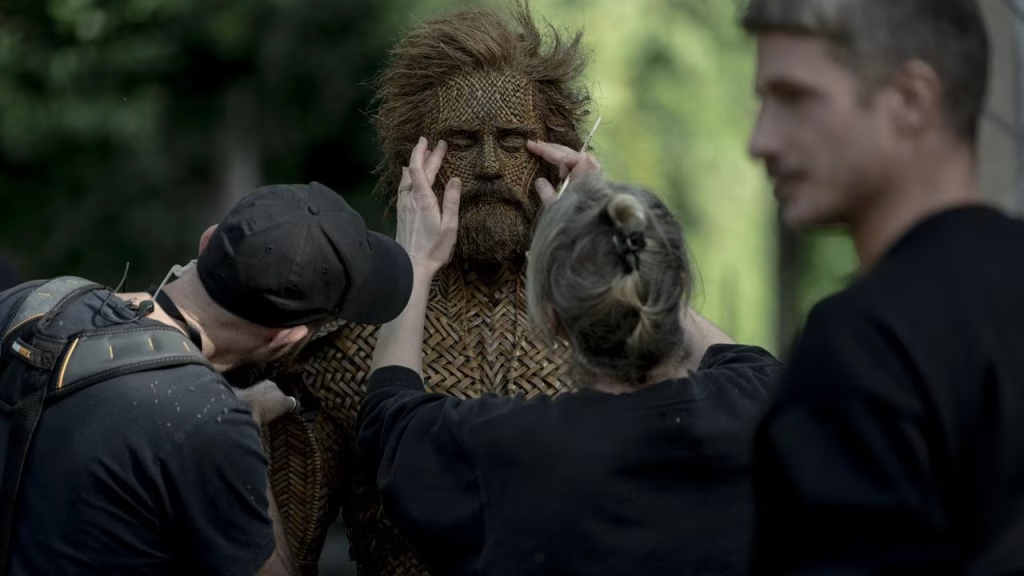
In Wicker, his body becomes literal craft material. The practical suit built with Weta Workshop transforms him into a woven fantasy while preserving enough facial movement for a performance. His brow furrows beneath the lattice. His massive torso looks impressive and faintly impractical.
Of course he wanted to wear it.
Murderbot Found the Introvert Inside the Action Figure
Murderbot may be the purest example of Skarsgård using his appearance against expectation.
The title suggests a relentless killing machine. The character has the physical specifications of one. Yet this self-hacking security construct would rather avoid eye contact and watch episodes of its favourite soap opera, Sanctuary Moon.
Skarsgård plays the role with tiny movements and exhausted pauses. Murderbot can tear through a threat, but ordinary conversation leaves it stranded. Human affection feels more dangerous than combat. Every concerned question from a client lands like an attempted home invasion.
Casting Skarsgård makes the joke sharper. He looks designed to dominate an action franchise. Instead, he spends the series trying to fold himself away from emotional attention.
The performance also reveals something that his darker work can hide. He is extremely funny. His comedy comes from restraint rather than mugging. A slight tightening around the eyes tells us that Murderbot has just encountered another unbearable display of human concern.
Skarsgård’s best roles often place an imposing body around a character who has lost control of the situation. Murderbot gives that tension a sweet, awkward centre.
Pillion Turns Dominance Into Another Performance
In Harry Lighton’s Pillion, Skarsgård plays Ray, a leather-clad biker who begins a dominant and submissive relationship with Colin, played by Harry Melling.
Ray seems built from familiar Skarsgård materials. He is physically commanding, sexually confident and difficult to read. The role could have become a collection of poses. Skarsgård instead treats dominance as a language the character has learned to speak.
The film’s BDSM setting brings power into the open. Rules are discussed. Desire becomes specific. Control has rituals and limits, even when the emotional relationship grows messier.
Skarsgård appears drawn to that contradiction. Ray can command a room while remaining elusive inside it. The performance uses his magnetism, then questions what that magnetism allows him to avoid.
It also continues a run of unusual love stories. Pillion explores intimacy through submission. Wicker creates a husband by weaving one from reeds. Somewhere, a conventional romantic comedy agent is staring mournfully at an unanswered phone.
Wicker Makes Perfection Deeply Peculiar
The Wicker Husband could have been played as a visual gag with excellent abdominal craftsmanship. Skarsgård gives him sincerity.
That choice saves the character.
Olivia Colman’s Fisherwoman commissions Peter Dinklage’s Basketmaker to make her a spouse after years of ridicule from her village. The result looks uncanny, but he arrives with a gentle nature and complete devotion. He listens to her and respects her work. He offers the warmth that the human community has withheld.
Skarsgård reportedly found the character intimidating because goodness gave him less obvious conflict to grab. That anxiety makes sense when looking across his filmography. He usually plays men with darkness leaking through their charm. The Wicker Husband’s strangeness sits on the outside.
His task is to make an impossible body feel emotionally safe.
The performance depends on stillness. His woven face has limited mobility, so attention becomes expressive. He listens with his whole posture. The physical scale that made Amleth terrifying becomes protective beside Colman.
There is comedy in watching this enormous handcrafted man navigate marriage. Skarsgård gives the joke a soul. Without that commitment, the romance would feel like an extended sketch. With it, the Fisherwoman’s attachment becomes touching and the villagers’ hostility becomes cruel.
A lesser performance would keep asking the audience to admire the costume. Skarsgård lets us forget it for a moment.
Then the light catches his basket chest and the absurdity returns. Perfect.
Weirdness Protects Him From Becoming Dull
Skarsgård’s choices reveal a healthy suspicion of his own screen image. He knows what he looks like. More importantly, he knows that appearance can become a cage.
So he keeps finding roles that scratch at it.
A vampire turns predatory beauty into deadpan comedy. A Viking pushes heroic masculinity toward animal fury. A wealthy tourist in Infinity Pool disintegrates into cowardice. Murderbot places crippling social discomfort inside a powerful artificial body. Ray in Pillion complicates dominance with emotional distance.
Now the Wicker Husband transforms the leading man into furniture-adjacent folklore.
These performances share little in genre or tone, but they all ask Skarsgård to inhabit masculinity as something constructed. Power comes with a costume. Beauty invites assumptions. Control can disappear quickly.
He seems happiest when a role allows him to expose the construction.
The Joke Keeps Getting Better
There is a lovely perversity in watching an actor become more adventurous as his industry value grows. Success often encourages caution. Skarsgård has responded by making a romance in which Olivia Colman falls in love with him as a basket.
That choice feels generous toward the audience. We already know he can brood handsomely in low light. Wicker asks whether he can project tenderness through a woven mask while carrying the physical presence of a pagan garden ornament.
Apparently he can.
The film joins a career that grows harder to summarise with every new project. That may be the point. Skarsgård has avoided becoming a brand by treating each role as a chance to interfere with the last one.
He could have spent twenty years playing beautiful dangerous men. Instead, he has become a beautiful dangerous man, a traumatised Viking, a pathetic novelist, an avoidant android, a kinky biker and now a devoted husband made from willow.
At this rate, his next role may be a haunted wardrobe with unresolved feelings.
I would watch it.

Rachel Sikkema is a New Zealand-based writer and creative entrepreneur who explores the intersection of film, culture, and modern relationships. Through her articles, she examines how stories shape the way we connect, love and see ourselves – all for God’s glory. When she’s not writing about film and television, she’s watching Dexter and The White Lotus for the third time.