The yellow walls are already too much.
That is the first little miracle of The Backrooms. Before the running, before the shaky camera, before any creature starts making itself known in the distance, the place has already done something unpleasant to your brain. The wallpaper has that dead office glow. The carpet looks damp from decades of imaginary foot traffic. The lights buzz with the confidence of a building that plans to outlive you.
It feels familiar, but only in the worst way.
A normal horror location usually arrives with personality. A haunted house has history. A castle has drama. A basement has the decency to look guilty. The Backrooms feels like a space designed by a committee that forgot human beings have souls. It has no romance, no gothic beauty, no grand evil carved into the walls. Just cheap texture, bad lighting, and the quiet suggestion that you were never meant to be there.
That is why the idea lingers. The Backrooms turns the most ignored kind of place into a trap. Not a dungeon. Not a lair. A room. Then another room. Then another.
The Terror of Useless Architecture
There is something especially nasty about a place that appears functional but serves no clear purpose. The Backrooms looks built. Someone, somewhere, had to decide on the color of those walls. Someone picked the carpet and installed the ceiling tiles and lights. Yet the result has no obvious use.
That contradiction is the whole nightmare.
A hallway should lead somewhere. A waiting room should imply an appointment. An office should contain desks, phones, coffee stains, a terrible printer that ruins everyone’s morning. The Backrooms borrows the language of those places but removes the reason for them. It is all setup with no human payoff.
That emptiness creates a weird kind of insult. You are surrounded by evidence of design, but no evidence of care. Everything has been assembled around the shape of human life while leaving actual life out of the equation.
The place feels built for people as a species, but for no person in particular.
That detail matters. The Backrooms scares us because it resembles all the spaces we move through without looking. Hotel corridors. Office suites. Medical waiting areas. School hallways after hours. The dead little stretches of a mall where the music still plays after half the shops have closed. Places made to process bodies, not comfort them.
We trust those places because they are boring. The Backrooms makes boredom feel predatory.
Liminal Horror Works Because We Recognize It
The word “liminal” gets thrown around so much now that it can start to feel like a filter. Empty pool, fluorescent hallway, abandoned play place, congratulations, you have discovered unease. But the best liminal horror still has a sharp little hook in it. It captures the moment when a space loses its social script.
A school hallway during the day is loud and ordinary. A school hallway at midnight feels like trespassing inside your own memory.
The Backrooms understands that shift perfectly. It takes places designed for transition and traps us in the transition forever. Doorways lead to more doorways. Rooms open into more rooms. The walls repeat like the building is copying itself with no concern for quality control.
That repetition does strange work on the viewer. You start searching for variation. A stain. A shadow. A dark opening in the wall. A slightly wrong corner. The eye becomes frantic because the image refuses to reward attention in the usual way.
A monster lets you focus. A maze like this makes focus feel useless.
That is a meaner kind of fear than a jump scare. It suggests that the space has no center to reach, no real outside to return to, and no caretaker who can hear you banging on the walls. The building has swallowed the idea of exit.
The Ugliness Makes It Worse
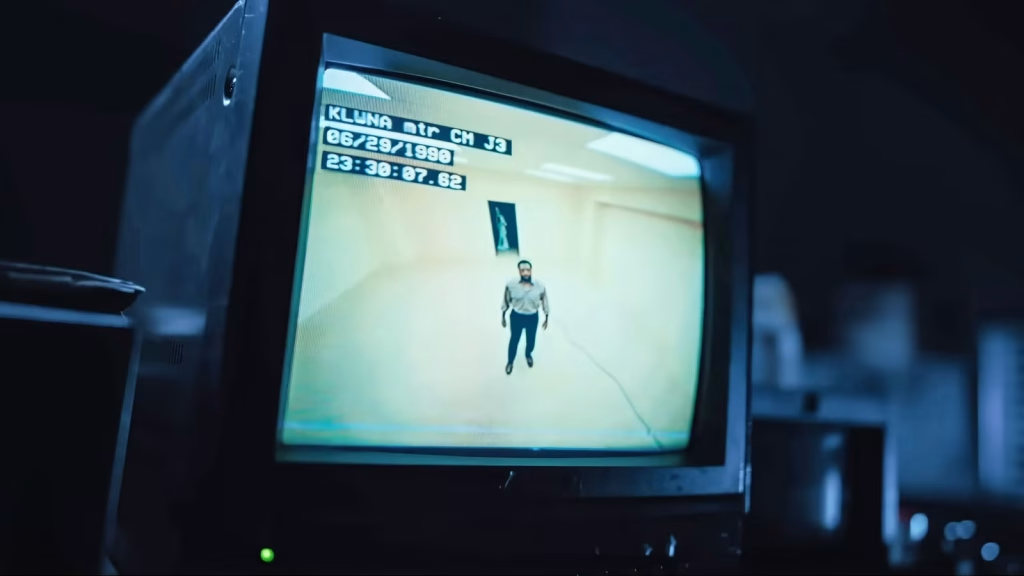
The Backrooms would lose power if it looked cool.
That sounds blunt, but it is true. A sleek sci-fi labyrinth would make the concept easier to admire. A decaying asylum would bring built-in horror flavor. A shadowy gothic corridor would let the viewer settle into familiar genre pleasure.
The Backrooms looks cheap.
The yellow is not rich or cinematic. It is institutional. The carpet has the texture of something that should have been replaced years ago. The ceiling lights flatten everything beneath them. The whole place has the mood of a training center in a corporate park near an airport.
That ugliness makes the horror feel closer to daily life. Nobody expects to fall into a baroque nightmare while walking through a rented office building. Nobody expects an empty hallway with commercial carpet to become metaphysical punishment. That is exactly why the image bites.
It turns bad taste into cosmic dread.
The design feels impersonal in a way that modern people know too well. We spend so much time in places made by systems, budgets, leases, codes, and committees. Most of them work well enough. Many of them look dead behind the eyes. The Backrooms pushes that feeling until it becomes supernatural.
The scariest part may be how little it has to exaggerate.
Empty Space Becomes a Character
Good horror locations often behave like characters. The Overlook Hotel in The Shining has moods. The house in Poltergeist feels like it has an appetite. The woods in The Blair Witch Project keep rearranging the rules while pretending to be ordinary trees.
The Backrooms belongs in that family, but its personality is harder to pin down. It has no obvious face. No grand entrance. No singular iconic room where the whole myth gathers itself. Its personality comes from refusal.
It refuses to end, explain or become beautiful. It refuses to give the person inside it a clean story to follow.
That makes the place feel weirdly alive. Not alive like a beast, exactly. More like a system that keeps running after everyone who understood it has vanished. The lights hum. The walls stand. The air sits heavy and stale. You can almost smell the carpet glue.
I love how petty that horror feels. Not epic. Petty. The universe could have sent you to fire, ice, or a pit full of bones. Instead, it dropped you into the saddest office annex in existence and left the fluorescents on.
That joke has a cruel edge.
The Absence of People Is the Loudest Thing
The Backrooms often feels most frightening when nothing appears. A distant sound can be scary. A figure at the end of a hall can raise the pulse. Still, the long stretches of vacancy are where the idea really breathes.
Because a place like this should have people.
Not friends, necessarily. Just someone. A cleaner pushing a cart. A bored receptionist. A maintenance worker with keys. A tired employee eating lunch under lighting that should be illegal. The absence of even one ordinary person makes the space feel contaminated.
It also creates a social panic. Humans use other humans to confirm reality. If someone else is waiting in the same room, the room becomes legible. Annoying, maybe, but legible. If nobody appears in a place built to contain crowds, the mind starts filling in the missing bodies.
Where did everyone go?
That question is scarier when the space shows no sign of violence. No blood or wreckage. No clear emergency. Just absence so complete it becomes a texture. The Backrooms feels abandoned and untouched at the same time, which is a deeply cursed combination.
It suggests people were never part of the plan.
Kane Parsons Found the Right Texture

Kane Parsons’ found footage approach works because it lets the Backrooms stay awkward. The camera does not glide through the space like a polished studio tour. It stumbles, turns too quickly, catches too much blank wall, and lets the viewer feel the geometry of the rooms before the mythology arrives.
That roughness is essential.
The Backrooms should feel like footage that should have stayed on a hard drive. It should feel discovered rather than presented. The more cleanly explained the place becomes, the more it risks turning into a theme park map. Levels, rules, entities, factions, danger ratings. All of that can be fun, and fans have built some wonderfully strange corners out of the concept.
Still, the original fear is beautifully simple. You fall through the surface of the world and land in a place that looks almost normal.
Almost is doing a lot of work there.
Parsons’ version keeps returning to the physical wrongness of the environment. Rooms are too large, too bare, too yellow. Openings sit where they should feel useful but instead feel like traps with better manners. The camera makes the viewer aware of scale, distance, and dead air.
That dead air is the real special effect.
Places Built for No One Feel Possible
The Backrooms has lasted because it turns a modern anxiety into a visual. We already know what soulless spaces feel like. We understand the particular sadness of a hallway outside a conference room and the hum of a building after hours.
The Backrooms takes that low-level discomfort and removes the escape hatch.
That is why the idea keeps working even when no monster appears. The place itself is the wound. A creature can add urgency, but the rooms create the deeper fear. They suggest a world where human design has become detached from human meaning.
A place can be built and still feel empty of intention. It can be lit and still feel blind. A place can surround you without offering any sign that it knows what a person needs.
That is the horror of The Backrooms. It is not only that you might be lost. It is that the place around you has no interest in the concept of being found.
The walls keep going. The lights keep buzzing. Somewhere ahead, another room waits with the same awful carpet and the same dead yellow glow.
And somehow, it feels made for no one except you.

Rachel Sikkema is a New Zealand-based writer and creative entrepreneur who explores the intersection of film, culture, and modern relationships. Through her articles, she examines how stories shape the way we connect, love and see ourselves – all for God’s glory. When she’s not writing about film and television, she’s watching Dexter and The White Lotus for the third time.