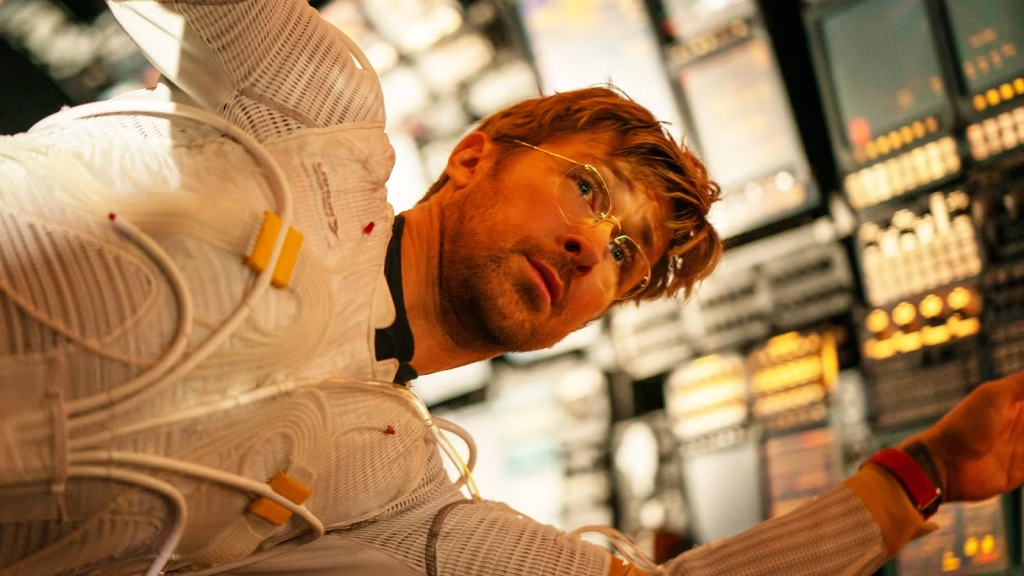
The image that sticks with Project Hail Mary should probably be Ryan Gosling floating through a spaceship, trying to solve a cosmic extinction problem with math, panic, and whatever tools are bolted to the wall.
That is the clean poster version.
The real hook is much stranger and much sweeter. It is Ryland Grace realizing that the most important thing in the universe may be a friend who looks like a nightmare mineral sample, speaks in music, and has absolutely no patience for sloppy problem-solving.
That is where the story gets its heartbeat.
Andy Weir’s premise has all the shiny hard sci-fi furniture. A dying sun. A lone astronaut. A mission built on desperate engineering. Equations that behave like action scenes. The kind of science that makes readers feel briefly convinced they could troubleshoot an interstellar crisis if someone handed them a whiteboard and a protein shake.
Yet the reason Project Hail Mary lingers has less to do with the machinery than the relationship at its center. Ryland Grace and Rocky are a classic odd couple, just launched into deeper space and given a species barrier the size of a planet.
One of them is a human teacher with scrambled memory and a talent for explaining complicated things in plain language. The other is an Eridian engineer whose body, senses, culture, and instincts work by completely different rules.
Put them together and the movie becomes something wonderfully old-fashioned. Two weirdos trapped in a high-pressure situation, learning each other’s rhythms because they have no better option and then, slowly, because they care.
The Science Gets You in the Door
Project Hail Mary knows exactly how to flatter the science nerd part of the brain.
Ryland Grace wakes up in a spacecraft with no memory, surrounded by medical equipment and bodies that tell him the mission has already gone badly. From there, the story invites us to watch him deduce his own life. It turns memory loss into a puzzle box, then turns the puzzle box into a survival manual.
That setup is satisfying in the Andy Weir way. The pleasure comes from watching a smart person observe, test, revise, and swear a little when the universe behaves rudely. There is a reason The Martian worked so well on the page and on screen. Weir understands that competence can be thrilling when it has a pulse.
Ryland does not win because he is a chosen one. He wins small moments because he notices things and measures. He makes a dumb little plan, improves it, and then tries again when the dumb little plan tries to kill him.
Ryan Gosling is a fun fit for that kind of hero because he can make thought visible. He has a gift for playing men whose faces are doing more calculation than they want to admit. Even when Grace is frightened, there is a comic precision to the way he processes disaster. You can almost see the internal spreadsheet glitching.
The hard sci-fi wrapper matters. It gives the story its texture, its stakes, and its particular flavor of dread. But it also sets up the real magic trick. The more technical the problem becomes, the more human the solution feels.
Rocky Changes the Temperature of the Whole Story
Then Rocky arrives, and the movie breathes differently.
Plenty of alien stories treat first contact like a grand historical event. Governments gather. Soldiers aim weapons. Scientists make speeches under blue lighting. Project Hail Mary goes for something more intimate and, frankly, more charming.
First contact here feels like two people trying to assemble furniture with instructions written in different alphabets.
Ryland and Rocky have to invent a relationship from scratch. They have no shared language at first. No shared biology or familiar facial expressions. No easy way to say the most basic things. Food, sleep, danger, help, trust. Every word has to be earned.
That is buddy movie gold.
The best buddy movies build comedy and feeling from friction. One character is loose, the other is rigid. One charges ahead, the other overthinks. One has a system, the other keeps touching the system. Ryland and Rocky are that dynamic taken to a cosmic extreme. Their misunderstandings are funny because they are practical. Their breakthroughs are moving because each one costs effort.
Rocky also gives Grace something a lone-survivor movie can only fake for so long. A person to bounce against.
Without Rocky, Grace’s intelligence risks becoming a series of monologues. With Rocky, problem-solving becomes conversation. Even when they are speaking through translation, samples, gestures, and trial runs, the scenes have the rhythm of two coworkers trapped on the worst group project ever assigned.
A very high-stakes lab partner comedy. With extinction outside the window.
The Friendship Works Because It Stays Useful

The sweetness of Ryland and Rocky’s bond comes from its practicality.
They do not become friends because the plot needs a soft middle section. They become friends because survival demands cooperation. Trust starts as a tool. Then, almost by accident, it becomes affection.
That progression gives the relationship weight.
Rocky saves Grace because Grace matters to the mission. Grace helps Rocky because Rocky has knowledge he needs. At first, everything can be explained as strategy. Then the calculations start to wobble. They check on each other and adapt for each other. They learn the little emotional equivalents of tone of voice and body language.
A good buddy movie always has this quiet shift. The other person begins as an obstacle, then becomes part of the main character’s operating system.
Think of the great odd-pair stories. The pleasure comes from watching two incompatible people build a private language. In Project Hail Mary, that idea becomes literal. Grace and Rocky have to name the universe together before they can save anything in it.
That is such a lovely sci-fi idea. Communication as survival. Friendship as engineering.
The movie’s biggest emotional beats come from that shared labor. Not from speeches about unity. Not from sentimental shortcuts. From the fact that these two beings keep choosing to solve the next problem together.
Ryland Grace Needs Rocky More Than He Knows
Grace is an appealing hero partly because he has the energy of a man who would rather be teaching a classroom than starring in a myth.
He is clever, decent, scared, and occasionally petty in the way people get when they are exhausted and alone. His heroism has dents in it. That matters.
Rocky pulls something better out of him.
With another human, Grace might perform competence. With Rocky, he has to communicate honestly. He has to slow down and admit confusion. He has to make his mind legible to someone who experiences reality through different senses.
There is a beautiful humility in that.
A lesser version of this story could make Grace the wise human who teaches the alien how to feel. Project Hail Mary gives Rocky plenty of authority. He is brilliant, stubborn, funny, and emotionally direct in ways Grace often struggles to be. He brings his own science, his own fears, his own loyalty.
That balance keeps the friendship from feeling like a gimmick. Rocky is not a pet with dialogue. He is not a mascot for lonely astronauts. He is a full partner, and the story gets a lot of mileage from letting him be better than Grace at things.
Sometimes the alien is the adult in the room. Delightful.
Eva Stratt Belongs to a Different Movie
Sandra Hüller’s Eva Stratt gives the Earthbound side of Project Hail Mary its harder edge. She represents the brutal math of catastrophe. Decisions, resources, sacrifice, permission stripped down to emergency logic.
Stratt is fascinating because she operates in a genre closer to political thriller than buddy comedy. Around her, the film becomes colder. People become assets. Time becomes a weapon. The future is something to be dragged into existence by force if necessary.
That contrast matters because it makes the Grace and Rocky material feel warmer without turning soft.
Earth is full of hierarchy, fear, and impossible choices. Space, bizarrely, becomes the place where a more generous version of intelligence can grow. Grace and Rocky have no institutions to hide behind. They have only the work and each other.
The movie keeps asking which kind of problem-solving saves people. Stratt’s ruthless command or Grace and Rocky’s shared curiosity.
The answer has room for both, which is part of why the story has bite. Still, the part that makes people lean forward is the friendship. We remember the cooperation more than the command structure.
The Best Buddy Movies Are About Translation
A buddy movie can be about cops, roommates, rivals, musicians, athletes, spies, or two beings trying to save separate civilizations from the same cosmic disaster. The shape holds.
Two characters meet.
They clash.
They build trust through action.
They learn how the other one thinks.
By the end, their bond has changed what each of them believes is possible.
Project Hail Mary simply makes that structure feel new by taking every familiar beat and running it through hard sci-fi logic. The banter has to survive alien syntax. The teamwork has to survive incompatible atmospheres. The emotional confession may arrive through behavior rather than words.
That is why Rocky lands so hard with audiences. He gives the movie a relationship you can root for on a scene-by-scene level. Every shared discovery feels like a tiny victory. Every misunderstanding has stakes. Every gesture of care feels earned because the story has shown how difficult care is across that distance.
The cosmic scale helps, of course. Saving Earth is a pretty good reason to keep watching.
But the smaller scale is the secret. Two minds in the dark, tapping on the walls between them, slowly realizing there is someone tapping back.
The Disguise Is Part of the Fun
Calling Project Hail Mary a buddy movie does not reduce the sci-fi. It explains why the sci-fi works so well.
The astrophage, the ship, the experiments, the terrifying distances, the elegant little bursts of deduction, all of that gives the movie its architecture. The friendship gives it furniture, mess, noise, warmth. A place to sit down.
Hard sci-fi often gets talked about as if its highest purpose is accuracy. Accuracy is lovely. Accuracy gives the story flavor and discipline. But the genre becomes powerful when the science reveals character.
Grace and Rocky do not just solve problems. They reveal themselves through the way they solve them. They get annoyed. They improvise. They protect each other. They make room for the other person’s mind.
That is the movie hiding in the spacesuit.
Project Hail Mary may look like a story about one man sent across the stars to save humanity. The more interesting version is about two lonely problem-solvers who find each other in the middle of impossible math and decide, with growing tenderness, to become a team.
Science gets them to Tau Ceti.
Friendship gets them through it.

Rachel Sikkema is a New Zealand-based writer and creative entrepreneur who explores the intersection of film, culture, and modern relationships. Through her articles, she examines how stories shape the way we connect, love and see ourselves – all for God’s glory. When she’s not writing about film and television, she’s watching Dexter and The White Lotus for the third time.