By Rachel Sikkema
Published October 14, 2026
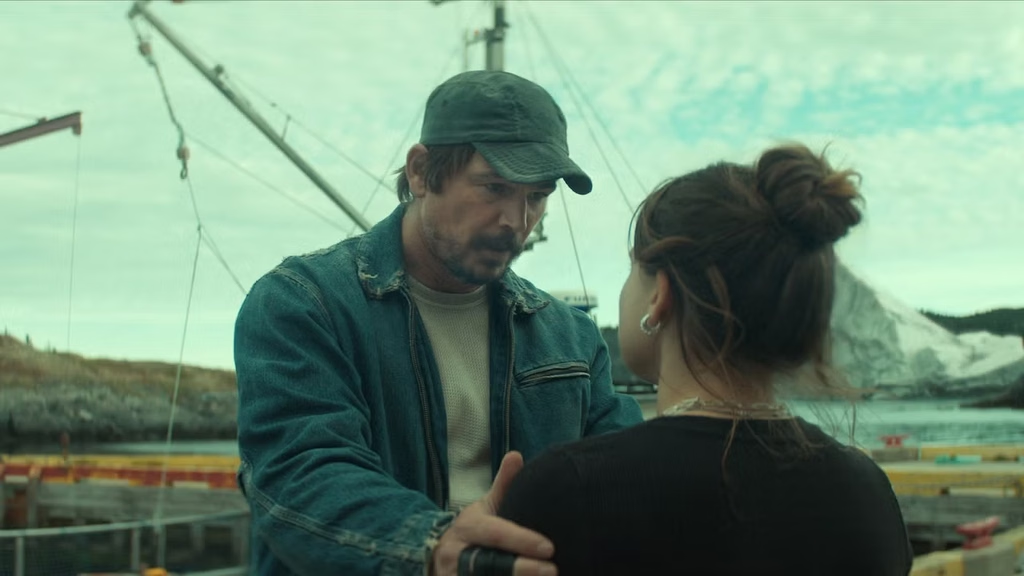
The ocean in Below is frightening because staying away from it would dismantle the lives built around it. Calvin Penney needs that water to earn a living. Snook’s Arm depends on the same uncertain resource. Once something dangerous starts moving beneath the surface, the sensible advice to keep your distance becomes an expensive proposition.
That is the series’ strongest horror idea. These people have to keep dealing with the place that scares them.
Josh Hartnett’s Calvin understands the sea through work and painful experience. Fear has already been part of that relationship for years. The creature makes the risk spectacular, but the pressure to go back out feels horribly ordinary.
Going Home Barely Solves Anything
Ocean horror often gives its characters a temporary reason to enter dangerous water. They are exploring somewhere remote or enjoying a holiday. Survive the encounter and there is another life waiting on shore.
Calvin’s life is organised around returning.
A boat sitting idle might offer immediate safety. It also leaves the question of tomorrow’s income hanging over the household. Every day spent waiting for reassurance has a cost.
That makes me more patient with his determination than I might be with a horror character opening an obviously terrible door. He has something practical pulling him towards the danger. The water contains the possibility of getting through another week.
Snook’s Arm gives that dilemma a whole community. One person changing jobs would be difficult enough. A fishing village finding a replacement for the thing around which it developed is another undertaking entirely.
You can tell people to stay ashore. Someone still has to explain what happens next.
Calvin Knows the Water and Still Has to Guess
Hartnett’s fisherman brings an appealing kind of competence to Below. His familiarity with boats and fishing gives him a reason to act. He has spent his life learning how to function in this environment.
The creature exposes the limits of that knowledge.
I like horror that allows experience to remain useful while making the experienced person afraid. Calvin has skills. The sea still contains something those skills have never prepared him to understand.
There is a particular humiliation in being frightened at work. The place where you usually know what to do suddenly makes you hesitate. Other people may continue looking to you for answers because you have always been the person who could manage.
Calvin carries that pressure alongside his responsibilities as a father. His children need him to make decisions while he is trying to establish what kind of danger they are facing.
His partnership with marine biologist Fonda Howander gives that uncertainty somewhere productive to go. Mackenzie Davis’s character approaches the mystery with a different body of knowledge. Between them, practical familiarity and scientific inquiry have to catch up with something already affecting the town.
Neither gets the luxury of understanding everything before acting.
The Ice Offers Money Before It Offers Answers

Calvin’s attempt to sell iceberg ice is a small detail with a nasty aftertaste. He sees a chance to make extra money. The rejected ice later becomes part of the explanation for what has gone wrong.
That is an especially effective way to connect the horror to his circumstances. An object in the landscape becomes an opportunity because he needs opportunities.
From a comfortable distance, an iceberg can be scenery. For Calvin it may have saleable value. Below lets the same thing acquire another meaning as the danger becomes clearer.
His willingness to look for income also makes the character feel less like a designated monster hunter. He is trying to get by. The supernatural-looking crisis interrupts a life that already requires improvisation.
I find that more unsettling than a character pursuing danger out of curiosity. Calvin has a reason to inspect what the sea brings him. Financial pressure keeps directing his attention towards things another person might happily leave alone.
The ocean keeps presenting possibilities. He has to decide which ones he can afford to ignore.
The Danger Follows Them Into an Ordinary Necessity
The contamination of the local water supply makes retreat even harder to imagine. The creature’s secretions enter a system people rely on, producing symptoms that draw them towards the sea.
An ordinary drink becomes part of the threat.
That development gives the setting a reach beyond the boats and shoreline. The residents’ dependence extends into their bodies. Avoiding an obvious stretch of dangerous water offers limited reassurance when the problem has already travelled inland.
Wade’s symptoms make this intimate for Calvin. Charlie Heaton’s character brings the mystery into the family through physical changes and disturbing behaviour. His father has to respond to a son in trouble while the cause remains difficult to grasp.
The relationship with the ocean has become so embedded in daily life that separating safe contact from dangerous contact feels almost impossible.
This is where Below gets under my skin most effectively. The familiar precautions start looking inadequate. Staying inside usually feels like taking control in a creature story. Here, a household still needs water.
Leaving Comes With Someone Else’s Terms
The resettlement proposal supplies an apparent exit. Residents can accept money and vacate their land.
For someone watching their livelihood collapse while the town grows more dangerous, the offer deserves serious consideration. A family might reasonably decide that survival elsewhere is worth the upheaval.
Then the Crockers’ interests make that escape route look much uglier.
The people positioned to benefit from departure have information the residents lack. Fear helps hurry the decision along. The community’s need for relief becomes useful to those hoping to gain control of its resources.
That puts Calvin and his neighbours in a miserable position. Staying carries physical danger. Leaving involves trusting an arrangement shaped by people with reasons to undervalue what they are surrendering.
I appreciate how this complicates the easy audience response of telling everyone to get out. Departure requires transport and somewhere to go. Starting again takes money. The existence of an exit says very little about whether the people offering it have treated you fairly.
Snook’s Arm has plenty of water around it and a remarkably narrow range of choices.
The Sea Can Never Become Completely Safe

The revelation that warmer water is driving the creature’s crisis widens the problem beyond anything Calvin can defeat in a single confrontation.
He can respond to the immediate threat. The conditions bringing it close to his town extend far beyond him.
That feels appropriate for a story about people whose work depends on an environment they can read more easily than they can control. Knowledge helps them make decisions. It offers no guarantee that the next season will resemble the last.
The ending leaves that vulnerability in place. A return to daily life still means living beside a changing ocean. Calvin has gained understanding without acquiring command over what might arrive next.
For me, that uncertainty gives Below more staying power than the question of how large its creature might be. A monster can eventually become familiar. The prospect of needing something increasingly unpredictable keeps finding fresh ways to frighten.
Calvin can look at the water with better knowledge of its dangers. Tomorrow’s living is still somewhere out there.

Rachel Sikkema is a New Zealand-based writer and creative entrepreneur who explores the intersection of film, culture, and modern relationships. Through her articles, she examines how stories shape the way we connect, love and see ourselves – all for God’s glory. When she’s not writing about film and television, she’s watching Dexter and The White Lotus for the third time.