
Tommy Shelby has always carried himself like a man who already died once and kept walking anyway. That has been the engine of Peaky Blinders from the beginning. He survives the war and gang fights. He survives politics, betrayal and his own worst instincts. So when a film is called The Immortal Man, the title lands like a challenge. Is Tommy really impossible to kill? Or, has he simply spent years delaying the bill?
That question is what makes Peaky Blinders: The Immortal Man feel like a genuine ending rather than a victory lap. Set against wartime Britain and built around Tommy’s return from self-imposed exile, the film pushes him back into the world with one last brutal purpose. Cillian Murphy plays him with the same icy control fans expect. However, there’s a new weariness underneath it. Tommy still looks dangerous. He still talks like every sentence has already been weighed. However, he no longer feels invincible. He feels haunted, exhausted, and strangely close to the truth about himself.
Tommy Finally Has to Face What He’s Become
One of the smartest things this story appears to do is strip away the old myth of Tommy as the man who can always outthink fate. For years, that myth kept the series alive. Even when Tommy lost people, he kept moving, kept building, kept turning pain into strategy. That made him fascinating, but it also made him slippery. You could admire him one minute and wonder whether he was rotting from the inside the next.
The Immortal Man seems far less interested in preserving his mystique than in testing it.
Instead of treating Tommy like a gangster legend who deserves one more triumphant march through Birmingham, the film corners him with the consequences of his life. This is where the title becomes ironic in the best way. Tommy is not immortal because he cannot die. He is immortal because his influence, his damage, and his mythology outlive every attempt to bury them. That is much darker, and honestly much more fitting for this character.
If the series was about a man turning survival into power, the film looks like it wants to ask what happens when power stops feeling like survival at all.
Duke Changes the Emotional Center of the Story
A lot seems to hinge on Duke Shelby here, and that makes sense. Tommy has never really been a character who could end in isolation, even though he spends much of the story drifting toward it. His real ending has to come through family, because family has always been both his excuse and his weakness.
Barry Keoghan’s Duke brings that tension into focus. He is not just another younger Shelby meant to keep the machine running. He represents inheritance in its ugliest form. Tommy built an empire and called it protection. What he also built was a blueprint for violence, control, and emotional ruin. Duke is the person standing there when the bill arrives.
That makes their relationship more interesting than a simple father-son clash. Duke is part son, part successor, part judgment. Tommy looking at Duke means Tommy looking at what survives him. And that is where The Immortal Man gets its sting. Ending Tommy’s story is not really about whether his body makes it out alive. It is about whether the thing he created consumes the next generation too.
That is a much harsher ending than a shootout.
The Film Turns Tommy’s Legend Against Him
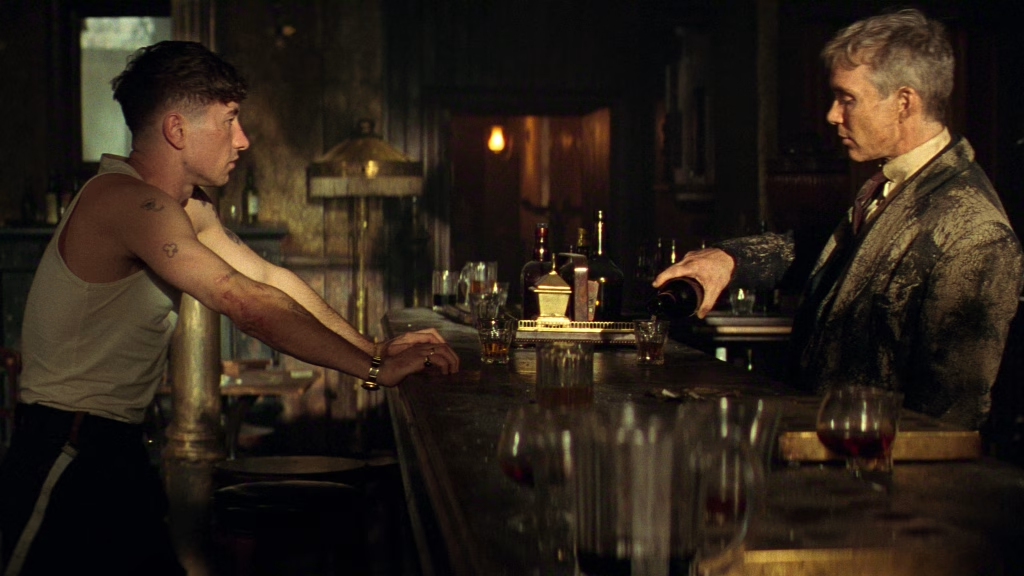
Peaky Blinders has always loved turning Tommy into something close to folklore. Other characters talk about him like he’s half man, half omen. He walks into rooms and the atmosphere changes. He acts like fear is just another tool in his pocket. The series built that image carefully over years, which is why the film’s approach feels so important.
A title like The Immortal Man invites one final coronation. Instead, the stronger choice is to make Tommy confront the emptiness inside that legend.
That seems to be the lane the film takes. He returns to save his son, protect what remains of the family, and face a wider threat linked to war and fascism. The stakes are bigger than the usual Birmingham turf battle, but the emotional core stays personal. Tommy is still fighting enemies, but the real fight is with the story he has told himself for years, that all of this bloodshed had some higher purpose.
Did it? Or was he simply brilliant at making destruction sound noble?
That question has followed the series for a long time. The Immortal Man appears ready to answer it in the bleakest way possible.
Arthur and Ada Matter Even in Absence and Loss
You can’t really end Tommy Shelby’s story without dealing with the family members who shaped him most. Arthur Shelby and Ada Thorne were never just supporting players. Arthur was Tommy’s chaos, guilt, and history walking around in human form. Ada was often the clearest-eyed person in the room, the sibling who could see through his grand speeches.
The film’s handling of those relationships seems designed to leave Tommy with nowhere to hide. Once the people who anchored him are gone, or become part of his remorse, there is no performance left to do. No political mask. No strategic grin. No cigarette-and-silence routine to buy time. He has to sit with himself.
That is why this story feels like an ending even before the final scenes. It removes the scaffolding. Tommy is no longer the mastermind perched above everyone else. He is a man walking through the wreckage of his own decisions.
For a character this iconic, that is exactly the right move. Big endings are not always about spectacle. Sometimes they are about forcing the main character to lose the language he used to control the room.
Death Is Only Part of What Makes This an Ending

The crucial thing about Tommy Shelby is that physical death was never the only possible end for him. In some ways, the series already told us that. After the war, part of him was permanently trapped in that psychological no-man’s-land. Every season since then has been about whether he can live with himself, not whether he can beat the next opponent.
So if The Immortal Man ends with Tommy dying, that matters. Of course it does. But the more important point is what that death means.
If he dies after choosing family over power, or after finally admitting the cost of the empire he built, then the film gives him something the series rarely allowed him: clarity. Not innocence. Definitely not innocence. Tommy Shelby has done far too much for that. But clarity, maybe. Peace, in the Peaky Blinders sense of the word, which usually means a few quiet seconds earned after unimaginable suffering.
And even if the wider franchise continues, that would still count as an ending for Tommy. A ghost, a memory, a myth, a story people tell in pubs years later, that is not the same thing as Tommy Shelby the man still driving the plot. It would mean the character has passed into legend, which is exactly where someone like him belongs.
That is why The Immortal Man could end Tommy Shelby’s story so effectively. Not because it suddenly makes him mortal, but because it finally stops treating survival as the same thing as winning. For Tommy, that may be the only ending that ever made sense.

Rachel Sikkema is a New Zealand-based writer and creative entrepreneur who explores the intersection of film, culture, and modern relationships. Through her articles, she examines how stories shape the way we connect, love and see ourselves – all for God’s glory. When she’s not writing about film and television, she’s watching Dexter and The White Lotus for the third time.