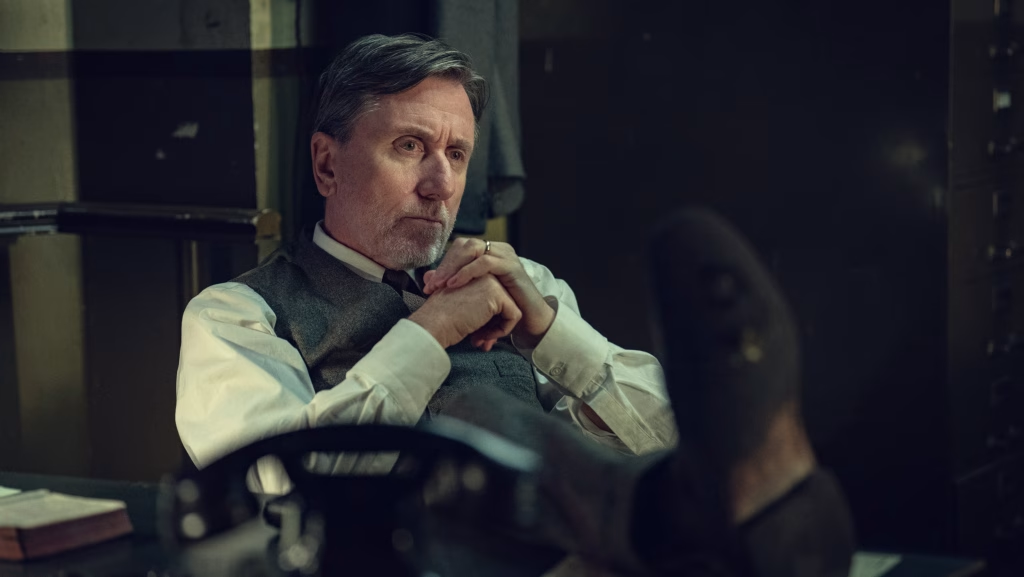
There was never any danger of people showing up for Peaky Blinders: The Immortal Man. The audience was always going to be there. Tommy Shelby is too iconic and the pull of unfinished business is too strong. The real question was never whether people would watch. It was whether the movie could still feel like Peaky Blinders.
That is a trickier challenge than it sounds. A series can sprawl. It can breathe. It can spend ten quiet minutes on a look across a table and somehow make that feel like a threat. A movie has less room for that kind of slow poison. So if The Immortal Man is going to work as more than a victory lap, it needs to remember what made this story addictive in the first place. Cillian Murphy is back as Tommy Shelby, and Tim Roth, Stephen Graham, and Barry Keoghan are among the key cast.
Tommy Has to Feel Dangerous Again
The biggest thing the movie needs to get right is Tommy himself.
Not because Cillian Murphy needs help. He does not. He could probably make ordering a drink feel like a declaration of war. The issue is that Tommy has already gone through so many transformations that a movie can easily fall into the trap of treating him like a legend instead of a man. Once that happens, the character starts to feel embalmed. He still looks great in a coat, but the pulse gets weaker.
The best version of Tommy Shelby is never fully settled. He is sharp, haunted and often impossible to trust even when he is telling the truth. The film needs that tension back in every scene. If Tommy walks into a room, the audience should feel like anything could happen.
That matters even more in a war setting. Official plot details place the film in Birmingham in 1940, with Tommy pulled back from self-imposed exile during World War II. That setup only works if Tommy still feels capable of destruction, not just reflection.
The Story Has to Be About More Than Nostalgia
Franchise movies love nostalgia because nostalgia is efficient. One familiar song, one old location, one callback line, and suddenly everyone feels sentimental. But Peaky Blinders was never at its best when it was winking at itself. It was best when it acted like power, trauma, family, class, and violence were all tangled together.
So the movie needs to resist the urge to become a museum exhibit for its own greatness.
Yes, viewers want the atmosphere. They want the smoke, the leather gloves, the hard stares, the operatic music cues, and the constant sense that every bad decision somehow becomes more glamorous in Small Heath. But style cannot be the whole meal. It has to be tied to conflict. If the film only gives people the surface pleasures of Peaky Blinders, it will feel polished and empty in the exact wrong way.
What it should do instead is use the wartime setting to push the story somewhere harsher and stranger. War changes the meaning of power. It changes masculinity, loyalty, business, and survival. A gangster story inside a nation already at war should feel unstable. It should feel like the old Shelby methods still work in some places and fail badly in others.
The Supporting Players Need Real Weight
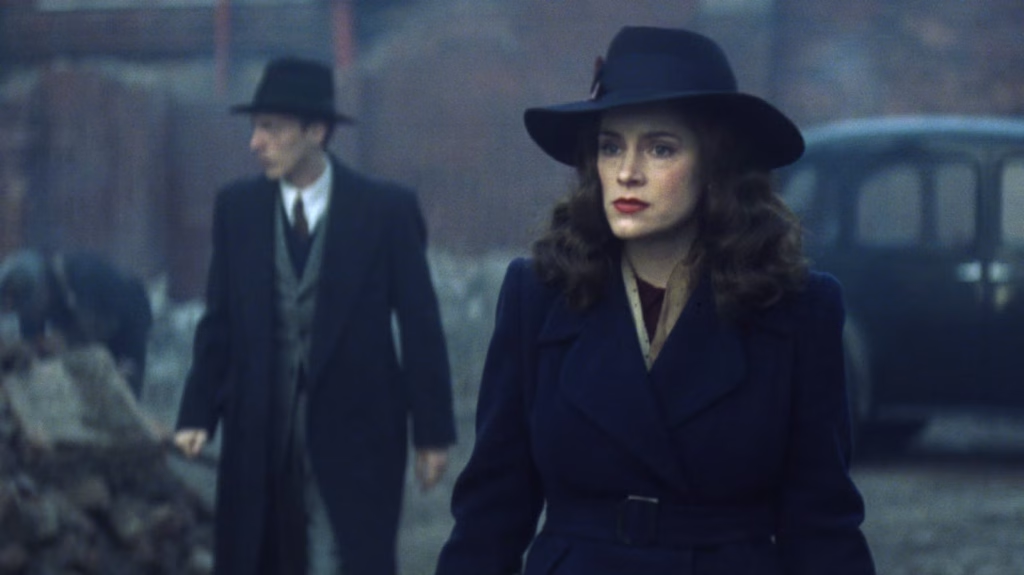
This is another place where a movie can get into trouble fast.
A series can give space to side characters until they stop feeling like side characters at all. Peaky Blinders built much of its power from that. Ada never mattered because she was Tommy’s sister on paper. She mattered because she could challenge him from a moral and political angle he could never fully dismiss. Arthur mattered because he was both terrifying and tragic. Polly mattered because she understood the emotional cost of the family business better than anyone.
A film does not have enough time to give everyone that same depth, so it has to choose carefully. But the people around Tommy still need to feel like they have their own gravity. Sophie Rundle returning as Ada is especially important for that reason. She often grounds the story when Tommy starts drifting too far into myth. Barry Keoghan’s Duke also matters because he represents the future of the Shelby line.
If the film gets lazy with its supporting cast, everything narrows. Then it becomes one intense man having Very Important Feelings in expensive lighting. That can work for a scene or two. It cannot carry the whole story.
The Villains Need to Feel Specific
One of the sneakiest problems in prestige franchise storytelling is the generic antagonist. Someone who exists mainly so the hero has something to stare down. That is not enough here.
The strongest Peaky Blinders opponents always represented something larger than themselves. They were not just obstacles. They brought a worldview with them. That is why the political and ideological threats often landed harder than the purely criminal ones. When official details point to Tim Roth playing a Nazi-linked economic operator, that suggests the movie understands this on paper. The question is whether it delivers that threat with enough texture and menace on screen.
The movie needs villains who feel smart, historically grounded, and personally dangerous. Not cartoon monsters. Not generic men in dark rooms. If Tommy is confronting his legacy, then the people opposing him should force him to face what his methods have built, encouraged, or failed to stop.
It Has to Earn Its Ending

This may be the most important part of all.
When a long-running series becomes a movie, there is always pressure to make the ending bigger. Louder. More final. More quotable. But Peaky Blinders has never thrived on neat closure. Its best endings leave a bruise. You understand what happened, but you also feel what it cost.
That is the tone the movie needs. Not a tidy farewell wrapped up with a dramatic speech and a swelling soundtrack. It should leave Tommy Shelby changed in a way that actually means something. Maybe that means punishment. Maybe it means surrender. Maybe it means survival that feels heavier than death. Whatever form it takes, it has to feel emotionally true to the man the series spent years building.
That matters even more now that the franchise is continuing beyond the film. Recent announcements confirm a new sequel series set in the early 1950s. That means The Immortal Man is not just ending one chapter. It is also handing the world off to what comes next. The film needs to close Tommy’s story in a way that feels complete without shrinking the universe around him.
What the Peaky Blinders movie really needs to get right is the balance between myth and humanity. Tommy Shelby has always worked because he feels larger than life but recognizably human at the same time. Lose the humanity, and he becomes a statue. Lose the myth, and he becomes just another damaged gangster. The sweet spot is where Peaky Blinders has always lived. If the movie can find that again, it has every chance of feeling worthy of the name.

Rachel Sikkema is a New Zealand-based writer and creative entrepreneur who explores the intersection of film, culture, and modern relationships. Through her articles, she examines how stories shape the way we connect, love and see ourselves – all for God’s glory. When she’s not writing about film and television, she’s watching Dexter and The White Lotus for the third time.