
Alexander Skarsgård’s chest in Wicker looks less sculpted than assembled. Thin brown strips cross over one another in tight geometric patterns. His shoulders flare like the rim of an ambitious picnic basket. Even his nipples have been woven with startling dedication.
The immediate assumption is digital wizardry. A human body contains too many curves, hinges and expressive little movements for rigid basket material to follow politely. Yet most shots of the Wicker Husband contain little or no CGI.
Skarsgård is actually inside there.
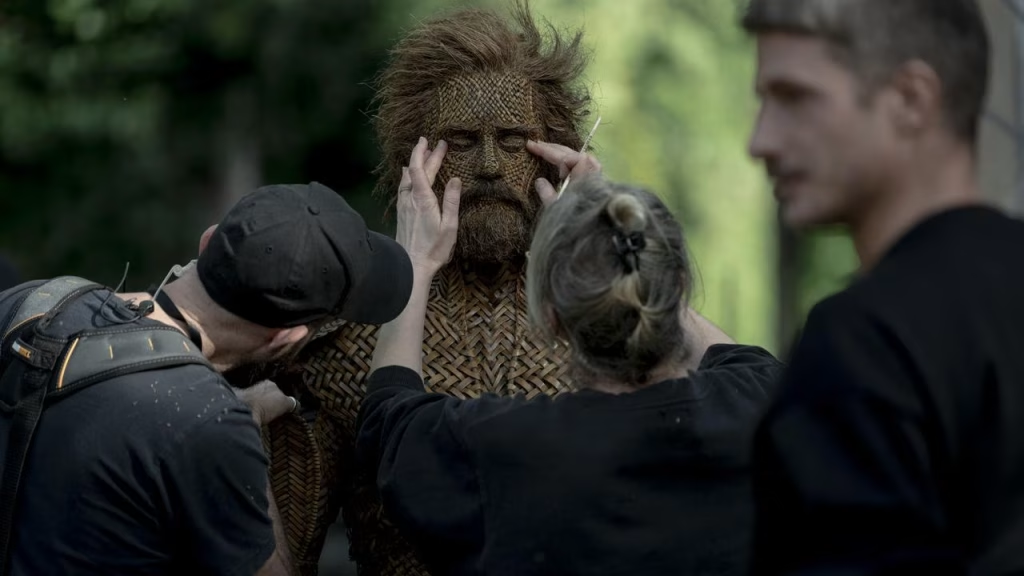
Wētā Workshop created a wearable fabricated suit and full facial prosthetic makeup for the role. The finished character combines body scanning, physical construction, prosthetics, hand-applied woven texture and a restrained layer of visual effects.
A team had to turn one of cinema’s most recognisable leading men into a romantic household object without losing the man underneath. Somehow they pulled it off.
The Husband Had to Exist in the Room
Directors Eleanor Wilson and Alex Huston Fischer understood the central problem early. Wicker depends on Olivia Colman’s Fisherwoman falling sincerely in love with a man made from woven material.
A digital character could deliver the correct shape. It would still leave Colman performing intimate scenes opposite markers, empty space or an actor waiting to be replaced in post-production.
That distance could have killed the romance.
The Wicker Husband needed weight. Colman had to feel his arms around her and look into an actual face. When he entered a cottage, his body needed to interrupt the light. When he sat on a bed, the mattress needed to acknowledge him.
So the filmmakers approached Wētā Workshop before much of the production had fallen into place. The New Zealand company has spent decades solving similar problems across fantasy and science fiction. Its artists build creatures and armour that can survive a camera moving close enough to reveal every seam.
The assignment here carried a peculiar challenge. Make Alexander Skarsgård look hollow, woven and handmade. Also make him kissable.
Weaving a Human Body Causes Trouble
Traditional wicker likes certain shapes. Baskets tend to curve in regular ways because their long fibres bend across supporting strands. The human body behaves with far less courtesy.
Cheeks swell. Knees compress. Shoulder blades shift beneath skin. A torso twists through several planes at once. Real wicker pulled tightly around those forms would resist movement, buckle or turn Skarsgård into a decorative cupboard.
Wētā’s solution reportedly began with a precisely shaped printed shell based on his body. Woven material could then be applied across that structure, giving the surface its basket texture while the engineered form underneath handled the difficult anatomy.
This approach creates the best kind of screen illusion. What the audience sees remains physically present, but the apparent method of construction differs from the actual one.
The Wicker Husband looks as though Peter Dinklage’s Basketmaker bent reeds directly into a living man. Behind that rustic fantasy sits scanning, fabrication and a great deal of modern problem-solving.
Magic always has technicians.
His Face Became the Hardest Basket

A woven torso can survive a little stiffness. A face has nowhere to hide.
The character needed to speak, listen and fall in love while wearing a lattice across nearly every recognisable feature. Too much movement would make the material feel soft and rubbery. Too little would leave Skarsgård trapped behind a handsome hamper.
Wētā Workshop prosthetic makeup designer Joe Dunckley led the practical effects work. Lead makeup effects artist Sarah Rubano handled the application. Their design included full facial prosthetic makeup tailored to Skarsgård’s own expressions.
His brow became especially important. During rehearsals, Skarsgård showed the filmmakers how he furrowed it. That small movement helped guide the sculpting so his performance could pass through the woven surface.
It is a lovely detail because the Wicker Husband’s emotional life depends on attention. He often reacts quietly to the Fisherwoman. A slight change around the eyes or brow has to carry the moment through layers of makeup.
The team preserved just enough of Skarsgård’s facial mechanics for us to read him while allowing the weave to remain visibly rigid. His features seem carved from basketry, yet a thought can still travel across them.
That balance is fiendishly difficult. The suit has to look incapable of expression while expressing plenty.
A Private Test Proved the Creature Could Perform
When Skarsgård first wore the completed look, Wilson and Fischer cleared the room. The actor spent a private ten-minute test with the directors and read poetry in character.
There is something wonderfully earnest about this image. Months of design work culminated in a very tall Swedish man standing inside a wicker face and reciting poems to two filmmakers.
The test answered a question more important than whether the costume looked impressive. Could an audience connect with the person inside it?
A still photograph can sell texture. Performance requires rhythm and presence. Skarsgård had to discover how much movement could register through the suit. The directors had to learn where the camera would find tenderness.
Once the Wicker Husband could hold attention during a quiet reading, the production had its character rather than a display piece.
The Suit Changed Skarsgård’s Performance
Heavy transformation asks actors to adjust their usual tools. A tiny facial reaction may disappear under prosthetics. A casual turn of the head can look mechanical when a rigid surface follows it.
Skarsgård had to perform with greater physical clarity. Posture mattered. The angle of his head mattered. Stillness became expressive because the suit made every deliberate movement feel slightly uncanny.
This limitation suits the Wicker Husband. He has entered the world fully formed, but his behaviour carries an appealing newness. Skarsgård’s careful movements suggest someone learning how his body works while already knowing whom he loves.
The costume also changes his familiar screen presence. His height and broad frame often create menace. Wētā exaggerates both, building an enormous woven torso that could loom over Colman.
Then Skarsgård fills that body with gentleness.
That contrast makes the design romantic rather than merely spectacular. The intimidating silhouette contains a patient husband. Wētā provides the architecture. Skarsgård changes the temperature inside it.
Tiny Digital Touches Create the Hollow Illusion
Practical construction handles most of the transformation, though a few details benefit from visual effects.
The human being inside the suit naturally fills spaces that should appear empty. In selected shots, digital artists added points of light through gaps in the weave. Those glimmers convince the eye that nothing exists beneath the outer structure.
It is a subtle effect with a large payoff. Light passing through the body confirms that this creature has no ordinary flesh. His torso becomes a genuine woven volume rather than armour worn over a man.
Sound completes the illusion. Creaks and fibrous rustles give movement a material quality. Before the audience consciously studies the suit, the soundtrack has already told us what his body feels like.
This is practical and digital work behaving sensibly together. The physical suit gives Colman something real to touch. Visual effects remove the final traces of the performer hidden inside. Sound supplies an inner life made from friction.
Each department adds a thin strand. The character emerges from the weave.
The Craftsmanship Supports the Love Story
A lesser film might use the Wicker Husband for one good reveal and a stream of basket jokes. Wicker certainly enjoys the comic possibilities. Woven nipples were never going to pass unnoticed.
The design also carries the film’s emotional argument.
The villagers judge the Fisherwoman by her smell, clothes and unmarried status. Her handcrafted husband looks stranger than anyone around him, yet he offers the kindness their conventional society lacks. His artificial body becomes a test of what people consider human.
That idea works because the practical suit feels tactile. We can imagine its roughness against skin. We notice the gaps, edges and shifting layers. Colman’s attraction has to cross a real physical difference.
The romance gains tenderness from the effort required to build its object of desire. This husband has been made strand by strand, first within the story and again by the artists outside it.
Many Hands Made One Very Handsome Basket
Wētā Workshop describes the character as the product of many hands and many strands. That phrase neatly captures why the result feels special.
The Wicker Husband carries evidence of labour. His patterns change around the shoulders and chest. His face has been designed around an actor’s brow. Every section had to satisfy the needs of sculpture, costume and performance at once.
The finished body looks ancient and technologically ingenious. It appears handmade because it was, even when modern fabrication provided the hidden foundation.
Most importantly, the craft disappears at the right moment. We can admire the weave when Skarsgård enters a scene. Once he looks at Colman, we begin watching a husband.
Then he turns slightly, the light slips through his chest and you remember that Wētā Workshop built a romantic lead out of basket technology.
Frankly, the wicker nipples deserve their own award.

Rachel Sikkema is a New Zealand-based writer and creative entrepreneur who explores the intersection of film, culture, and modern relationships. Through her articles, she examines how stories shape the way we connect, love and see ourselves – all for God’s glory. When she’s not writing about film and television, she’s watching Dexter and The White Lotus for the third time.