If you walk out of Bugonia feeling half convinced Michelle Fuller is an alien and half convinced Yorgos Lanthimos is playing a very elaborate joke on you, that is probably the correct emotional state. This is a film that spends most of its runtime asking whether Teddy’s paranoia has finally snapped in two or whether he has accidentally stumbled onto a truth nobody else is willing to see.
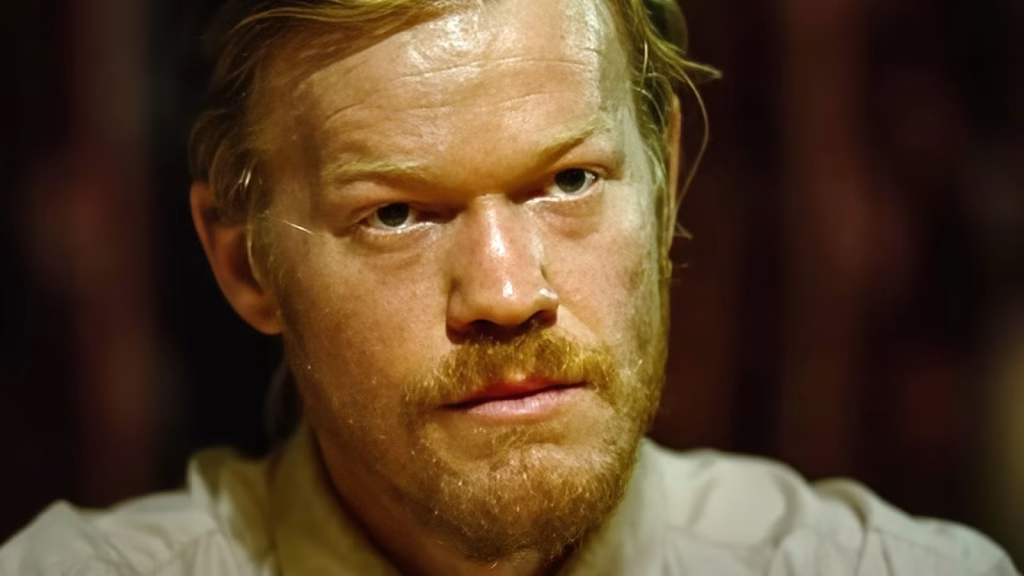
Michelle, played by Emma Stone, is introduced as a powerful corporate executive kidnapped by Teddy, a conspiracy-minded beekeeper played by Jesse Plemons, who becomes certain she is an extraterrestrial threat. For a long stretch, the movie wants you to sit in that uncertainty and squirm.
The Movie Wants You to Doubt Teddy First
For most of the film, the smartest reading is that Teddy looks delusional for good reason. He has built an entire belief system around Michelle’s body, her manner, her corporate power, and his own fear that the people running the world are less than human.
That fear has obvious social meaning in a story this pointed. Michelle is not just some random woman he fixates on. She is a pharmaceutical CEO, polished to a near inhuman sheen, which makes her the perfect target for a man who already believes elites are poisoning society from above.
Michelle’s Behavior Keeps the Question Alive
Emma Stone plays Michelle like someone who is always translating herself into acceptable corporate language. Even under pressure, she rarely feels messy in an ordinary human way. She negotiates. She assesses. She pivots. That does not prove she is an alien, obviously, because it could also describe a ruthless executive who has spent years learning how to stay unreadable. Still, Bugonia knows exactly what it is doing by giving Michelle that eerie composure. The performance keeps feeding Teddy’s theory without ever fully surrendering to it.
The film also piles on details that seem ridiculous in isolation but gain force through repetition. Teddy insists her hair is part of how she communicates with her species. He obsesses over physical traits. He reads ordinary power as evidence of something nonhuman. Any one of those ideas should collapse under scrutiny. Instead, Lanthimos keeps returning to them just enough that they start to feel less like random ravings and more like a cracked language for describing class domination, technocratic coldness, and the basic creepiness of people who speak in mission statements.
The Ending Says Yes on a Literal Level
Taken literally, the answer is yes. Michelle really is an alien. The final stretch stops hedging and reveals that her confession is not just a desperate manipulation tactic. After Teddy dies in the explosion, Michelle returns to her office, enters the closet he believed was a teleportation device, and is actually transported to a ship.
Once aboard, she appears before fellow Andromedans and helps make the decision to end the human experiment. The movie then shows a worldwide collapse of human life while the natural world, especially bees, appears to continue without us. That is not the kind of ending that leaves much wiggle room if you are reading events at face value.
So if the question is purely plot-based, Bugonia eventually tips its hand. Michelle is not merely coded as alien or treated like one by Teddy. She is presented as one. That makes the film stranger, meaner, and more provocative than it would be if Teddy were simply wrong from start to finish. It also flips the moral comfort viewers might want. The paranoid kidnapper is violent and unstable, yet the horrifying cosmic truth he latches onto turns out to be real. That is the kind of twist that leaves a nasty taste on purpose.
But the Ending Is Still Playing With Interpretation
Here is where things get more interesting. Lanthimos has talked about how divided viewers are on the ending, and that division matters. Even with the spaceship reveal, the film still invites a symbolic reading.
The alien twist can be taken as literal science fiction, but it also works as a dark exaggeration of a simpler idea: people with enormous institutional power can feel so detached from ordinary life that they may as well be another species. Michelle’s final judgment on humanity lands with extra force because she has spent the whole movie embodying elite distance, managerial calm, and a kind of bloodless authority.
That is why the question “Is Michelle actually an alien?” is a little slippery. The film answers yes, then keeps poking at what that yes is doing. Is it satirizing conspiracy thinking by making the impossible true?
Is it mocking the fantasy that exposing one secret villain would explain the world’s problems? Is it suggesting that humanity is ruining the planet so thoroughly that even a ridiculous cosmic tribunal starts to feel almost plausible? Probably some ugly combination of all three. Bugonia is not interested in making you comfortable about any of them.
What Michelle Really Represents

Michelle works best when you stop treating her as only a twist and start seeing her as the film’s coldest idea made flesh. She is corporate power with a smile. She is the suspicion that polite authority can hide something monstrous. She is also a challenge to Teddy’s worldview, because even when he is right about her nature, he is still wrong in so many other ways that the victory barely counts as one. He cannot understand her clearly. He can only force everything into his own damaged framework.
That tension is what gives the movie its sting. Michelle is real, but so is projection. The alien truth does not cleanse Teddy or make his violence noble. It only makes the world of the film more rotten than it first appeared. And honestly, that is a very Lanthimos move. He takes a question that could have become a neat genre reveal and turns it into something nastier, sadder, and faintly absurd.
So yes, Michelle is actually an alien in Bugonia if you are following the plot to its endpoint. But the more interesting answer is that she is also the film’s embodiment of elite distance, ecological judgment, and the sickening possibility that the people steering the world no longer belong to it in any meaningful emotional sense. That is why the reveal lingers. It is not just a gotcha. It is a punchline with poison in it.

Rachel Sikkema is a New Zealand-based writer and creative entrepreneur who explores the intersection of film, culture, and modern relationships. Through her articles, she examines how stories shape the way we connect, love and see ourselves – all for God’s glory. When she’s not writing about film and television, she’s watching Dexter and The White Lotus for the third time.