By Rachel Sikkema
Published October 10, 2026

Other Mommy makes Bela’s mother frightening by turning recognition into something she can no longer trust. The entity wears a face that should help Bela feel safe, forcing her to question the person she would normally run towards when scared. Jessica Chastain playing both her mother and the creature gives that uncertainty a cruel intimacy. Even familiarity needs checking now.
The disturbing idea is that the disguise comes with emotional authority. A mother’s face carries years of reassurance and ordinary closeness. The entity can borrow all of that before Bela has worked out what stands in front of her.
That is the film’s sharpest source of fear for me. Beneath the supernatural chaos lies a child trying to decide whether the adult reaching for her deserves to be trusted. The face offers an answer that the behaviour keeps making harder to believe.
Bela Already Knows How to Read This Face
Arabella Olivia Clark’s Bela lives in a household where her parents’ strained relationship complicates the comfort home should provide. Her mother Ursula has moods and frustrations. Like any child, Bela has to navigate the difference between an adult being upset and an adult being upset with her.
The opening bedtime scene establishes a small version of that problem. Bela and her father Russell are enjoying themselves until Ursula steps in to bring the evening back under control. It is a familiar family moment, with one parent carrying the less entertaining responsibility.
That matters because Ursula’s face already means several things to Bela. It can offer affection or announce that playtime is over. Her mother can love her and still feel difficult to approach.
The entity enters that existing uncertainty. Bela has experience trying to understand changes in her mother’s manner. Now something supernatural makes those changes potentially dangerous.
Calling Ursula’s face the safest in Bela’s world describes the security Bela should be able to find there. The family’s difficulties have already made that security uneven. Other Mommy pushes into the gap between recognizing a parent and knowing what kind of reception you will get.
A stranger would have to establish a connection. This creature arrives wearing one.
Jessica Chastain Makes the Smile Feel Like a Demand
The exaggerated smile is the film’s most immediately recognizable image. Chastain stretches an expression associated with welcome until it starts asking too much of the person looking back.
There is something particularly unpleasant about a smile that appears to require a response. It puts pressure on Bela to accept the mood being offered. Be pleased. Come closer. Treat this as affection.
The expression can also be read as a clumsy attempt to perform warmth. Other Mommy seems to understand that mothers smile at children, while struggling with everything that makes the gesture reassuring. Warmth involves attention to the other person. A grin can simply occupy a face.
That gap gives Chastain’s dual role its purpose. Ursula and the entity share features, but those features carry different intentions. Bela has to look past resemblance and interpret what someone wants from her.
The film risks making its creature too visibly monstrous for that uncertainty to last. Once the grin announces danger quite so loudly, the disguise becomes easier for an audience to reject. I find the underlying possibility more troubling than the most extravagant expressions.
A familiar face behaving slightly wrong leaves a horrible amount of room for doubt. You can imagine a child trying to explain the difference and finding that every available description sounds small.
Affection Becomes a Way of Asking for Access
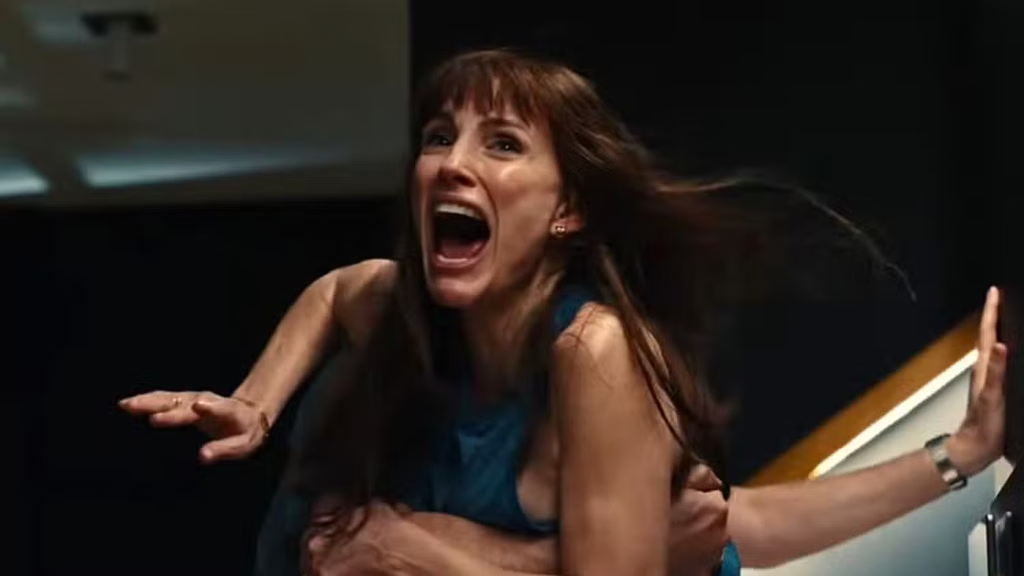
“Can I go inside your heart?” sounds like something a child might hear in a sentimental story. Other Mommy gives the question a physical threat.
The wording matters. It presents an invasion as an invitation to become closer. Bela is being asked to participate in something she has little ability to understand, by a presence using the language and appearance of care.
That makes the request feel coercive even when it takes the form of a question. A child can hear an appeal for affection as something she is expected to answer kindly. Refusing may feel hurtful before it feels sensible.
The entity benefits from that confusion. It places its own desire at the centre of the exchange and waits for Bela to accommodate it.
I think this is more disturbing than a creature simply breaking through a locked door. The heart is supposed to belong to Bela. Other Mommy approaches it as a place where persistence might eventually secure entry.
The maternal disguise makes that persistence harder to dismiss. When someone who looks like your mother asks to be loved, suspicion can feel like a betrayal. Bela is left managing feelings that the creature has deliberately made difficult to separate.
A Child Should Never Have to Solve This Problem
Watching an adult confront a double invites a certain kind of puzzle. We look for clues and wonder how quickly they will identify the fraud.
With Bela, the same situation feels unfair before it feels clever.
She has to judge the intentions of an entity that understands how to approach her. Her need for comfort becomes part of the danger. Even a sensible impulse, such as wanting her mother nearby, can lead her towards the wrong presence.
The adults do encounter the creature themselves, which spares Bela the familiar horror-film ordeal of spending the whole story trying to prove that something exists. Yet being believed only resolves one part of her predicament.
Someone still has her mother’s face.
Knowing there is a threat cannot give Bela back the ease of recognizing Ursula without hesitation. Her parents can try to protect her while the entity continues exploiting a relationship that protection depends upon.
That is why the child’s perspective matters so much. We can recognize the premise as a supernatural trick. Bela has to experience it as a problem inside her family, using the limited knowledge and emotional resources available to her.
She should be allowed to see her mother and relax. The film makes that ordinary relief feel precarious.
The Disguise Reaches Further Than the Monster

Rob Savage fills Other Mommy with escalating supernatural danger, but its central image can do damage while standing still. Once a trusted face has been copied, the original becomes harder to look at innocently.
Chastain’s presence in both roles keeps that association alive. The audience carries the creature into moments involving Ursula. We inspect expressions that might otherwise pass without notice, searching for a sign that the person before Bela has changed.
There is a nasty consequence to that shared suspicion. Ursula can become frightening through proximity to the imitation, even when Bela needs her real mother’s comfort. The entity has found a way to interfere with reassurance itself.
For me, this is where the film’s idea has the most staying power. A monster can leave the room and still alter what the room feels like. Other Mommy can disappear while leaving Bela with a new reason to hesitate.
The face remains familiar. What has changed is the work required to trust it. Other Mommy takes a child’s simplest route towards safety and inserts a question she should never have needed to ask before reaching for her mother.

Rachel Sikkema is a New Zealand-based writer and creative entrepreneur who explores the intersection of film, culture, and modern relationships. Through her articles, she examines how stories shape the way we connect, love and see ourselves – all for God’s glory. When she’s not writing about film and television, she’s watching Dexter and The White Lotus for the third time.