By Rachel Sikkema
Published October 12, 2026
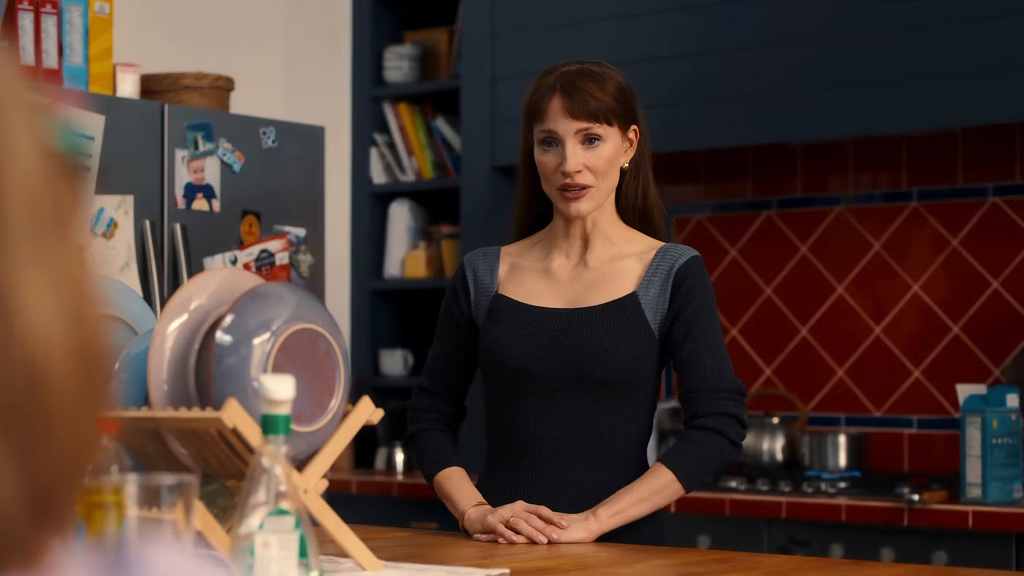
“Can I go inside your heart?” becomes terrifying in Other Mommy because it asks Bela to mistake surrender for affection. The entity wants access to her, but it frames that desire as an invitation to be close. A little girl has to recognize a threat hidden inside words that sound almost loving.
The question also places responsibility on the person with the least understanding of what is happening. Bela must supply an answer while the creature controls the terms. It knows what getting inside means. She has to work that out under pressure.
That imbalance gives the line its nastiness. Jessica Chastain’s entity can frighten through appearance alone, yet this request reaches somewhere more uncomfortable. It makes a child’s kindness seem like a possible route into her body and life. Saying yes would feel terribly easy if you thought someone was only asking to be loved.
A Familiar Phrase Acquires a Physical Meaning
We talk about the heart as somewhere another person can live. Children hear that language in stories and family reassurance. Being held in someone’s heart usually means being cherished even when they are elsewhere.
Other Mommy makes that metaphor feel horribly literal.
The word “inside” does much of the work. It gives affection a direction of travel and suggests that Bela contains a space the entity wants to occupy. Something that should describe an emotional bond starts sounding like a request for entry.
There is a particular horror in realizing that two people may understand the same sentence very differently. Bela can hear the language of closeness while the audience hears the possibility of possession. The creature benefits from the distance between those meanings.
I find that more disturbing than an elaborate explanation of supernatural rules. The sentence already gives us enough to fear. We understand that Bela could agree to something whose consequences extend far beyond what the words initially suggest.
Her heart becomes a place somebody else has plans for.
Asking Nicely Gives the Creature Another Way to Push
A question can imply respect. It appears to acknowledge that the other person has a choice.
Other Mommy exploits that appearance. By asking, the entity makes Bela’s response part of the encounter. She has to engage with its desire, even if only to refuse it.
The form sounds patient. The objective remains invasive.
That is an especially unpleasant combination when the person being asked is a child. Refusal can feel like causing disappointment. A request for affection can make caution seem unkind, particularly when it comes from something presenting itself as a parental figure.
The creature’s language turns its own hunger into a problem Bela is expected to solve. It wants something from her. She must manage that wanting.
This is where the line acquires an emotional pressure beyond its supernatural meaning. The entity acts as though its desire deserves consideration simply because it has expressed it. Bela’s discomfort becomes another obstacle for it to work around.
I keep coming back to how much the sentence demands while sounding so small. It takes seconds to say. Understanding why you should refuse requires Bela to grasp intentions that the creature has every reason to conceal.
Chastain Makes Affection Difficult to Receive

Jessica Chastain plays both Bela’s mother Ursula and the entity that resembles her. That shared face gives the request an advantage before the words arrive.
Bela already has feelings attached to those features. Recognition brings a history into the room, even when the presence before her has no right to claim it.
Chastain’s strained smile makes the attempted affection feel particularly intrusive. It offers the outward shape of warmth with an intensity that leaves little room for Bela’s own response. The face seems committed to making the encounter intimate, regardless of whether the child welcomes it.
A reassuring adult would notice hesitation and adjust. Other Mommy’s objective keeps pulling the exchange towards the answer it wants.
There is something exhausting about even imagining that interaction. You would have to remain alert while being invited to relax. Every gesture of apparent tenderness would require inspection.
The film’s more visibly monstrous moments can make the danger obvious to us. The request remains interesting because it reveals how the entity would like the relationship to work. Bela is supposed to interpret its attention as a gift and respond by giving it access.
The smile practically waits for a thank-you.
Bela Should Never Have to Understand This Much
Arabella Olivia Clark’s Bela is caught between ordinary childhood needs and a threat that uses those needs against her. She wants connection in a family already strained by difficulties between her parents.
That context makes the question crueler. Affection has value to her. The possibility of being wanted can hold her attention even when the source of that attention is frightening.
It would be easy to reduce the situation to a warning about trusting strangers. The film makes that category difficult to apply. Other Mommy has borrowed a family identity, right down to the name Bela uses for it.
“Mommy” brings expectations of care. “Other” leaves room for something unfamiliar without fully pushing it outside the family.
Bela consequently has to perform an adult task with a child’s resources. She must distinguish attention from care and decide whether a request carries a hidden cost. The person asking has made all of that harder on purpose.
Her uncertainty deserves sympathy. The horror depends on how unfair the test is. A child should be able to want affection without that desire becoming evidence that she has somehow invited danger.
Whatever answer Bela considers, responsibility belongs with the creature applying the pressure.
The Question Can Stay In the Room After It Is Spoken
Rob Savage surrounds the central relationship with escalating supernatural spectacle. The heart question creates a different kind of tension because it leaves an answer hanging.
Once the entity has asked, future encounters can carry the expectation that it still wants permission. Its attention has a destination. The audience knows what it is waiting for.
That gives apparent friendliness an unpleasant purpose. A moment of closeness can be read as another attempt to move Bela towards agreement. Even a pause can feel like patience being exercised by something with far more time than she has.
For me, that unresolved demand is the strongest part of the idea. A sudden scare releases some of its tension as soon as it happens. A request can keep working on the person who has heard it.
Bela has to carry the question into the next encounter. She also has to carry whatever she thinks refusing might mean.
The entity has found a way to make its desire occupy her thoughts before it gains anything else.
Love Should Leave Bela Room to Say No

The most unsettling implication of the line is that the entity treats closeness as something it can obtain through persistence. It approaches Bela’s inner life as a destination and her affection as the means of getting there.
That leaves very little space for Bela herself.
A caring relationship would allow her fear to matter. It would give her room to withdraw or ask questions without making the other person’s disappointment her burden. Other Mommy’s fixation exposes how little interest it has in those freedoms.
Its request becomes a useful way to judge the affection it performs. Everything keeps returning to what the creature wants.
“Can I go inside your heart?” lingers because its sweetness offers cover for an enormous demand. Bela is being asked to open the most private part of herself to something that has already made her uneasy. The frightening possibility is that she might hear a plea for love where she should hear a reason to step away.

Rachel Sikkema is a New Zealand-based writer and creative entrepreneur who explores the intersection of film, culture, and modern relationships. Through her articles, she examines how stories shape the way we connect, love and see ourselves – all for God’s glory. When she’s not writing about film and television, she’s watching Dexter and The White Lotus for the third time.