If you strip Pluribus down to its emotional core, it is not really about an alien virus, or a hive mind, or even the fate of the world. It is about the strange, exhausting experience of having to stay yourself when everything around you is begging you to merge, soften, comply. That tension is baked into the premise, but it really lives in Rhea Seehorn’s performance as Carol Sturka, a woman whose interior life keeps splintering under pressure from a world that now thinks and feels as one.
The series imagines a near future where an extraterrestrial signal leads to “the Joining,” a global shift that turns almost all of humanity into a content, cooperative hive mind known as the Others. Carol is one of only thirteen people who remain immune, marooned in Albuquerque while her neighbors, colleagues, and even her partner become part of the same smiling consciousness. Out of many, one, the title quietly promises. Carol’s existence is the uncomfortable opposite: out of one, many.
Living in a World That Has Moved On
The first episodes spend a lot of time letting you feel how wrong the world suddenly is for Carol. Everyone around her shares knowledge, memories, and intentions. They move through hospitals and cul-de-sacs with unnerving ease, finishing one another’s sentences because they literally share a mind.
Carol, by contrast, is stuck in the old operating system. She still has to wonder what people are thinking and grieve Helen (Miriam Shor). She still has to decide what to do next, alone. The Others insist they want the remaining humans to join them peacefully. They radiate pleasant concern, like customer service agents for a new reality. For Carol, that politeness only underlines how off everything feels.
Carol Sturka and the Split Between Inner Life and Outer Role
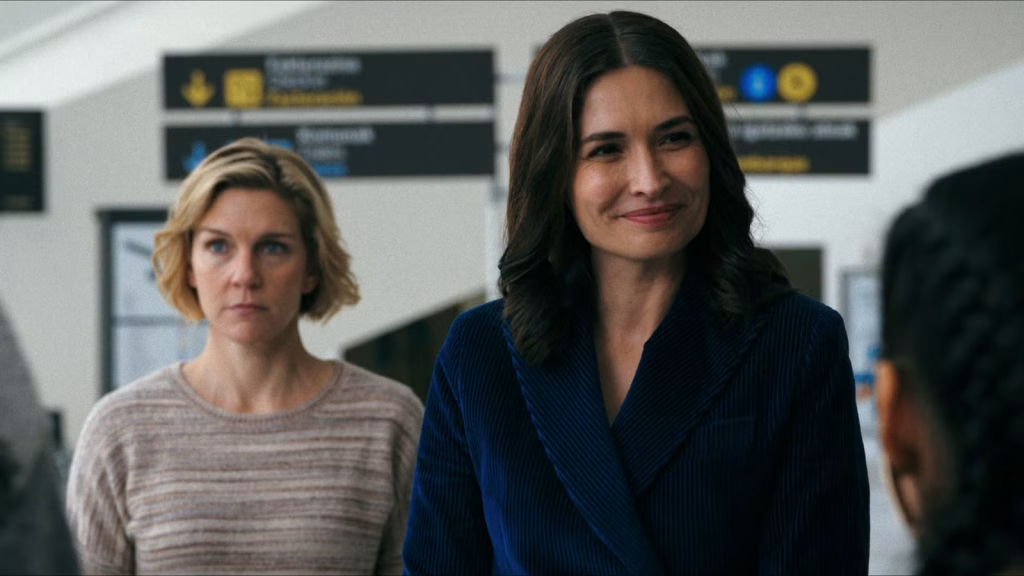
Seehorn plays Carol as someone who already lived with a divided self before the aliens ever called. She is a successful romance novelist who can write intimacy on the page, yet struggles to sustain it in her real life. The public persona, the book tours, the brand of “fantasy romance author” sit slightly apart from the woman at home, with her list of resentments and her complicated relationships.
One of the sharpest early choices is her decision to test a truth serum on herself. She steals sodium thiopental from the hospital and uses it to interrogate her own mind, eventually forcing herself to admit that she is sexually attracted to Zosia, the calm, unnervingly kind liaison assigned to her by the hive mind.
The Hive Mind as a Mirror of Identity
A hive mind story usually invites the same questions: Is losing individuality a nightmare or a relief? Is conflict-free living worth the cost? Pluribus takes those familiar questions and twists them slightly. The Others are not overtly sinister at first. They are peaceful and do not lie. They seem genuinely invested in Carol’s wellbeing, even when they close ranks to protect their own.
The hive mind also externalizes something most of us already live with. We might not share neurons with our neighbors, but we do move through algorithm-shaped culture where you can feel the pull to think with the group. Pluribus takes that soft social pressure, turns the volume all the way up, and then lets us watch someone try to stay weird and wounded and particular inside it.
Other Immune Characters and Their Broken Reflections
Carol is not the only holdout. Across the globe there are twelve other people who never joined, and the series slowly uses them to sketch a spectrum of fractured selves.
Koumba Diabaté, played by Samba Schutte, responds to the end of the old world by leaning into hedonism. He fills his post-Joining life with pleasure, parties, and surface-level company, almost as if he is trying to build a one-man counter-hive of sensation. His fractured self comes from excess: if the Others offer one steady emotional temperature, Koumba keeps spiking his.
Seen together, these characters turn the idea of “resistance” into something more complicated. Refusing to join the hive mind does not automatically equal healthy individuality. You can fracture by drowning yourself in distractions, or by cutting yourself off completely. The show uses each immune person as a different answer to the same question: if you cannot be one with everyone else, who are you going to be instead?
Why Fractured Selves Feel So Familiar Right Now

Part of why Pluribus lands so strongly is that you do not need an alien RNA signal to recognize this feeling. Modern life already nudges us into fractured identities. There is the version of you that lives in group chats, the one that shows up on social media, the one that performs at work, and the one that surfaces in private at 2 a.m. The gap between those selves can feel wider every year.
Pluribus dramatizes that tension with genre flair. Carol’s attempts to map the Others, to catalogue their limits, to test the boundaries of the Joining, all echo the way a lot of us try to map the systems around us. We read the room, study the algorithm, adjust our tone. Carol is doing that too, just with higher stakes and better production design.
Pluribus may wrap all of this in hive-mind lore and eerie smiles, but at heart it is telling a very grounded story about what it costs to stay particular in a world that rewards sameness. The fractured self hurts. It is lonely. It is messy. The series makes the case that it is also the only self worth fighting for.

Rachel Sikkema is a New Zealand-based writer and creative entrepreneur who explores the intersection of film, culture, and modern relationships. Through her articles, she examines how stories shape the way we connect, love and see ourselves – all for God’s glory. When she’s not writing about film and television, she’s watching Dexter and The White Lotus for the third time.