The first thing Pluribus takes away from most people is their name. Once the alien virus hits and The Joining begins, humanity melts into a smiling hive that speaks in a collective “we,” with shared thoughts, shared feelings and no private corners left. It looks peaceful. It sounds loving. It carries the same tone as a relentlessly upbeat group chat that never goes mute.
Vince Gilligan frames this happiness apocalypse around Carol Sturka, played by Rhea Seehorn, who becomes one of only thirteen people on Earth who remain uninfected. She stays stubbornly, painfully herself while almost everyone else dissolves into a cheerful crowd. The show sells that crowd as anonymous and safe, a place where guilt supposedly evaporates because there is no longer a “you” who did the thing in the first place.
On paper, that sounds like the ultimate escape. In practice, Pluribus keeps asking a harder question. When nobody has a name, where does the blame go?
A World Where Individuality Is Treated as a Problem
The Joining is introduced as a kind of global upgrade. A cosmic signal arrives, a wave spreads, and suddenly billions of people become perfectly synced. Conflict plummets. Violence drops. The chaos of separate minds and clashing desires gives way to a soft, beaming unity that insists everything is fine.
Inside that unity, anonymity looks like salvation. Old mistakes fold into the collective. Private shame is washed out in an ocean of shared experience. If everyone has thought the thought, then no one person has to carry it. That is how the hive sells itself, as a sanctuary from the exhausting business of being a single flawed human.
Carol as the Last Fully Visible Person

Carol sits at the opposite end of that spectrum. As one of the rare people who remain unjoined, she becomes almost painfully visible. Governments court her. Cameras track her. The hive itself develops an obsession with fixing her misery, treating her as a glitch that keeps the story from being fully triumphant.
Rhea Seehorn plays Carol as someone who would have preferred a quiet life and now carries the weight of an unwanted role: the last stubborn “I” in a world that wants everything to be “we.” She cannot hide in the crowd. Every decision she makes has a name, a face and a clear line of responsibility. When she lashes out, withdraws, or compromises, there is no collective voice to blur it.
The Hive and the Comfort of Shared Guilt
The hive mind, by contrast, makes moral decisions feel abstract. When billions act as one organism, how do you assign blame for coercion, manipulation or subtle cruelty. If a joined crowd pressures Carol, or nudges the remaining uninfected toward conversion, the action belongs to everyone and no one at the same time.
Pluribus keeps nudging us to notice that dynamic. The hive smiles while it erases dissent. It speaks in gentle tones while it proposes deeply invasive solutions. The ethical move is always framed as consent, yet the pressure under that consent is enormous. When a voice comes from everywhere, resisting starts to look irrational.
The Unjoined and the Temptation to Vanish
Not every immune character responds like Carol. Manousos Oviedo, played by Carlos Manuel Vesga, chooses a different path. He is one of the few remaining outliers who refuses to engage with the hive at all, retreating into storage units and liminal spaces where the joined cannot reach him easily.
Manousos leans into a different sort of anonymity. He is technically individual, yet he removes himself from society so thoroughly that he becomes a rumor, a shadow. This version of hiding has its own moral tangle. When you disconnect completely, you also dodge responsibility for helping anyone else. Your refusal might be principled, it might also be selfish, and the show refuses to give you an easy answer.
The Digital Echoes of Anonymity
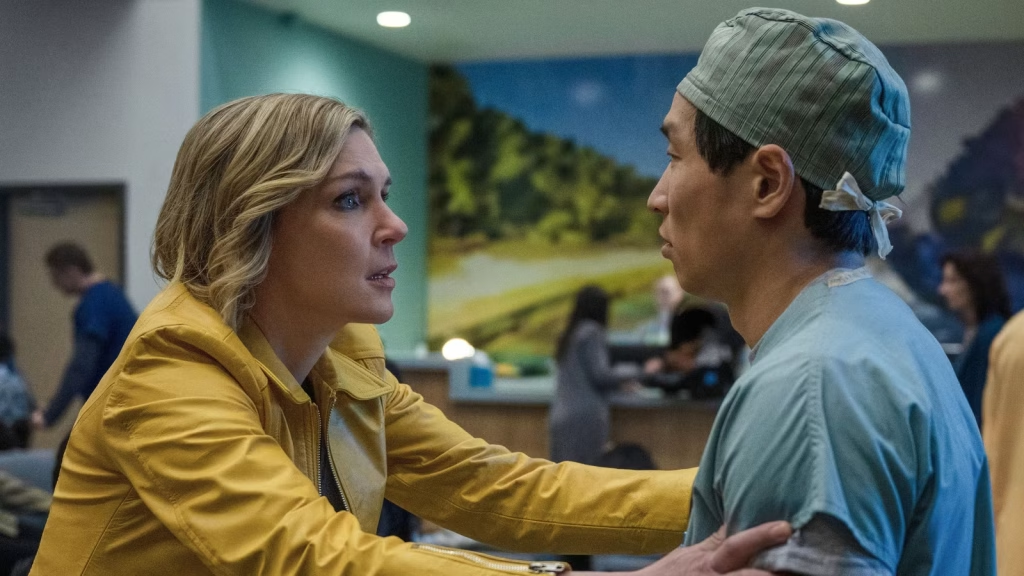
Even though Pluribus plays out in a sci-fi register, its moral questions feel eerily familiar. The Joining’s constant, soothing chorus mirrors the atmosphere of social media feeds, where everyone shares, reacts and amplifies together. The show’s critics have already picked up on how closely the hive resembles a collective consciousness shaped by online platforms, always present, always commenting, always certain it knows best.
Anonymity in that context becomes a sliding scale. Behind a username or within a crowd, it is easier to lash out, to cancel, to dogpile. Being one face in a swarm can make harmful behavior feel trivial, even noble. At the same time, people on the other side of the screen can feel hunted, hyper visible, pinned down by scrutiny in a way that Carol would recognize instantly.
Why Anonymity Feels Heavier After Pluribus
By the time you move through the early episodes, anonymity no longer reads as a simple perk of being online or part of a group. It starts to feel like a substance that needs handling, something that can protect or poison depending on how much you use and why you reach for it in the first place.
Pluribus is a story about a virus and a hive mind, but it is also a story about what happens to morality when nobody can point to a single person and say, “That was you.” The show does not give a sermon about the right balance between individuality and anonymity. It does something trickier. It lets you sit with Carol, with Manousos and with that vast, cheerful “we,” and asks which form of exposure you could live with.
In the process, it makes anonymity feel less like a shield and more like a weight that has to be carried by someone, somewhere, even when the crowd insists that burden has magically vanished.

Rachel Sikkema is a New Zealand-based writer and creative entrepreneur who explores the intersection of film, culture, and modern relationships. Through her articles, she examines how stories shape the way we connect, love and see ourselves – all for God’s glory. When she’s not writing about film and television, she’s watching Dexter and The White Lotus for the third time.