
The first thing The Brutalist understands is the weight of a wall.
Brady Corbet’s movie treats architecture like a confession. Every slab of concrete, every huge interior, every coldly impressive line seems to carry the history of the person who imagined it. László Tóth, played by Adrien Brody with a haunted, sunken intensity, builds spaces that feel almost too heavy for human life. That is the point. His work looks like survival made physical.
The Brutalist has plenty of big ideas moving through it, but the film lands because those ideas keep attaching themselves to bodies, rooms, money, hunger, and humiliation. It is a movie about art, yes, but also about who gets to own the artist once the art becomes valuable.
The American Dream Has Teeth
László arrives in America after surviving Europe, and the movie refuses to treat his new life as a clean rebirth. There is no magical reset waiting for him. America offers possibility, but it also demands payment in pride, labor, silence, and pain.
That tension runs through the whole film. The country presents itself as a place where talent can be discovered and rewarded. László has talent in terrifying supply. He can look at space and see meaning where other people see property. Yet his genius only becomes useful to the wealthy when it can be turned into status.
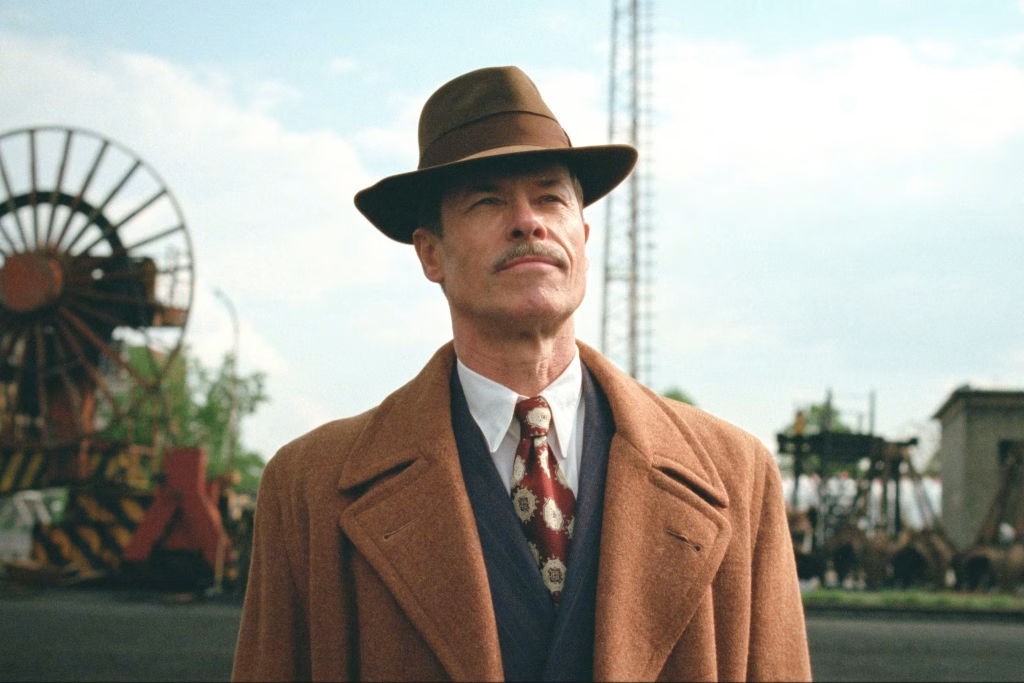
Harrison Lee Van Buren, played by Guy Pearce, represents the American dream from the other side of the table. He has money, land, influence, and the confidence of a man used to mistaking ownership for taste. His interest in László looks generous at first glance. Then it curdles. Patronage becomes control. Admiration becomes appetite.
The film keeps asking an ugly question. What happens when the dream opens the door, then makes you live in the servant’s quarters?
Art Becomes a Battlefield
The architecture in The Brutalist carries emotional violence. László’s buildings are severe, imposing, and beautiful in a way that almost hurts to look at. They do not comfort. They endure.
That makes sense for a man whose life has been shaped by rupture. László’s art comes from memory, discipline, and damage. His work has the blunt force of someone trying to impose order on a world that has already proved how easily order can collapse.
The film has a sharp feel for the way great art gets talked about by people who want to possess it. Van Buren can recognize László’s brilliance, but recognition gives him a new way to dominate. He wants the building, the name, the aura. He wants to stand near genius and have some of it reflect back on him.
That is one of the movie’s crueler observations. The artist may create the work, but the person with the money often gets the plaque.
Trauma Lives in the Design
László does not move through America like a man simply chasing success. Brody plays him as someone whose mind keeps returning to places the movie only partially shows. His posture, his pauses, his sudden flashes of rage and need, all suggest a person carrying more than he can explain.
The film’s interest in trauma feels unusually physical. It sits in László’s face. It sits in the way he smokes, works, waits, and withdraws. It also sits in the buildings themselves. Brutalist architecture becomes more than a style here. It becomes a language for the unspeakable.
Concrete is honest in this movie. It has no decorative charm. It bears marks. It looks permanent and wounded at the same time. That makes it the perfect material for László’s inner life.
His designs feel like memorials even when they are commissioned as monuments to someone else’s power.
Immigration Costs More Than Arrival
One of the most painful threads in The Brutalist is the gap between arriving somewhere and actually belonging there. László reaches America, but the film keeps showing how fragile that arrival is. He has to rebuild his career, his dignity, and eventually his family life under conditions set by people who see him as useful before they see him as whole.
His separation from Erzsébet, played by Felicity Jones, gives the film a deep ache. Their relationship carries history that America cannot simply absorb. When she enters the story more fully, the movie gains a sharper emotional charge because László’s survival has consequences beyond himself.
Erzsébet also changes the way we read him. Alone, he can look like a mythic suffering artist. With her, he becomes a husband, a refugee, a man who has failed and been failed. She brings another intelligence into the movie, one that sees through the bargains around him with painful clarity.
The immigrant story here has no easy gratitude built into it. László owes his new country nothing for exploiting him with better furniture.
Wealth Confuses Taste With Power
Van Buren may be the film’s most fascinating monster because he understands just enough art to be dangerous. He can sense that László is extraordinary. He can also sense that extraordinary people can be used.
The movie has a bitter eye for rich men who want culture as proof of their own importance. Van Buren does not merely want a building. He wants a legacy object. He wants László’s mind turned into something that can sit on his land and announce his greatness long after everyone involved has suffered for it.
Guy Pearce gives him a polished menace. He can sound refined while behaving brutally. That combination matters. The film knows that exploitation rarely enters the room announcing itself with a sneer. Sometimes it arrives as a commission, a dinner invitation, a compliment, a promise.
Money in The Brutalist does not only buy materials. It buys time, bodies, reputations, and silence.
The Body Pays for the Masterpiece
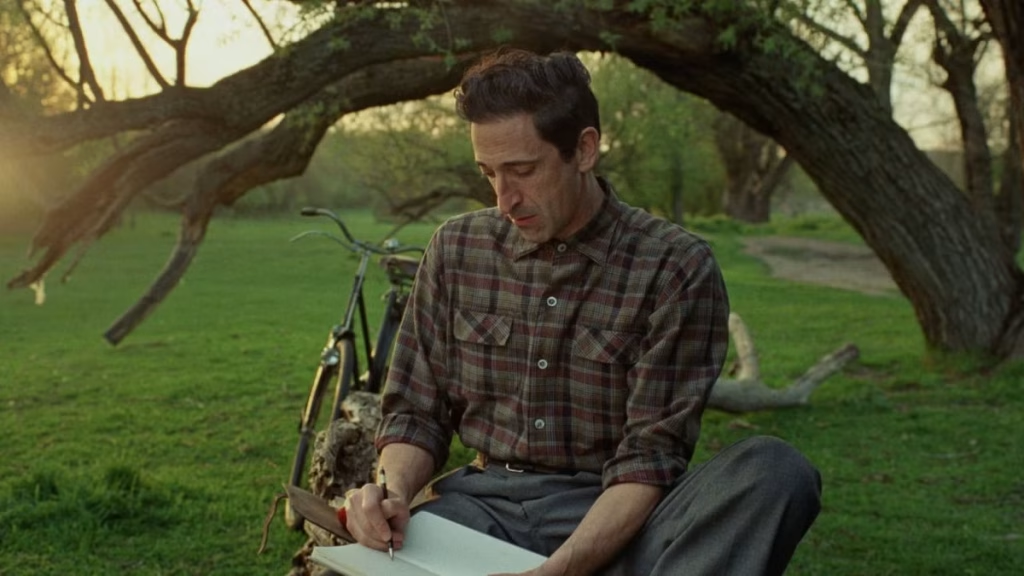
For all its grand scale, The Brutalist keeps returning to human fragility. László’s body suffers under the weight of his work and his addictions. The film links creation to appetite in ways that feel both romantic and repellent.
It would be easy for a movie about a tortured architect to polish that suffering into legend. Corbet pushes toward something harsher. László’s pain gives his art force, but it also damages the people around him. His genius has a cost, and the movie makes sure that cost stays visible.
That is where the film gets thorny in the best way. It admires László’s vision without letting him become a saint. He is brilliant, wounded, arrogant, needy, and sometimes unbearable. Brody makes those contradictions feel lived-in rather than arranged for prestige.
The masterpiece does not float above the mess. It rises out of it.
Brutalism Becomes a Moral Language
The title points straight at architecture, but The Brutalist uses the term more broadly. Brutalism describes the buildings, of course. It also describes the social order around László. The clean lines and hard surfaces echo a world where people talk elegantly while crushing each other.
There is something thrilling about the film’s refusal to make beauty gentle. László’s work has grandeur, but the grandeur feels almost accusatory. These spaces ask people to confront scale, history, and permanence. They do not flatter the viewer.
That is why the architecture works so well as the movie’s central metaphor. A brutalist building exposes structure. It does not hide its weight behind ornament. The film tries to do the same with capitalism, trauma, marriage, patronage, and national myth.
It shows the beams. It shows the pressure. It shows who gets trapped underneath.
The Film Is About Legacy, but Not the Comforting Kind
Everyone in The Brutalist seems to be building toward some version of permanence. Van Buren wants a monument. László wants to make work that outlasts him. Erzsébet wants a life that has shape after catastrophe. Even the film’s enormous running time feels tied to that ambition. It wants to feel carved rather than assembled.
But legacy here has a poisoned quality. To leave something behind, László has to submit to people who want to rewrite the meaning of his labor. His name may survive, but survival and victory are two very different things.
That is the tragedy humming beneath the film’s beauty. The world may remember the building while forgetting what it took from the person who made it.
The Brutalist is huge, severe, and sometimes deliberately exhausting, which feels right for a story about art made under pressure. Its themes are not tucked politely into speeches. They are poured into concrete, etched into faces, and left hanging in rooms that feel too large to ever become warm.
The movie’s great sadness is that László can build something monumental from his pain, but he cannot fully escape the systems that know how to use pain as fuel. His work stands. The damage stands with it.

Rachel Sikkema is a New Zealand-based writer and creative entrepreneur who explores the intersection of film, culture, and modern relationships. Through her articles, she examines how stories shape the way we connect, love and see ourselves – all for God’s glory. When she’s not writing about film and television, she’s watching Dexter and The White Lotus for the third time.