By Rachel Sikkema
Published November 29, 2026

The painting at the end of Widow’s Bay Episode 7 suggests that one of Richard Warren’s children survived Sarah’s attempt to escape the island. That would mean his bloodline could have continued, keeping his covenant with the island alive even after his death. Tom and Wyck come home believing they have broken the curse. The child in the water gives us a very good reason to doubt them.
It is a nasty little ending because the episode lets that relief settle first. Richard has been dealt with. The boat trip is over. After everything Tom and Wyck have endured, a moment of satisfaction feels earned.
Then the camera turns its attention to something hanging on a wall. Imagine surviving that night at sea only to discover the biggest problem was sitting in the inn’s décor.
The Child in the Water Changes the Story
The painting appears to depict Sarah taking Richard’s children away by boat. The crucial detail is the child separated from the boat, reaching towards help. An oar extends towards them, suggesting a possible rescue. The same painting appeared earlier in Episode 2, but the history revealed since then gives that small detail a much more troubling meaning.
A child falling overboard initially looks like another victim of the island. With the possibility of rescue, that image becomes a clue to survival.
That distinction matters enormously. Richard’s understanding of his family’s fate allows Tom and Wyck to approach the curse as a problem with one remaining human connection. A surviving child would make that understanding dangerously incomplete.
At the end of Episode 7, the sensible reading is that the painting strongly hints at a surviving branch of the Warren family. Naming a present-day descendant takes us beyond what this image alone establishes. The shot gives viewers a lead to follow, with enough uncertainty to make every familiar face on the island feel newly suspicious.
I like that the episode leaves us studying a small figure. After Richard’s grotesque return, something so physically modest gets the last word.
Why Richard’s Death Might Leave the Curse Intact
Richard explains that the covenant is tied to his bloodline. Ending that family line would end the pact. Tom and Wyck therefore have a reason to believe that taking him beyond the island’s boundary will free the town, provided his children really did die and left no descendants.
There is an enormous assumption tucked inside that plan.
Tom, played by Matthew Rhys, can see what happens to Richard when the boat crosses the boundary. Richard’s body is reduced to bones and dust. That is a concrete result after a night of terrifying uncertainty. It gives Tom something he can understand and act on.
The family history is much harder to verify. Richard has spent centuries buried underground. His confidence about what happened to everyone else deserves scrutiny, however useful his explanation of the covenant may be.
The painting exposes the gap between those two kinds of knowledge. Tom has witnessed Richard’s death. He has accepted an account of the children’s deaths.
A surviving child could grow up and have children of their own. Across generations, the consequences of Richard’s bargain could become attached to people who know very little about him. That possibility makes the apparent solution feel suddenly awful. How would Tom even begin to trace that history? What would he do with the answer?
The episode leaves those questions hanging over a victory that looked wonderfully straightforward a few minutes earlier.
Sarah’s Escape Becomes Even More Painful

The painting also changes how we think about Sarah’s attempt to get her children away.
After Episode 6, there is a strong emotional pull towards reading that departure as her last desperate chance to protect them. The image at the inn encourages us to look closely at what might have happened during the crossing.
A child reaching for an oar is such an ordinary image of rescue. Someone is drowning. Someone else is trying to help. For a moment, the supernatural machinery can recede and we can recognise the simple human urgency of it.
Then the implications arrive.
If saving that child allowed Richard’s bloodline to continue, an act of kindness may also have preserved the connection sustaining the curse. That is my favourite, most unpleasant implication of the painting. The child deserves to be saved. The possible consequences make that rescue frightening.
Responsibility still belongs with Richard and the bargain he made. His descendants would inherit the effects of a decision they had no part in making. The painting invites us to worry about those people before the story has even identified them.
It also makes Sarah’s situation feel crueler. The island’s reach may extend through the family she was trying so desperately to protect.
The Inn Has Been Displaying a Warning
The setting of the reveal does a lot of work.
The closing scene moves through an unpleasant guest being thrown out of the inn before settling on the painting. Everyday hospitality problems continue while a potentially devastating clue hangs nearby.
That feels perfectly suited to Widow’s Bay. Someone still has to deal with the customers, even when the town’s founding sins are threatening everyone.
There is also something wonderfully uncomfortable about a community displaying an image whose significance it has failed to grasp. A painting can become familiar enough to disappear. People pass it on the way to their rooms. It supplies atmosphere. Eventually, nobody gives the drowning child much thought.
The final shot forces our attention back onto that child.
My reading is that the painting reflects the town’s broader problem with its history. Terrible events have become stories and objects that people live alongside. Familiarity makes them manageable. Looking closely makes them dangerous again.
The earlier appearance rewards that closer look without requiring a lengthy speech. We now have enough context to find the threat for ourselves.
The Ending Gives Viewers a Head Start on Tom
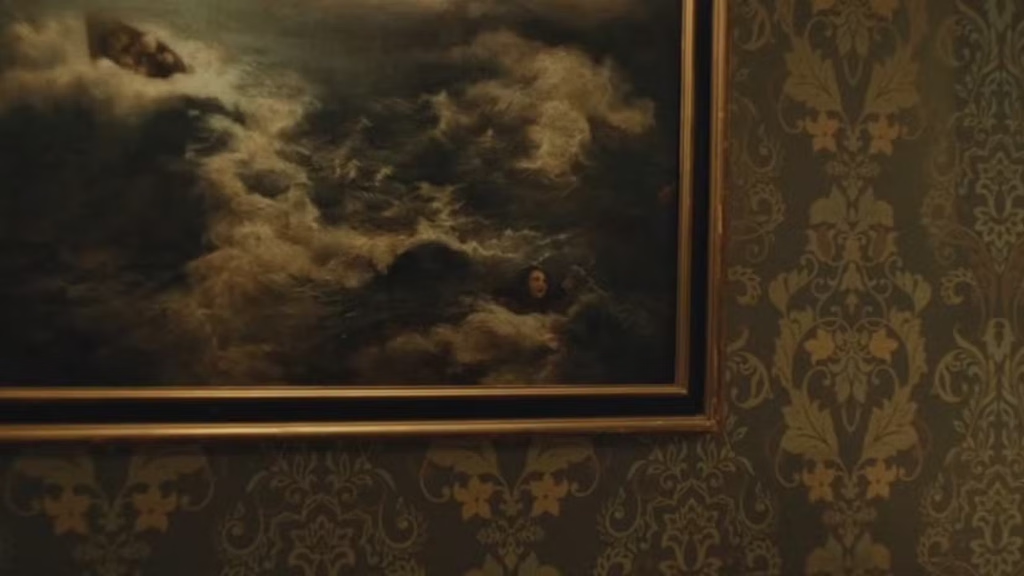
The painting leaves Tom and the audience in different places. He has survived an ordeal and has reason to feel hopeful. We have been shown a detail that could undo his conclusion.
That gap is where the ending gets its bite.
There is a related unease in Evan discovering photographs that challenge Tom’s account of his mother’s death. Both storylines bring an image into conflict with a version of the past someone has accepted. A family photograph can destabilise Evan’s trust. An old painting can destabilise the town’s hope of freedom.
As a reading of the episode, that connection feels especially sharp. Pictures preserve details that spoken explanations can leave out.
The painting’s central suggestion remains simple. A Warren child may have survived, and Richard’s death may have left the covenant untouched. Episode 7 lets us glimpse that possibility before Tom can investigate it.
For now, he gets his journey home. We get to stare at a child reaching out of the water and wonder whose family began with that rescue.

Rachel Sikkema is a New Zealand-based writer and creative entrepreneur who explores the intersection of film, culture, and modern relationships. Through her articles, she examines how stories shape the way we connect, love and see ourselves – all for God’s glory. When she’s not writing about film and television, she’s watching Dexter and The White Lotus for the third time.