By Rachel Sikkema
Published November 9, 2026

Wild Horse Nine and In Bruges ask the same uncomfortable question. Can someone who has done terrible things still deserve mercy? Martin McDonagh makes that question harder by giving the decision to a friend. Caring about the person in front of you comes naturally. Explaining why they deserve another chance gets considerably messier.
That is the connection that matters most between these films. The bickering killers and picturesque surroundings make the resemblance easy to spot. Underneath the insults sits a much nastier problem. Once you know somebody well enough to love them, your judgment of their crimes becomes personal.
Both films pull the audience into that compromised position. We enjoy the company. Then we have to decide what that enjoyment has persuaded us to forgive.
Spoilers for both films follow.
Ken Makes Mercy Feel Possible
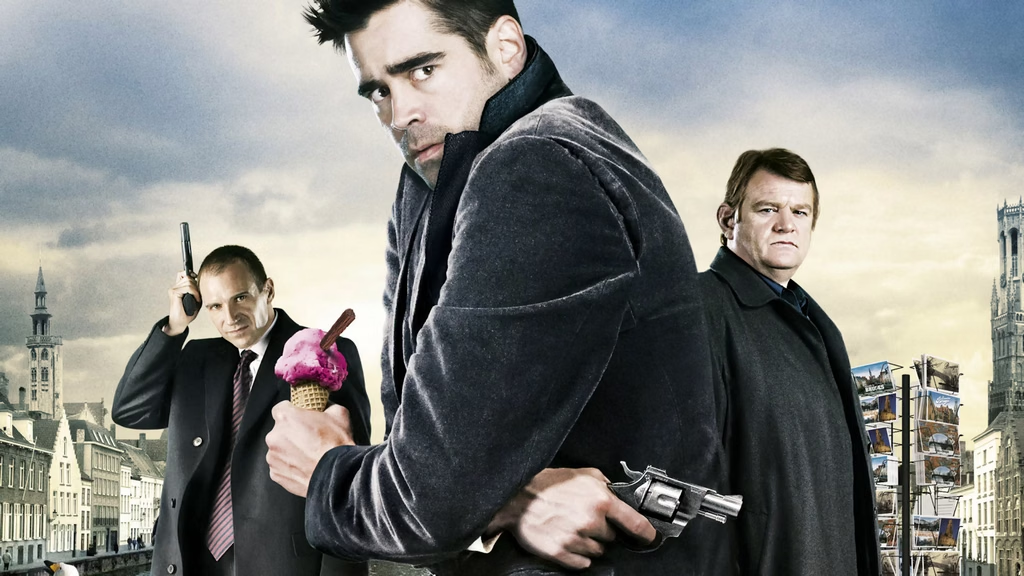
The crucial moment in In Bruges comes when Ken approaches Ray intending to kill him and discovers that Ray is about to take his own life. Ken intervenes. A man carrying out an execution suddenly finds himself trying to keep its intended victim alive.
Ray has accidentally killed a child while murdering a priest. Harry considers the child’s death an offence punishable by death. Ken comes to believe that Ray should have the chance to change. Those competing responses drive the film’s central conflict.
Brendan Gleeson gives Ken the exhausted patience of someone who has spent far too long looking after an impossible travelling companion. That everyday warmth matters. By the time he chooses to protect Ray, we have watched him tolerate the sulking and attempt to share a little pleasure in the city around them.
His affection has accumulated through small irritations. Anyone who has travelled with a difficult friend will recognise the feeling, though hopefully with fewer firearms involved.
Colin Farrell makes Ray’s guilt painfully accessible. His face can move from childish indignation to naked distress so quickly that the jokes start to feel like brief periods of shelter. You want him to have a future because you can see how badly the past is hurting him.
That desire deserves a little scrutiny. Suffering makes Ray easier to sympathise with. The child remains dead.
Ken takes a chance on what Ray might become. The film leaves us with the harder task of deciding how much moral weight that possibility should carry.
Chris Has Much Less Future to Offer
Wild Horse Nine puts the question under a different kind of pressure. John Malkovich’s Chris is a veteran CIA operative dying of cancer. His partnership with Sam Rockwell’s Lee carries the weight of years spent serving an organisation that has made violence routine. Their trip to Rapa Nui takes place against the approaching catastrophe in 1973 Chile.
With Ray, the prospect of change stretches ahead. Chris has very little time left. Any claim he makes on our compassion has to survive that difference.
A dying man can acknowledge the damage he has done. He can perform a final generous act. The people harmed across a career still have to live with what happened, assuming they survived it.
This gives the comparison its bite. It is relatively easy to support mercy when you imagine it producing decades of better behaviour. Mercy for somebody approaching death offers a much smaller return. You have to consider whether relief from suffering has value even when the recipient has almost no opportunity to make amends.
Malkovich is particularly well suited to that discomfort. Chris can hold your attention simply by talking. Spending time with him creates the intimacy that makes judgment difficult.
And that intimacy is unevenly distributed. We get to know the man who committed the violence. Many of the people affected by it remain outside the frame. A viewer can feel for Chris while still noticing whose suffering gets the close-up.
Friendship Gives Both Films a Dangerous Bias
I find the friendship more troubling than the criminality in these films. The crimes establish the moral problem. The affection makes us start negotiating.
Ken knows Ray as a young man capable of shame and change. Lee knows Chris through a shared life. Each has access to a person whom an outsider might reasonably see chiefly through the harm he has caused.
That knowledge can support compassion. It can also produce an awfully convenient defence.
We make allowances for people whose jokes we understand. Familiar habits become evidence of humanity. A stranger’s suffering has to compete with the memory of somebody who once made us laugh at exactly the right moment.
McDonagh gets a lot of mileage out of that weakness. His dialogue gives us the pleasure of being included in the friendship. We learn the rhythm of the insults. We begin to anticipate the reactions. Eventually, a threat to either man feels like a threat to a relationship we have joined.
The victims rarely receive that advantage.
There is a useful discomfort in realising how readily a funny conversation can influence your feelings about a killer. The laughter leaves you with a responsibility to keep looking.
The Two Films Make Mercy Lead in Different Directions
The sharpest difference lies in what the friends actually do.
Ken stops Ray from dying. Lee eventually honours Chris’s earlier request to end his life before the cancer does. Chris frames that request through his Catholic fear of suicide, handing Lee the burden of carrying it out.
That religious reasoning is painfully revealing. Chris is trying to arrange an acceptable departure from a life already crowded with killing. Even at the end, somebody else has to do part of the difficult work.
Lee’s love makes the request emotionally understandable. It also makes him vulnerable to it. Being the person somebody trusts most can mean receiving a burden that nobody else would accept.
Set beside Ken’s intervention, the ending becomes especially uneasy. Two friendships reach moments in which one man must decide what care requires of him. Their decisions lead in opposite directions.
I would resist treating either moment as a tidy statement of McDonagh’s beliefs about death. The drama lives in the particular relationship. These men have histories together, and those histories shape what they can bear to do.
The consequences belong to the surviving friend too.
Feeling Sorry for Someone Leaves Plenty Unresolved

The word redemption can make these stories sound more settled than they feel. It suggests an account that can eventually be closed. Enough remorse goes in and forgiveness comes out.
In Bruges makes me want Ray to survive long enough to discover whether he can change. Wild Horse Nine asks me to sit with compassion that has far less room to become anything useful.
I find the second proposition harder. Chris’s approaching death creates urgency around his pain, while the damage behind him extends far beyond his remaining life. His need is immediate. Other people’s losses are permanent.
Still, withholding all compassion has its own ugliness. A person can remain responsible for terrible acts while being frightened and in pain. Recognising that suffering requires us to hold several uncomfortable truths at once.
McDonagh’s friendships keep those truths close enough to hurt. We can understand why Ken protects Ray. We can understand why Lee stays with Chris. Understanding gives us access to their choices without settling the question of forgiveness.
By the end, I care about these men. I also want to know what happened to the people who never got to be their friends.

Rachel Sikkema is a New Zealand-based writer and creative entrepreneur who explores the intersection of film, culture, and modern relationships. Through her articles, she examines how stories shape the way we connect, love and see ourselves – all for God’s glory. When she’s not writing about film and television, she’s watching Dexter and The White Lotus for the third time.