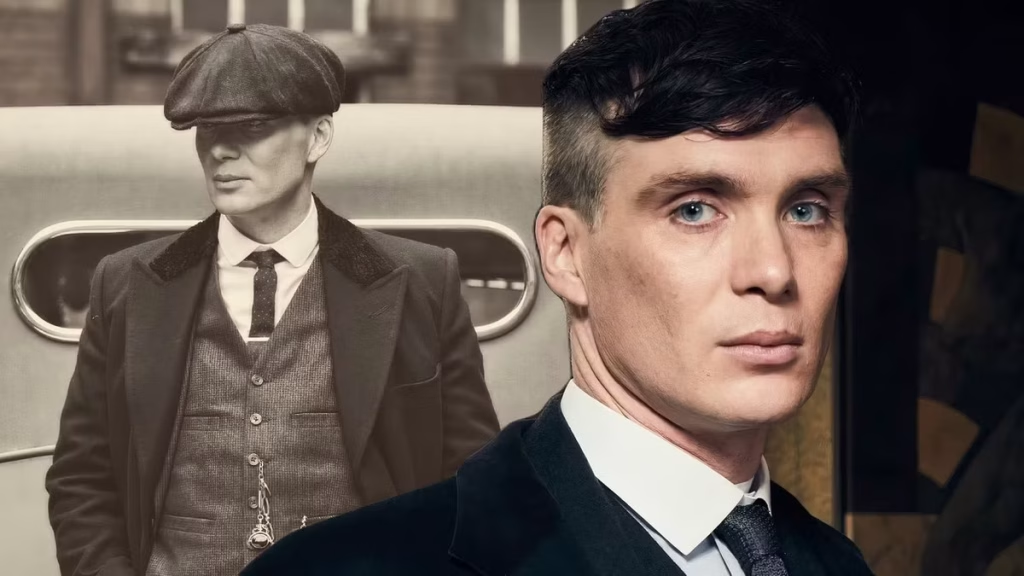
For years, Tommy Shelby has carried himself like a man who could keep moving no matter what the world took from him. That has always been part of the appeal. Cillian Murphy plays Tommy with that cold, almost supernatural stillness. So with The Immortal Man, the obvious question is whether it is praising Tommy’s myth or preparing to tear it apart. Recent official details and post-release coverage point to the film as the closing chapter of Tommy’s story. This makes that title feel less triumphant than it first sounds.
What makes the title interesting is that Tommy has never really been “immortal” in a literal sense. He’s immortal in the way certain men become immortal in their own heads and in other people’s stories. He survives wars, betrayals, political games, family disasters, and his own self-destructive instincts. Every season of Peaky Blinders turned that survival into part of his legend. People feared him because he kept coming back. Viewers were hooked for the same reason.
But legends have a nasty habit of trapping the people inside them.
Tommy Has Always Lived Like a Man Under Judgment
One of the smartest things Peaky Blinders ever did was make Tommy’s victories feel costly. He wins, yes, but he never gets to enjoy the win for long. There is always another consequence waiting on the other side of the room, probably smoking and staring at him. That rhythm matters here, because a “final reckoning” only works if the character has been accumulating emotional debt for years.
Tommy’s whole life has been built on deferral. He postpones grief, honesty and any real attempt at peace. He tells himself he is doing what must be done, and sometimes that is true. Still, the show has always hinted that practicality can become its own kind of moral cover. A man can call himself necessary for so long that he forgets to ask what he’s turning into.
That is why the title feels ominous. “The Immortal Man” sounds grand, but it also sounds ironic. It suggests a man who believed he could keep escaping the bill. A reckoning is what happens when the bill finally lands on the table.
The Myth of Tommy Shelby May Be the Real Target
Tommy Shelby works because he exists on two levels at once. He is a damaged veteran from Birmingham trying to control chaos. He is also a myth the series deliberately built piece by piece. The haircut, the coat, the voice, the walk, the terrible ability to make a room feel colder. The show understood the power of image long before half the internet turned Tommy into a mood board.
That is exactly why a final film has to do more than give him one more scheme.
If The Immortal Man were only interested in serving the legend, it would risk becoming a victory lap in a nice suit. But the stronger dramatic move is to ask what that legend has cost him and everyone around him. When a character becomes too iconic, the bravest ending is often the one that strips the icon down.
And honestly, Tommy has needed that for a while.
Family Was Always the Point, Even When Crime Looked Like the Point

People talk about Peaky Blinders as a gangster saga, and of course it is. There are deals, enemies, gunfire, betrayals and enough cigarette smoke to qualify as weather. But crime was never the whole story. Family was always the deeper wound.
That matters because final reckonings in this world are rarely about whether Tommy can beat an enemy. They are about whether he can live with what he has done to the people closest to him. The emotional stakes turn heavily on family, guilt, and acts Tommy cannot forgive in himself. That pushes the story away from simple hero worship and toward something harsher.
It also fits the DNA of the series. Tommy’s worst losses were never just strategic losses. They were personal. The moments that truly broke him were tied to blood, love, loyalty, and the awful feeling that protecting the family often meant poisoning it.
So if this film is his reckoning, it makes sense that the judgment would come through family too. That is the only thing that could really pierce the armor.
Cillian Murphy’s Tommy Was Never Meant to Stay Untouched
Murphy’s performance has always kept Tommy from becoming a cardboard antihero. Under all the control, there is exhaustion and dread. Under the confidence, there is a man who knows he crossed lines a long time ago and can never fully walk back over them.
That is why “final reckoning” feels like the right phrase. It suggests not only punishment, but recognition. Tommy has to see himself clearly at last. No more myth or tactical speech about necessary violence. No more pretending that survival by itself equals victory.
And that is more interesting than a neat redemption arc.
A full redemption would actually feel too easy for this character. Tommy Shelby has never belonged to easy endings. The more fitting close is something sadder and more honest. He understands what he became and pays for it in a way that carries emotional weight. Recent reporting around the film’s ending strongly supports that reading.
Why the Title Works Best if It Is a Contradiction
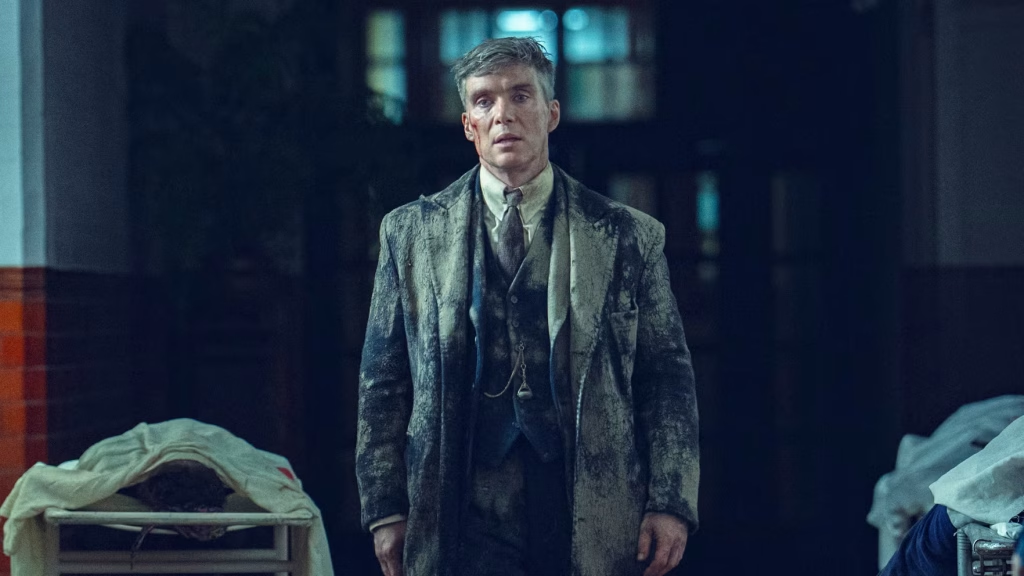
The best version of The Immortal Man is one where the title turns out to be a trap. It invites us to think about invincibility. Then, it forces us to confront fragility. It sounds like the name of a conqueror. However, it lands like the epitaph of a man who outlived too much and mistook endurance for escape.
That idea is pure Peaky Blinders.
Tommy has always been haunted by the gap between how powerful he appears and how broken he actually is. Calling him immortal only sharpens that contrast. In one sense, he is immortal because the Shelby myth will outlast him. In another, he never was. He was just a man who kept surviving long enough for people to mistake survival for destiny.
That is why the title can absolutely signal his final reckoning. Not because it proves he cannot fall, but because it frames the tragedy of a man who spent years acting as if he stood above consequence. When the reckoning comes, it is powerful precisely because the myth was so strong to begin with.
If The Immortal Man truly is Tommy Shelby’s last chapter, then the title feels less like a crown and more like a challenge. It asks whether a man can remain larger than life once his sins finally catch up with him. For Tommy, that may be the real end of the story. Not the loss of power, but the collapse of the legend that kept him going.

Rachel Sikkema is a New Zealand-based writer and creative entrepreneur who explores the intersection of film, culture, and modern relationships. Through her articles, she examines how stories shape the way we connect, love and see ourselves – all for God’s glory. When she’s not writing about film and television, she’s watching Dexter and The White Lotus for the third time.