The first rifle shots in Dunkirk feel almost rude.
There is no grand speech to prepare you. No tidy briefing room scene. No officer pointing at a map while everyone explains the stakes for the audience. Christopher Nolan drops Tommy, played by Fionn Whitehead, into a quiet French street and lets the sound of bullets do the explaining.
That opening tells you exactly how the movie works. Dunkirk has dialogue, but it treats words like a luxury. The men on the beach barely have time to ask questions. The pilots speak in clipped fragments. The civilians at sea, led by Mark Rylance’s Mr. Dawson, say more than the soldiers do, but even there, the emotion sits in glances, hands, silence, and the way someone keeps steering toward danger.
A lot of war films build intensity through speeches and strategy. Dunkirk builds it through waiting.
Waiting for a ship or a plane. Waiting for the tide and the sound overhead to become good news or disaster. It is one of Nolan’s most physical movies because it understands something simple and brutal. When survival is the only subject, conversation starts to feel ornamental.
The Silence Makes Everyone Look Smaller
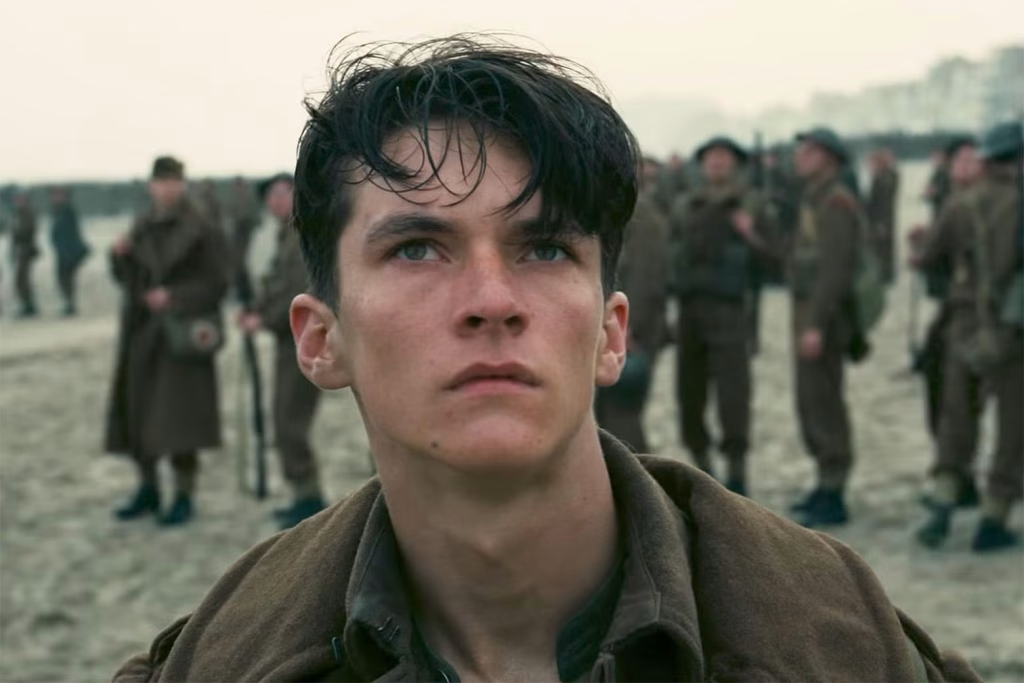
The beach in Dunkirk is enormous, which makes the soldiers look almost unbearably small. Long rows of men stand against pale sand and flat water, hoping the world will produce a way out. They do not need to talk about fear. Their bodies are doing that work already.
Tommy is a smart choice as the viewer’s anchor because he has the look of someone trying to disappear inside his own face. He watches. He flinches. He calculates. He grabs at chances when they come, even when those chances are ugly or desperate.
There is no big introduction for him, and that makes him feel more real inside the movie’s design. He could be anyone on that beach. That sounds like a simple point, but it matters. Nolan strips away the usual personal backstory until identity becomes secondary to motion. Get to the mole. Get on the ship. Get off the ship. Stay under the water. Run again.
The lack of dialogue turns faces into weather reports. A glance toward the sky means more than a paragraph. A soldier’s mouth tightening before a bomb lands tells us enough. The film trusts panic as a language.
That trust gives the movie its pressure. Nobody pauses to process the horror in clean sentences because the horror keeps interrupting.
Hans Zimmer Turns Time Into an Enemy
Hans Zimmer’s score in Dunkirk feels less like music and more like a machine placed too close to your ear. It ticks, pulses, rises, and circles back with that famous feeling of never quite releasing. The sound design pushes the audience into the same trapped rhythm as the characters.
This is one reason the sparse dialogue works so well. The movie already has a voice. It is the engine of a boat. It is the scream of a Stuka dive bomber. It is waves slapping metal. It is the awful creak of a ship becoming a coffin.
The ticking clock effect gives every scene a physical countdown even when nobody says what time it is. You can feel seconds being spent. That is much more nerve-racking than having a character explain urgency out loud.
Nolan has always loved time as a structure, but Dunkirk makes time feel mean. The film’s three timelines, the mole, the sea, and the air, move at different speeds, yet they all share the same pressure. The soldiers on the beach live in stretched-out dread. Dawson’s boat moves through hours of moral decision-making. Farrier, played by Tom Hardy, measures survival in fuel and altitude.
Hardy spends much of the movie behind a mask, which is such a Nolan thing to ask an actor to do. Still, it works. Farrier’s story becomes almost pure cinema. Eyes, gauges, sky, enemy plane, fuel needle. The man barely needs words because the cockpit has turned into a math problem with death attached.
The Dialogue Feels Like Rationed Air
When people do speak in Dunkirk, the lines land harder because the movie has made words scarce. A question feels urgent. A command feels sharp. A quiet statement can suddenly carry the weight of a confession.
Kenneth Branagh’s Commander Bolton is a good example. He has the posture of a man trying to hold an entire coastline together through sheer composure. He looks out at the water with that fixed, weary patience that says more than any motivational speech could. When he speaks, the restraint around him gives the words authority.
Cillian Murphy’s Shivering Soldier works differently. He is verbal in a way that feels jagged, not explanatory. His fear spills into the small civilian boat and changes the temperature there. He has survived something the film allows us to feel before we fully understand it, and Murphy plays him like a man whose nervous system has already left the war behind.
That is the cleverness of the writing. The movie uses dialogue for impact, not decoration. It avoids the usual war-film habit of giving every character a speech about home, duty, fear, or sacrifice. Those things are present, but they come through behavior.
A boy offers help. A father keeps going. A pilot turns back. A soldier tries to survive in ways that may make him ashamed later.
That is plenty.
The Camera Keeps Trapping Us in Bodies
Hoyte van Hoytema’s cinematography gives Dunkirk a clean, terrifying clarity. The frames often look beautiful, which somehow makes the danger worse. The sea is open and bright. The sky is huge. The sand is pale. There is nowhere to hide.
The intensity comes from how often the film makes space feel like a trap. A ship should mean rescue, then it becomes a metal box filling with water. A beached boat should mean shelter, then bullets punch through its hull. The open sky should mean freedom, then it becomes a hunting ground.
Because the characters rarely explain what they are feeling, the camera has to press us into their physical situation. It does. Nolan loves practical scale, and here that scale has an emotional purpose. You feel the difference between a man in a crowd and a man alone in the water. You feel how thin a plane seems against the sky. You feel how fragile a civilian boat looks when war comes toward it.
The movie also has a nasty gift for making waiting feel active. Men stand in line on the beach, but the line itself becomes suspense. A distant plane appears, and every body in the frame reacts. Nobody needs to shout, “We are in danger.” The entire beach stiffens.
That is the movie at its best. Human beings turned into a single held breath.
Nolan Removes the Comfort of Explanation
A more conventional version of Dunkirk might have followed a small group of soldiers with detailed personal arcs. We would learn about their families, their regrets, their sweethearts, their rivalries, their favorite biscuits, the whole kit. Some of that can be powerful in the right film.
Nolan chooses a colder route, and it pays off.
By withholding backstory, he removes the usual emotional cushions. The viewer has to respond to the immediate fact of survival. A young man wants to live. A pilot wants to protect men he may never meet. A civilian sails into danger because leaving people behind would cost him something inside himself.
That is direct, almost primal. It also keeps the film from turning the evacuation into a lesson delivered through dialogue. The history is there, of course. The scale of Operation Dynamo hangs over every frame. But the film’s main concern is sensation. What did it feel like to wait on that beach? What did rescue sound like? How long can a minute last when a plane is coming back around?
The sparse dialogue makes the audience participate more actively. We read faces. We measure distance. We listen for engines. We notice who hesitates and who moves. The film teaches us how to watch it.
The Restraint Makes the Ending Hit Harder

The famous emotional release near the end works because Dunkirk spends so much time refusing easy comfort. When the small boats arrive, the sight has power because the movie has trained us to scan the horizon like the soldiers do. Those shapes on the water mean life.
Nolan lets the moment breathe, but he keeps the sentiment from getting syrupy. That restraint is crucial. The film earns emotion through pressure rather than speechmaking.
Even the reading of Churchill’s words could have felt too neat in another movie. Here, it lands with a strange mix of relief and exhaustion. The words are public, polished, historic. The face reading them belongs to a young soldier who has been running, hiding, nearly drowning, and trying to keep himself alive by any available means.
That contrast gives the ending its ache. Language finally arrives, but it arrives after the body has already understood everything.
Dunkirk feels intense with so little dialogue because the film knows words would often soften the experience. The silence leaves room for engines, waves, ticking, breathing, and fear. It leaves room for faces to do the work. It leaves room for the audience to sit inside the unbearable gap between danger and rescue.
That gap is where the whole movie lives.
A man looks at the sky. A boat moves across the water. A line of soldiers waits on the sand.
No one has to explain why your chest tightens.

Rachel Sikkema is a New Zealand-based writer and creative entrepreneur who explores the intersection of film, culture, and modern relationships. Through her articles, she examines how stories shape the way we connect, love and see ourselves – all for God’s glory. When she’s not writing about film and television, she’s watching Dexter and The White Lotus for the third time.