The first German soldiers we see in Dunkirk appear as scraps of paper fluttering down an empty street.
Those papers carry a blunt message. The British troops have been surrounded. A young soldier named Tommy, played by Fionn Whitehead, stuffs one into his jacket before gunfire tears through the silence. He runs. Within minutes, he reaches the beach and discovers thousands of men waiting beneath a pale sky.
That image explains Christopher Nolan’s whole approach. Dunkirk rarely asks who these men were before the war. It traps us beside them in a terrible present tense, where every engine might bring death and every minute spent waiting feels stolen.
Most war films lead us into battle. Dunkirk makes us desperate to get out.
The Movie Begins After the Defeat
War movies often arrive carrying a sense of forward motion. Troops receive an objective. Officers study maps. A squad prepares to take a hill, destroy a bridge, defend a position, or rescue someone trapped behind enemy lines.
Dunkirk begins with the objective already reduced to its most basic form.
Survive.
The British Expeditionary Force has retreated to the French coast. The soldiers crowd the beach in long, exposed lines while the enemy closes in. Their guns have little value here. Their training offers limited comfort. Even courage has a strangely cramped role when the available choices are to wait, hide, swim, or squeeze onto a ship before the next bomb falls.
That starting point changes the emotional flavor of the film. Nolan removes the usual fantasy of control. Tommy and Gibson, played by Aneurin Barnard, keep trying to improve their odds through small acts of ingenuity. They carry a wounded man toward a departing medical ship. They hide below deck and scramble aboard whatever vessel seems capable of floating.
Each plan collapses almost as soon as it forms.
The retreat turns survival into a series of temporary bargains. A ship offers safety until a torpedo strikes. A beached boat provides shelter until bullets punch through its hull. The sea promises escape while oil burns across its surface.
There is always another trap waiting inside the rescue.
Time Becomes the Real Enemy
Nolan divides the story across three different spans. The soldiers on the beach endure one week. Mr Dawson’s civilian boat travels for one day. Farrier and the other RAF pilots fight above the Channel for one hour.
The structure sounds like a puzzle when explained aloud. On screen, it feels closer to panic.
Scenes interrupt one another before relief can settle in. A drowning soldier cuts against a pilot checking his fuel gauge. Men trapped inside a ship wait for the tide while a small boat moves toward France. Events overlap from different viewpoints, and moments that once seemed mysterious return with their meaning clarified.
The result has little interest in ordinary dramatic breathing room. Nolan and editor Lee Smith tighten the three timelines until they feel like parts of the same mechanism. Hans Zimmer’s score adds the famous ticking pulse, along with a rising musical effect that seems to climb forever.
There is no comfortable peak. The tension simply keeps finding a higher stair.
That makes Dunkirk unusually physical. You feel the wait for the tide and Farrier doing arithmetic in his head as the fuel gauge fails. You feel every second Mr Dawson spends steering toward men who may already be dead by the time he reaches them.
Time usually helps a story unfold. Here, time stalks the characters.
The Enemy Stays at the Edge of the Frame
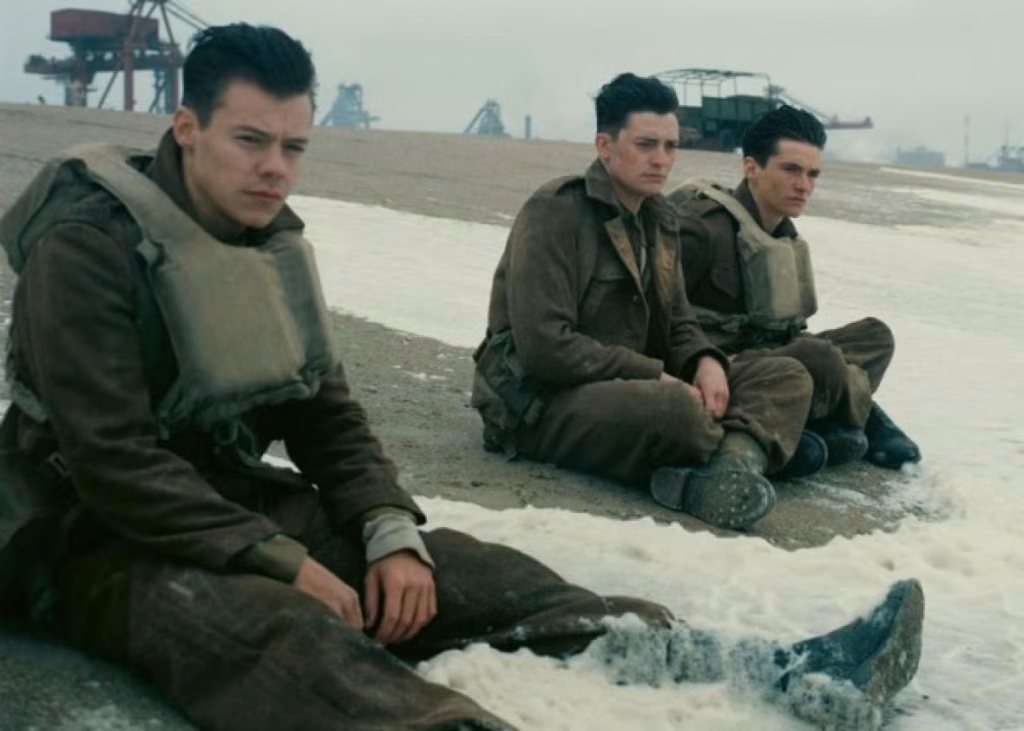
The film barely shows the German forces directly. Their presence arrives through bullets, bombs, torpedoes, and aircraft silhouettes.
That choice gives the enemy an almost elemental quality. The soldiers on the beach cannot confront a clear villain. They stare toward the horizon and listen for engines. The threat might come from the sky, beneath the water, or from somewhere beyond the dunes.
Nolan keeps returning to sound before impact. The approaching Stuka dive bombers produce a shriek that rolls across the beach. Soldiers drop to the sand in practiced waves. Nobody delivers a stirring speech. Nobody pretends bravery can alter the path of a falling bomb.
They press their faces into the ground and hope.
The aerial sequences offer more direct combat, though even those scenes feel stripped down. Farrier, played by Tom Hardy, spends much of the film behind a mask. His performance lives in his eyes, his breathing, and the small movements of a pilot constantly checking instruments.
The dogfights avoid flashy acrobatics. Planes turn slowly. Targets drift in and out of the gunsight. Fuel matters as much as firepower. The machinery has weight, and every maneuver costs something.
Character Arrives Through Behavior
Tommy receives almost no backstory. Gibson speaks little. Farrier remains hidden behind flight gear. Mr Dawson, played by Mark Rylance, reveals himself through the calm way he handles his boat and the gentle authority in his voice.
A more conventional film might pause to explain their homes, families, fears, and dreams. Dunkirk lets behavior do the work.
Tommy notices opportunities. Gibson quietly saves lives. Farrier studies a broken gauge and continues flying. Mr Dawson heads toward a war zone because hundreds of young men are stranded across the water.
Even Cillian Murphy’s shell-shocked soldier remains unnamed. His terror tells us enough. When he realizes the civilian boat is sailing back toward Dunkirk, his face crumples. The reaction carries the horror of everything he has already survived.
The limited dialogue also makes each ordinary sentence feel heavier. Mr Dawson tells his son Peter that men his age dictate the war while boys are sent to fight it. Later, Peter chooses kindness when he speaks to the frightened soldier responsible for a tragedy aboard the boat.
That moment lands quietly. Dunkirk understands that decency can demand its own kind of nerve.
Survival Carries Shame With It
One of the film’s sharpest scenes comes after the rescue. Tommy and Alex, played by Harry Styles, sit on a train returning through England. Alex fears the public will greet them with contempt. They have come home from a retreat, after all. In his mind, survival looks dangerously close to failure.
Then civilians hand food through the train windows. An older man tells them they have done well.
Alex can barely accept it.
That exchange gives the evacuation its emotional shape. The men on the beach wanted to live, yet many felt ashamed of arriving home alive. Nolan treats that conflict with surprising tenderness. He never turns the retreat into an easy victory. He finds dignity in endurance, cooperation, and the refusal to abandon people when the grand military plan has fallen apart.
The arrival of the small civilian boats captures this perfectly. Zimmer’s score swells. Commander Bolton, played by Kenneth Branagh, looks toward the water and recognizes what is coming.
“Home,” he says.
It could have been unbearably sentimental. Branagh gives the word a restrained warmth, and Nolan has earned the lift through nearly an hour and a half of suffocating pressure. The boats look small against the sea. That is precisely why they matter.
The Spectacle Feels Intimate

Nolan filmed Dunkirk on a huge scale, yet the movie rarely behaves like a grand historical pageant. Its scale makes the individual characters appear fragile.
Rows of soldiers stretch across the sand. Ships tilt into dark water. Aircraft cross an enormous sky as tiny shapes. The wide images offer beauty, though the beauty has a cold edge. The beach looks clean and almost peaceful from a distance. Up close, men fight over places on a boat.
Hoyte van Hoytema’s cinematography keeps moving between those perspectives. One shot gives us the geometry of thousands waiting by the water. The next puts us inside a cramped hull as seawater climbs around terrified faces.
The practical effects deepen that unease. Metal groans. Cockpits shake. Water hits with ugly force. Nolan’s camera often stays close enough to make the machinery feel dangerous even when it works correctly.
Watching the film in a loud cinema can feel like being bullied by engineering. I mean that as praise.
It Leaves the Mythology Slightly Unsettled
The evacuation of Dunkirk carries enormous symbolic weight in British history. Nolan embraces the courage of the civilian sailors and the RAF pilots, but he also preserves the fear, confusion, and selfishness around them.
Men shove past one another. Alex accuses Gibson of being a German spy because the group needs someone to sacrifice. Soldiers sneak onto ships ahead of the queue. Survival narrows their moral vision until another person’s death can resemble an available seat.
The film refuses to punish every ugly impulse or reward every noble one. Gibson performs quiet acts of bravery and receives no ceremonial recognition. George, played by Barry Keoghan, joins Mr Dawson’s voyage with dreams of doing something important. His contribution ends in painful, accidental tragedy.
History later calls the evacuation a miracle. Dunkirk shows how frightening and improvised a miracle can look from inside it.
That is why the film lingers. It gives us no commanding general to follow and no decisive battle to celebrate. It offers sand, water, fuel, weather, and a collection of frightened people trying to carry one another home.
Most war movies ask us to watch people face the enemy.
Dunkirk asks us to feel the distance between danger and safety, then stretches that distance until every yard becomes unbearable.

Rachel Sikkema is a New Zealand-based writer and creative entrepreneur who explores the intersection of film, culture, and modern relationships. Through her articles, she examines how stories shape the way we connect, love and see ourselves – all for God’s glory. When she’s not writing about film and television, she’s watching Dexter and The White Lotus for the third time.