By the time Avatar: Fire and Ash rolls around, Jake Sully (Sam Worthington) has already lived a full myth. He’s the outsider who became family, the soldier who turned on his own side, the reluctant symbol who won a war. That story used to feel clean: pick a side, protect your people, win the day. Now Pandora’s getting bigger, messier, and less interested in heroic slogans, and Jake is starting to feel like a leader built for a version of this world that no longer exists.
Jake is still brave, still capable, still deadly when he has to be. The problem is that bravery isn’t the same thing as relevance. In a film shaped by grief, new alliances, and Na’vi politics that don’t revolve around him, Jake’s leadership begins to read like an old map in a landscape that keeps reshaping itself under your feet.
The Hero Playbook Works Until It Doesn’t
Jake’s instinct as a leader has always been action first. When danger shows up, he moves. When people he loves are threatened, he escalates. It’s an approach forged in military logic and sharpened by survival on Pandora, where hesitation can get you killed and certainty can rally a clan.
But certainty is also Jake’s blind spot. The first Avatar rewarded him for conviction. The second film complicated it by forcing him to run, hide, adapt. Fire and Ash pushes harder. It’s not simply that the enemies change. It’s that the definition of “enemy” gets slippery. Jake keeps wanting a conflict he can frame, contain, and solve. Pandora keeps offering him conflicts that behave more like weather.
Grief Turns Leadership Into Something Uglier
The Sully family’s grief after Neteyam’s death (Jamie Flatters) doesn’t sit politely in the background while the plot happens. It reshapes the family’s internal power dynamics. Grief changes who speaks first, who gets listened to, who takes risks, who freezes.
Jake’s idea of protection can start to feel like control when everyone is hurting. It’s understandable. He’s trying to stop the next loss before it happens. Still, that impulse can shrink the world down to one paranoid objective: keep the family alive at any cost. When a leader narrows their vision like that, they can miss what their people actually need, which is not constant orders but the space to become themselves.
New Tribes Mean Jake’s Legend Stops Being a Universal Language
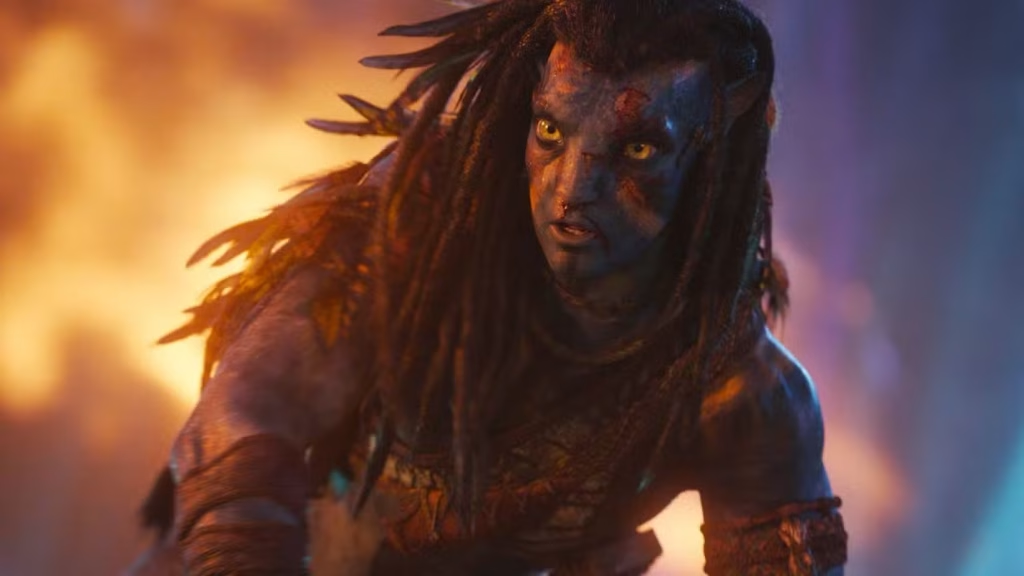
Jake’s identity as Toruk Makto and former Omatikaya war leader used to function like a key that opened doors. Now it can land like a threat.
Fire and Ash expands Pandora’s political landscape with new groups who have their own histories and scars. Varang (Oona Chaplin), the leader of the volcanic Ash People, is framed less as a cartoon villain and more as someone hardened by survival, willing to do whatever it takes for her people. That kind of leader doesn’t automatically respect Jake’s legend. She competes with it.
Spider Is the Problem Jake Can’t Solve With Authority
Miles “Spider” Socorro (Jack Champion) is basically a walking contradiction. Human by birth, raised alongside the Sully kids, emotionally tied to both Jake and Quaritch. You can feel how much Jake wants Spider to be simple. To pick a side cleanly. To fit neatly into the family’s moral geometry.
But Spider refuses to behave like a symbol. He’s a person, which is inconvenient in exactly the way real people are. He complicates the Sullys’ story because he exposes the uncomfortable truth that “us versus them” is a fantasy, even on a planet as visually divided as Pandora.
Quaritch Adapts Faster Than Jake Wants to Admit
Quaritch is still Quaritch. The menace is intact. The obsession is intact. What changes is his flexibility.
There’s an ugly irony in watching the villain integrate into Pandora in ways Jake resists. Quaritch, now living in a Na’vi recombinant body, finds alignment with the Ash People’s warlike energy and their scorched worldview.
He recognizes the terrain of conflict and settles into it like it’s home. In recent comments, Stephen Lang has described the fit between Quaritch and the Ash People as disturbingly natural, which suggests a dynamic where Quaritch doesn’t just invade Pandora, he learns how to weaponize its internal fractures.
Kiri Represents the Kind of Leadership Pandora Is Moving Toward
If Jake is the old model of leadership, Kiri (Sigourney Weaver) is the unsettling new one. She’s not a general or a politician. She’s not even fully understood by the people who love her. What she has is connection, and connection is power on Pandora in a way that guns and slogans can’t match.
Kiri’s presence also shifts the franchise’s idea of authority. She doesn’t lead by giving orders. She influences the world by sensing it, responding to it, and maybe, in her own way, speaking with it. Cameron has highlighted Weaver’s performance as a major acting transformation, emphasizing how Kiri’s teenage vulnerability and intensity matter to the story’s emotional engine.
Jake’s Real Challenge Is Learning to Follow

Jake doesn’t need to stop being strong. He needs to stop believing strength automatically entitles him to be the one in front.
The most interesting version of Jake in Fire and Ash isn’t the fighter. It’s the man confronting the possibility that his greatest gift to his family might be making room for them to outgrow him. That’s a brutal lesson for anyone who has survived by being indispensable.
So what does relevance look like for Jake now? It looks like listening before reacting and letting Lo’ak (Britain Dalton) make choices he wouldn’t make. It looks like respecting Neytiri’s pain without trying to manage it into something convenient and understanding that new clans don’t owe him trust because he once saved someone else’s home.
Jake Sully became a leader by changing. The tragedy would be if he stopped changing the moment the world demanded it most.

Rachel Sikkema is a New Zealand-based writer and creative entrepreneur who explores the intersection of film, culture, and modern relationships. Through her articles, she examines how stories shape the way we connect, love and see ourselves – all for God’s glory. When she’s not writing about film and television, she’s watching Dexter and The White Lotus for the third time.