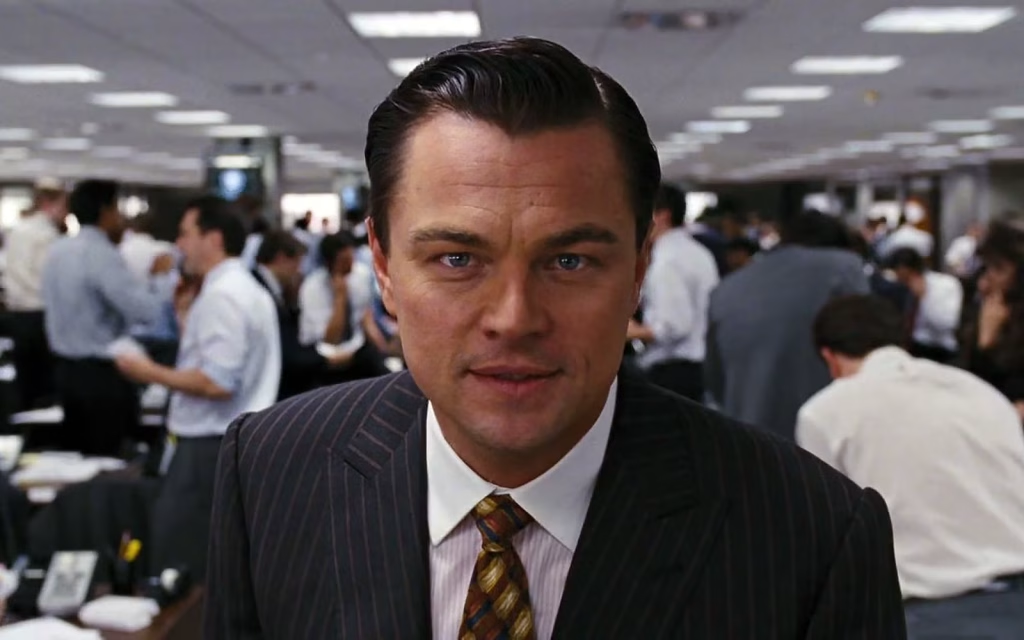
Leonardo DiCaprio spends a shocking amount of The Wolf of Wall Street looking ridiculous. Not movie-star ridiculous, where the lighting still flatters the cheekbones and the chaos has a clean magazine finish. Proper ridiculous.
He drools. He screams. He crawls. He sells. He sweats through speeches like a motivational speaker who found religion in a brokerage account. He makes Jordan Belfort magnetic, then keeps pushing until the magnetism turns sour in your mouth.
That is why the performance works so well. DiCaprio understands that Jordan cannot be played as a slick villain from a safe distance. He has to be funny. He has to be persuasive. He has to make the room move. Then he has to become gross enough that you start questioning why the room moved in the first place.
It is one of those performances that looks huge on the surface, yet the control underneath is almost sneakier than the volume.
He Turns Charm Into a Weapon
Jordan Belfort’s real talent is not finance. The movie makes that clear early and keeps making it clearer with every sales call. His talent is emotional manipulation dressed as confidence.
DiCaprio plays that confidence like a live current. Watch him during the Stratton Oakmont speeches. His body seems to feel the audience before his brain forms the next line. He waits for the laugh, rides the applause, leans into a chant, then drops his voice just enough to make everyone feel chosen.
He knows how to make greed sound like belonging.
That is the scary part. Jordan does not stand apart from the brokers as some icy mastermind. He makes himself the center of a tribe. The office becomes a room full of people begging to be infected by his certainty.
DiCaprio sells that infection beautifully. His grin has heat. His eyes keep searching for the next weak spot. Even when Jordan is lying, which is most of the time, the performance shows how much he enjoys creating belief. He is not just conning clients. He is performing a version of himself for anyone close enough to clap.
He Lets Jordan Be Pathetic
The smartest thing DiCaprio does is refuse to protect Jordan’s dignity.
That sounds simple, but it matters. A lot of actors play corrupt men with a little hidden coolness. The character may be awful, but the performance still asks us to admire the posture, the wardrobe, the stare. DiCaprio goes another way. He lets Jordan become needy, childish, sweaty, and embarrassing.
The Quaalude scene is the obvious masterpiece of humiliation. Jordan thinks he has survived the drugs with heroic composure, then the movie cuts to what he actually looks like. DiCaprio folds his body into useless shapes. His face goes slack. His voice becomes a mangled little engine of panic and ego.
It is broad comedy, but it lands because the ego remains intact. Jordan is physically wrecked and still convinced of his own importance. That gap is the joke.
DiCaprio plays the body as the truth and the narration as the lie. Jordan can tell himself he is powerful, brilliant, unstoppable. His own limbs disagree.
The Voice Never Stops Selling

Jordan’s narration is one of the performance’s quiet traps. He talks to the audience like a man offering VIP access to a secret room. He explains, brags, skips details, and waves away the boring parts with a smirk.
DiCaprio’s voice makes that intimacy feel dangerous. He pulls the viewer close, then starts editing reality in real time. He knows which details make him sound clever. He knows which crimes can be turned into punchlines. He knows when confusion can be useful.
There is a little flicker of contempt in the narration too. Jordan likes us, but only as long as we keep up. He is always a half step ahead, ushering us past the moral wreckage before we can stare at it too long.
That is a hard balance. If the narration sounded too smug, the movie would flatten. If it sounded too honest, Jordan would lose his slipperiness. DiCaprio gives it the rhythm of a sales pitch told by someone who has mistaken speed for truth.
You can feel him closing the deal with the audience.
His Physical Comedy Has Real Precision
DiCaprio’s work in The Wolf of Wall Street is often described as wild, which is fair. It is also precise. The chaos has choreography.
The Quaalude crawl gets the trophy, but the physical detail is everywhere. The way Jordan pumps his arms during speeches. The way he uses his chest like a drum of authority. The way his smile arrives too fast when he wants something. The way he shifts from rich-guy smoothness to feral panic the second control slips.
He moves like a man whose body has been trained by appetite.
That makes the comedy sharper. DiCaprio does not just act intoxicated or greedy in a general way. He finds different textures for each collapse. Drugged Jordan has a different rhythm from furious Jordan. Performing Jordan has a different posture from cornered Jordan. Husband Jordan, boss Jordan, narrator Jordan, and addict Jordan all share the same hunger, but they wear it differently.
The performance is big because Jordan is big. The craft is in making each kind of big feel specific.
He Makes the Speeches Feel Addictive
The office speeches are easy to remember as shouting, but DiCaprio gives them more shape than that. Jordan builds each one like a high.
He starts with insult, joke, confession, or promise. He lets the room respond. Then he feeds their reaction back to them with extra voltage. By the time he reaches the peak, the brokers are no longer listening for meaning. They are listening for permission.
Permission to sell harder. Permission to spend more. Permission to behave worse. Permission to turn money into a personality.
DiCaprio makes that permission seductive. His Jordan understands the emotional need underneath the greed. These men want to feel chosen by wealth. They want to believe their worst instincts are proof of strength. Jordan gives them language for that fantasy.
That is why the speeches work as cinema. They are not just exposition about corruption. They show corruption becoming entertainment, then community, then identity.
It is ugly. It is also thrilling in the moment, which is exactly the problem.
He Plays Well Against Everyone

A performance this loud could swallow the room, but DiCaprio is generous in a strange way. He gives the other actors plenty to bounce against.
With Jonah Hill’s Donnie Azoff, he becomes looser and more juvenile. Their scenes have the energy of two men daring each other to remove the last remaining adult from the building. Hill’s weird, impulsive timing pushes DiCaprio into even more shameless territory.
With Margot Robbie’s Naomi Lapaglia, he changes again. Robbie’s stillness cuts through him. DiCaprio lets Jordan look smaller around her when the fantasy begins to rot. He keeps trying to sell himself as powerful, but Naomi sees the fear and need under the suit.
With Kyle Chandler’s Agent Denham, DiCaprio plays irritation under polish. Jordan cannot stand a man who refuses to be impressed. The yacht scene works because DiCaprio lets us see Jordan’s worldview snag on something solid. He keeps smiling, but the smile has teeth marks in it.
Those shifts keep the performance from becoming one long blast of volume. Jordan adapts to every room, and DiCaprio lets us watch the adaptation happen.
He Keeps the Emptiness Visible
For all the noise, the performance has a hollow center. That is easy to miss because the movie moves so fast. DiCaprio gives Jordan so much energy that he can seem full of life, but the life keeps curdling into need.
He wants money, sex, drugs, applause, loyalty, escape, forgiveness, admiration, and another chance to hear himself talk. No amount of getting seems to create satisfaction. Every win becomes fuel for the next demand.
DiCaprio lets that emptiness peek through in quick flashes. A look after a fight. A panic when the FBI closes in. A childish rage when Naomi refuses him. A desperate insistence that he can still control a situation already sliding away from him.
The performance never asks us to pity him for long. Good. Jordan turns pity into another kind of currency. But DiCaprio does show the hunger underneath the spectacle, and that gives the movie its nasty aftertaste.
He Understands Scorsese’s Tone
The biggest reason the performance works may be that DiCaprio fully commits to Martin Scorsese’s dangerous tone. The Wolf of Wall Street is funny, disgusting, energetic, and morally abrasive. It needs an actor willing to entertain the audience without rescuing the character.
DiCaprio walks that line with nerve.
He makes Jordan charismatic enough for the world of the movie to make sense. You understand why people follow him, copy him, protect him, and cheer for him. Then he makes Jordan repellent enough for the performance to accuse that same attraction.
That is a brutal little trick. The movie lets us enjoy the sales pitch while showing us the poison in it. DiCaprio is the delivery system.
By the end, Jordan has become a man selling sales itself. He has turned disgrace into material. He stands before another crowd, and the old hunger fills the room again.
DiCaprio’s performance works because he makes that hunger feel alive. Not admirable. Alive. He plays Jordan Belfort as a man who can turn greed into music, shame into comedy, and fraud into a standing ovation. Then he lets us hear how ugly the song is once the applause fades.

Rachel Sikkema is a New Zealand-based writer and creative entrepreneur who explores the intersection of film, culture, and modern relationships. Through her articles, she examines how stories shape the way we connect, love and see ourselves – all for God’s glory. When she’s not writing about film and television, she’s watching Dexter and The White Lotus for the third time.