Jordan Belfort does not walk into The Wolf of Wall Street like a criminal mastermind. He walks in like a hungry kid who has found the room where all the adults keep the candy. Leonardo DiCaprio gives him that bright, eager, awful spark from the start. He wants money, sure, but he wants something even more dangerous.
He wants permission.
Martin Scorsese’s movie is loud enough to be mistaken for a celebration if you only half-watch it. The parties roar. The suits shine. The sales floor turns into a church for men who worship commission. But the longer the film runs, the more obvious its real subject becomes. Greed here is not just a desire for wealth. It is a system of excuses, a drug that convinces people their worst impulses deserve applause.
That is why The Wolf of Wall Street still feels so nasty under all the jokes. It understands greed as performance, addiction, and social infection.
Jordan Sells Desire Before He Sells Stocks
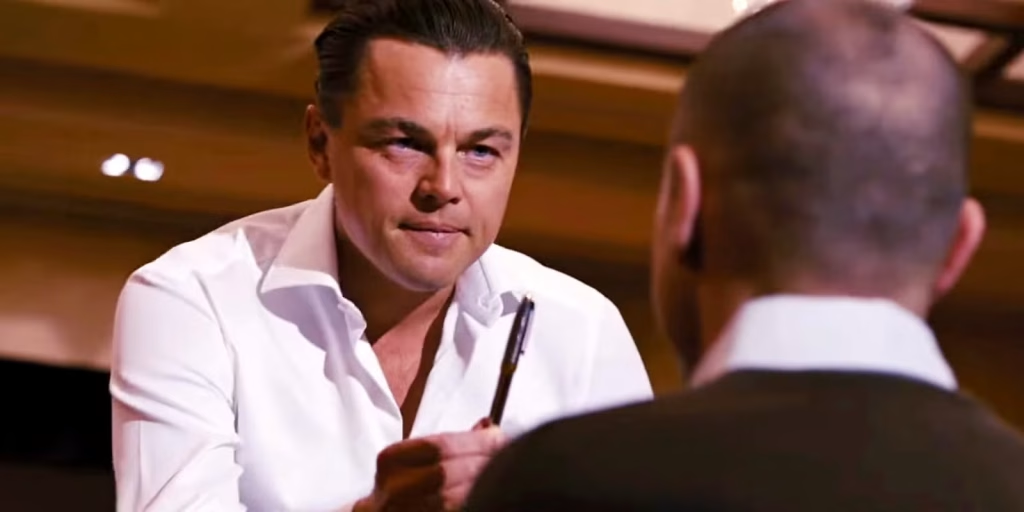
The famous pen scene lays out the whole movie in miniature. Jordan’s gift is not financial genius. It is psychological pressure. He knows how to make people feel lack. He knows how to turn that lack into panic. Then he offers himself as the man with the answer.
That is the real product.
The stocks barely matter to him, which is the point. Jordan sells the fantasy of being the kind of person who wins. He sells shortcuts and access. He sells the idea that hesitation is for losers and decency is for people too broke to afford better morals.
DiCaprio plays those sales speeches like rock concerts. Jordan works the room with his whole body. He leans in, backs off, whispers, screams, grins, sweats. He reads the room the way a shark reads water. Every broker at Stratton Oakmont wants to be touched by that confidence.
Greed spreads because Jordan makes it feel communal. Nobody in that office wants to be the sober person at the table.
The Movie Lets Excess Look Fun for a Reason
A lot of the controversy around The Wolf of Wall Street comes from how entertaining it is. The movie is funny. Deeply funny. Jonah Hill’s Donnie Azoff is a walking bad decision with teeth, and DiCaprio commits to physical humiliation with the courage of a man who has thrown vanity into the sea.
Scorsese lets the parties look wild because greed often arrives dressed as fun. That is part of the scam. If the office looked miserable from the beginning, nobody would buy the fantasy.
The marching band, the drugs, the flying money, the chanting, the obscene office games. All of it looks like freedom for about five seconds. Then it starts to look repetitive, then mechanical, then dead-eyed.
That progression matters. The film does not wag a finger from a tasteful distance. It lets us feel the pull before revealing the trap. It shows how greed turns stimulation into routine. More money leads to more noise, which leads to more emptiness, which demands more noise.
Jordan’s life becomes a treadmill covered in champagne.
Donnie Shows What Greed Does to Shame
Jonah Hill’s Donnie is hilarious because he has almost no filter between impulse and action. He sees Jordan’s money and immediately wants in. Not after a careful ethical review. Not after reflection. He hears a number, quits his job, and basically offers his soul with a grin.
There is something useful about how grotesque Donnie is. He makes greed look naked.
Jordan still wants to think of himself as a genius, a rebel, a king. Donnie has less interest in elegant self-mythology. He wants the toys and the drugs. He wants the status and to behave badly in a room where bad behavior gets rewarded.
That lack of shame becomes contagious. In the Stratton Oakmont world, embarrassment has been replaced by applause. The more shameless the act, the more it proves loyalty to the tribe.
Donnie and Jordan make each other worse because each man confirms the other’s appetite. Their friendship is funny, but it has the moral atmosphere of a locked room running out of oxygen.
Naomi Sees the Cost Behind the Fantasy
Margot Robbie’s Naomi Lapaglia enters the film with such force that she briefly seems to belong to a different movie. She is glamorous, sharp, and fully aware of what Jordan’s world offers. Robbie never plays her as naive, which makes the role more interesting.
Naomi is attracted to the money, but she also understands power. She knows Jordan wants to be seen as unstoppable. She knows how to use that hunger against him. Their relationship begins as part of his fantasy and becomes one of the few places where the fantasy starts cracking in public.
Robbie’s best scenes come when Naomi refuses to keep playing along. Her disgust has texture. It is not abstract moral disappointment. It is the exhaustion of living with a man who turns every desire into entitlement.
The scene where Jordan’s chaos reaches the family home is especially ugly because the film strips away the office energy. No cheering brokers. No sales-floor chants. Just fear, control, and a child nearby. Greed has finally followed him into the space where he can no longer pretend it is just business.
Naomi’s face says what Jordan cannot sell his way out of.
Scorsese Makes Greed Feel Like Addiction
The movie’s speed is not just style. It is diagnosis.
Scorsese and editor Thelma Schoonmaker cut the film like a binge. Scenes rush, overlap, and spiral. Jordan narrates with slick confidence, then skips details when the facts might slow the high. The structure itself feels impatient with consequences.
That impatience is pure Jordan.
He cannot sit still inside his own life. Money buys pleasure, then pleasure loses force, then he needs a bigger hit. A better drug. A larger deal. A louder room. A more dangerous risk. The appetite never matures. It only scales.
The Quaalude sequence is funny because DiCaprio makes Jordan’s body betray him with spectacular precision. It is also pathetic. Here is a man with everything he claimed to want, reduced to crawling across a floor because he still needs more of something.
That is the movie’s bleak joke. Greed promises control and creates dependence.
The Victims Stay Out of Frame on Purpose
One of Scorsese’s boldest choices is how rarely the film sits with Jordan’s victims. We hear about people being fleeced. We know ordinary investors are being manipulated. But the movie keeps us mostly inside Jordan’s bubble.
That absence has a sting.
Jordan does not think about those people, so the film makes us feel the obscenity of a world built to erase them. The victims exist as voices on phones, numbers on paper, marks in a sales strategy. Their invisibility is part of the crime.
A more conventional movie might cut away to suffering families to make sure we understand fraud is bad. Scorsese trusts the audience to feel the moral vacuum created by their absence. We are trapped in Jordan’s point of view, and that point of view is a luxury room with no windows.
It is uncomfortable because the film makes the viewer sit close to charisma. Jordan’s charm is not softened. It works. That is what makes it dangerous.
The FBI Scenes Puncture the Fantasy
Kyle Chandler’s Agent Denham brings a dry, grounded energy that the film badly needs. He is not dazzled by Jordan’s yacht, smile, or money. His face has the calm irritation of a man watching a toddler drive a sports car.
The yacht conversation between Jordan and Denham is one of the sharpest scenes because Jordan cannot understand a person who refuses the bait. He keeps offering the logic of his world. Money talks. Everyone has a price. Every moral position is secretly waiting for a better offer.
Denham’s refusal enrages him because it threatens the foundation of the fantasy.
Jordan needs to believe greed is universal. If everyone wants what he wants, then he is not corrupt. He is merely honest. He is brave enough to admit the truth. That is the lie he sells himself.
Denham’s presence suggests a different possibility. Some people can see the pitch and still walk away.
The Ending Is Colder Than It First Looks
By the end, Jordan has lost plenty, but the film refuses to serve up a clean punishment fantasy. He goes to prison, cooperates, reemerges, and finds a new stage. He now sells sales itself. The scam has become a lesson plan.
That final audience is quietly horrifying.
They stare at him with hunger. They want the secret, the magic phrase, the confidence, the shortcut. The audience knows he fell. They also know he got rich first. For some people, that order of events still sounds like a deal worth considering.
Scorsese ends there because greed survives Jordan. It moves from the brokerage floor to the seminar room. It changes outfit and becomes self-help, branding, aspiration, content.
The last image points back at us with a nasty little smile. How much of Jordan’s pitch did we enjoy? What did we forgive because he made us laugh? How often does culture punish greed with one hand and market it with the other?
The Wolf of Wall Street is really saying that greed is not just wanting too much. It is wanting too much and building a whole moral universe where too much becomes the minimum. It turns people into tools, crimes into stories, shame into energy, and consequences into publicity.
That is why the movie has such a sickly afterglow. It is a blast to watch, then it leaves a bad taste on purpose. Jordan Belfort does not win because he keeps all the money. He wins because people keep leaning forward when he starts talking.

Rachel Sikkema is a New Zealand-based writer and creative entrepreneur who explores the intersection of film, culture, and modern relationships. Through her articles, she examines how stories shape the way we connect, love and see ourselves – all for God’s glory. When she’s not writing about film and television, she’s watching Dexter and The White Lotus for the third time.