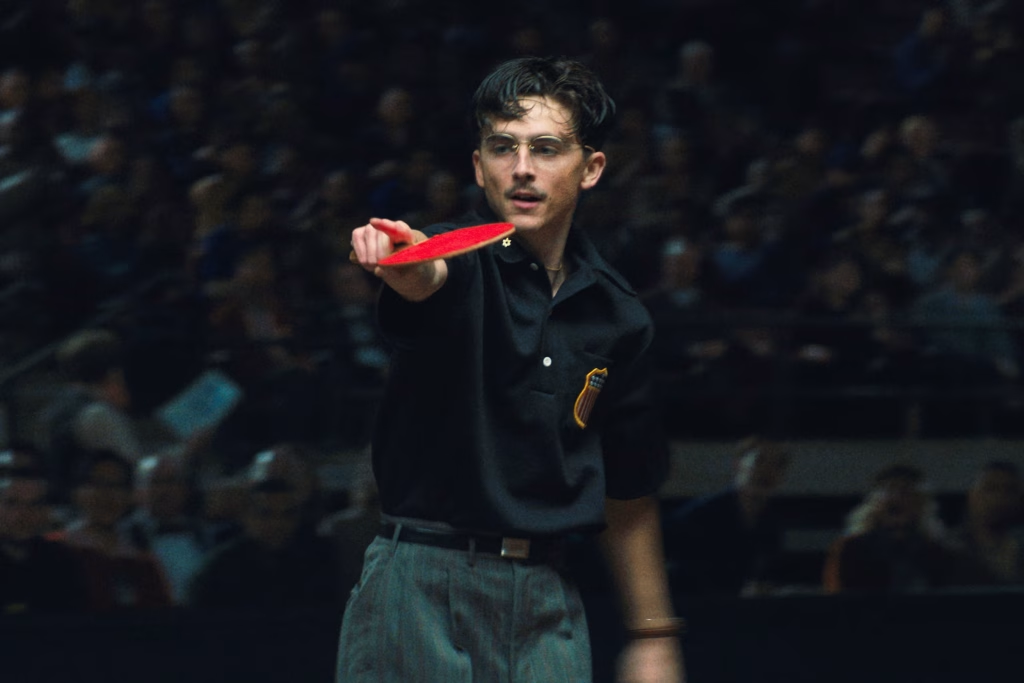
Marty Mauser spends Marty Supreme chasing victory the way some people chase caffeine: compulsively, creatively, and with the shaky certainty that everything falls apart without the next hit.
On paper, he’s a table tennis phenom with a chip on his shoulder and a talent for turning a match into a street fight with rules. In practice, he feels like something stranger and more modern: a man who doesn’t only want to win, but wants witnesses. Preferably lots of them. Preferably stunned.
So what’s the real addiction here? The scoreboard, or the spotlight?
The fun part is that the movie refuses to pick one, because Marty doesn’t, either. Winning is the clean story he tells himself. Being watched is the messy truth that keeps leaking through.
Winning Isn’t the Whole Drug
Marty talks and moves like a person who thinks winning will finally make him safe. If he’s the best, nobody can laugh at him. If he’s the champion, nobody can deny he mattered. That’s a recognizable hunger, and the film gives it real weight.
But Marty’s version of “winning” keeps shape-shifting. It’s not enough to beat someone, he has to beat them in a way that feels like destiny. He doesn’t chase victory like a finish line. He chases it like a storyline.
That’s why even his practical goals have a theatrical edge. The pursuit is always louder than it needs to be. The risks are always a little dumber than they need to be. He isn’t optimizing for success so much as he’s optimizing for a moment that people will talk about.
The Gaze Matters More Than the Scoreboard
There’s a specific vibe Marty gives off that has nothing to do with table tennis technique. He walks into rooms like he’s already being introduced, like someone is narrating his legend just out of frame. Timothée Chalamet plays him with that twitchy charisma that keeps flipping between confidence and panic, as if Marty’s self-belief depends on an audience staying seated.
A pure “winning addict” would take the most efficient route to the trophy. Marty keeps detouring into spectacle. He creates scenes and escalates situations. He pushes every interaction toward an emotional reaction, even when silence would serve him better.
His Hustles Feel Like Auditions

Marty’s talent isn’t only athletic. It’s social. He’s always pitching himself, even when he isn’t speaking. He sells an idea of Marty: the unstoppable guy, the misunderstood genius, the charming menace, the poor kid who’s about to kick the door in.
Look at how he uses other people as stages.
Rachel Mizler, played by Odessa A’zion, knows him from before the myth. That should make her an anchor. Instead, she becomes part of the performance. Their relationship has heat, affection, and genuine history, but it also has that unsettling feeling that Marty is always half aware of how their story looks from the outside. He doesn’t only want love. He wants loyalty that reads as proof.
Kay Stone, played by Gwyneth Paltrow, represents a different kind of audience: wealth, taste, glamour, the kind of approval Marty can’t win with a paddle alone. When he’s with her, Marty’s ambition gets dressed up. He starts acting like he belongs in a larger movie. He isn’t only chasing resources. He’s chasing legitimacy, the kind that comes from being seen next to the right person.
A person addicted only to winning doesn’t need all these performances. Marty does. He needs to be reflected back at himself.
Shame Becomes Part of the Engine
One of the sharpest things the film understands is that attention doesn’t always arrive as applause. Sometimes it arrives as humiliation. Marty doesn’t avoid shame the way most people do. He metabolizes it.
There are moments where the movie puts him in situations that would break a normal ego, and he takes them like he’s paying an entry fee. When he agrees to be degraded in public, it doesn’t read as strategy in the usual sense. It reads like a bargain with the universe: hurt me now, crown me later.
That’s not the behavior of someone who only wants results. That’s the behavior of someone who is weirdly comforted by the presence of an audience, even when that audience is cruel. Being watched confirms he exists. Being watched confirms the stakes are real.
His Rival Threatens More Than His Title
Koto Endo isn’t only a competitive obstacle. He’s a narrative threat. Marty can’t stand him because Endo represents a kind of winning that doesn’t require Marty’s mythmaking. Endo shows up with technique Marty doesn’t understand, and suddenly Marty can’t control the terms of the spectacle.
If Marty were only addicted to winning, he’d adapt quietly. Train harder. Study. Evolve. Instead, he spirals into the emotional problem: what does it mean if the world moves on without him as the main character?
The Ending Suggests He Wants One Honest Witness

For all the noise, Marty Supreme keeps sneaking in a more tender idea: that Marty’s biggest craving might be for a specific kind of being seen. Not the loud kind. The true kind.
It takes this guy who’s been chasing public proof and drops him into a private moment where the only witness that matters is the person he’s been running from: Rachel, and the life he helped create. The breakdown there doesn’t feel like victory. It feels like the first time Marty’s performance stops working, and he’s left with plain human feeling.
Which is kind of the point. Marty has spent so long trying to be watched that he almost forgets how to be known.
Marty Supreme isn’t addicted to winning or being watched. He’s addicted to the feeling that winning produces when other people see it and agree that he’s real. The tragedy is that the gaze can never fill him. The smallest, quietest witness is the one that finally cracks him open.

Rachel Sikkema is a New Zealand-based writer and creative entrepreneur who explores the intersection of film, culture, and modern relationships. Through her articles, she examines how stories shape the way we connect, love and see ourselves – all for God’s glory. When she’s not writing about film and television, she’s watching Dexter and The White Lotus for the third time.