
Perfection is a seductive liar in The Bear. It promises relief, meaning, even redemption. Then it turns around and demands your sleep, your relationships, and your ability to feel proud of anything for longer than ten seconds. That tension is the show’s secret engine, and it’s why the series stays so sharp even when it’s quiet.
Christopher Storer’s Chicago-set pressure cooker has moved fast across its run, with Season 1 arriving in 2022, Season 2 in 2023, Season 3 in 2024, and Season 4 in 2025.
At the center is Carmen “Carmy” Berzatto (Jeremy Allen White), a chef carrying grief, genius, and a deep fear that if he slows down, he’ll collapse. Around him is an ensemble that makes perfection feel communal, contagious, and sometimes cruel. Sydney Adamu (Ayo Edebiri), Richie Jerimovich (Ebon Moss-Bachrach), Natalie “Sugar” Berzatto (Abby Elliott), Tina Marrero (Liza Colón-Zayas), Marcus Brooks (Lionel Boyce), and Neil Fak (Matty Matheson) are not supporting players in the usual sense. They are co-owners of the show’s emotional weight.
Carmy’s Perfectionism as Self-Defense
Carmy is a character who confuses excellence with safety. He has learned that if the standard is high enough, maybe nothing can touch him. That’s a brutal way to live, and the show never romanticizes it for long.
The restaurant becomes a physical expression of his internal pacing. If the food is flawless, maybe his grief over Mikey can be organized into something that looks like meaning. But perfection does not resurrect anyone.
Richie and the Emotional Version of Excellence
Richie’s arc proves that The Bear isn’t only about food. It’s about identity. Ebon Moss-Bachrach gives Richie the unpredictable energy of a man who has spent years convincing himself he is fine, only to realize he has no idea who he wants to be when the noise stops.
Richie’s growth is tied to a new understanding of professionalism as care. The show reframes excellence as attentiveness. How you greet a guest. How you protect your team. How you show up when nobody is clapping.
That shift is quietly radical. Richie moving toward competence is not a glow-up montage. It’s a man learning to respect himself enough to stop sabotaging the room.
The Kitchen as a Trauma Echo Chamber

The series’ most stressful scenes feel intense because they’re emotionally accurate. A kitchen is a perfect metaphor for how trauma functions at speed. Small triggers become large reactions. Miscommunications multiply. People who care about each other have no time to prove it.
Tina, Marcus, and Sugar each embody a different survival strategy. Tina’s pride and guarded warmth reflect years of having to fight for space. Marcus channels his need for order and beauty into craft. Sugar carries the invisible labor of keeping everything from imploding while also trying to protect her family from repeating old patterns.
The show suggests that perfectionism thrives in environments where chaos once felt normal. When you grew up in volatility, control can feel like love.
Family History as the Original Impossible Standard
The Berzatto family story is one of the show’s most quietly devastating layers. The memory of Mikey (Jon Bernthal) is felt in every renovation and every moment of doubt.
Perfection becomes a way to rewrite the family narrative. If the restaurant succeeds, maybe the pain will look like it was heading somewhere all along. But The Bear is too emotionally intelligent to let that fantasy hold unchallenged.
This is why the series keeps winning attention for performances across its ensemble. The show treats internal damage as something that shapes behavior without excusing harm.
Season-To-Season Urgency and the Shrinking Margin for Error
By the time the series reaches its later seasons, the dream has teeth. A polished restaurant is not just a creative goal. It’s a financial risk with people’s livelihoods attached. The pressure shifts from messy potential to high-stakes maintenance, which is where perfectionism tends to become most dangerous.
What The Bear captures so well is the way success can narrow your life. Bigger ambition means fewer places to hide. Everyone is watching. Every service is a test of whether the dream was ever sustainable or whether it was built on exhaustion and hope.
The show also understands that perfection is often a shared delusion. A team can collectively normalize overwork and emotional suppression because it feels like devotion. It takes maturity to admit that greatness achieved through self-erasure is a deal with a hidden price tag.
Why the Show’s Perfection Theme Hits So Hard
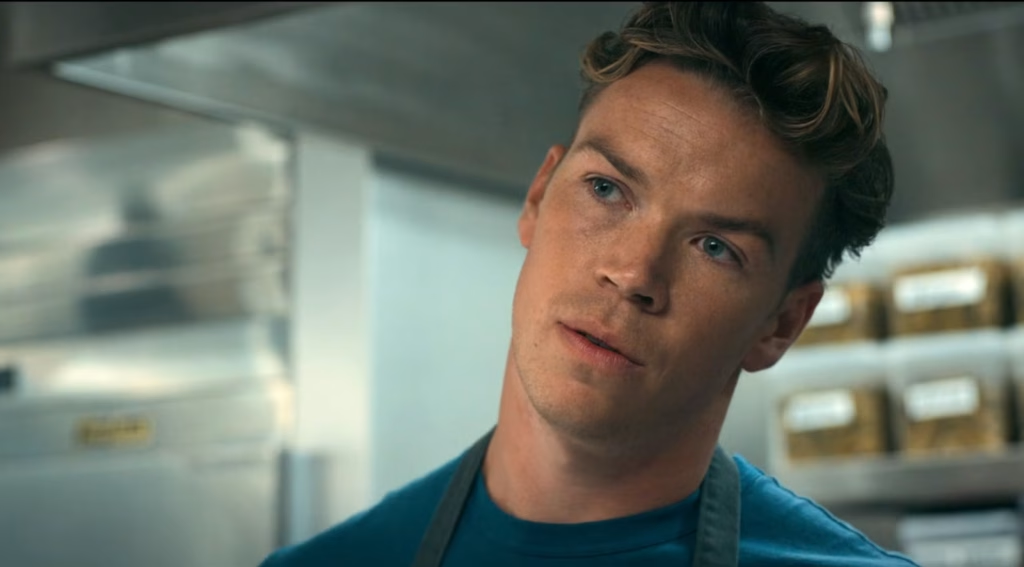
Many series about work are ultimately about competence. The Bear is about worthiness. The characters are not asking only, “Can I do this?” They’re asking, “If I do this beautifully, will I finally feel okay?”
That is why the show resonates far beyond restaurant culture. Anyone who has attached their identity to output will recognize the trap. The idea that rest is earned. The fear that slowing down means you’re losing ground. The suspicion that joy is a distraction.
The show’s most humane moments push against that voice. A quiet act of mentorship. A meal that becomes an apology. A rare second where someone chooses kindness over control.
The Bear makes perfection feel both intoxicating and exhausting, which is exactly how it plays out in real life. Through Carmy, Sydney, Richie, and the rest of this bruised, brilliant team, the series argues that excellence is meaningful only when it doesn’t cost you your humanity. The weight of perfection is real, but so is the possibility of learning a lighter way to carry it.

Rachel Sikkema is a New Zealand-based writer and creative entrepreneur who explores the intersection of film, culture, and modern relationships. Through her articles, she examines how stories shape the way we connect, love and see ourselves – all for God’s glory. When she’s not writing about film and television, she’s watching Dexter and The White Lotus for the third time.